
The review article published in the journal BiocharBiochar is a carbon-rich material created from biomass decomposition in low-oxygen conditions. It has important applications in environmental remediation, soil improvement, agriculture, carbon sequestration, energy storage, and sustainable materials, promoting efficiency and reducing waste in various contexts while addressing climate change challenges. More X by Yating Ji, Donald W. Kirk, Zaisheng Cai, and Charles Q. Jia introduces a revolutionary framework for understanding biochar. By treating physical traits like “genes,” researchers can now predict how different types of plant waste and heating temperatures will produce specific materials. Traditionally seen as a simple soil additive, biochar is now being re-engineered as a multifunctional carbon system. The study establishes that the physical properties of these materials, including their strength, heat management, and ability to conduct electricity, are all deeply interconnected through their microscopic structure. This integrated approach allows for the creation of sustainable materials that can perform complex tasks in high-tech industries.
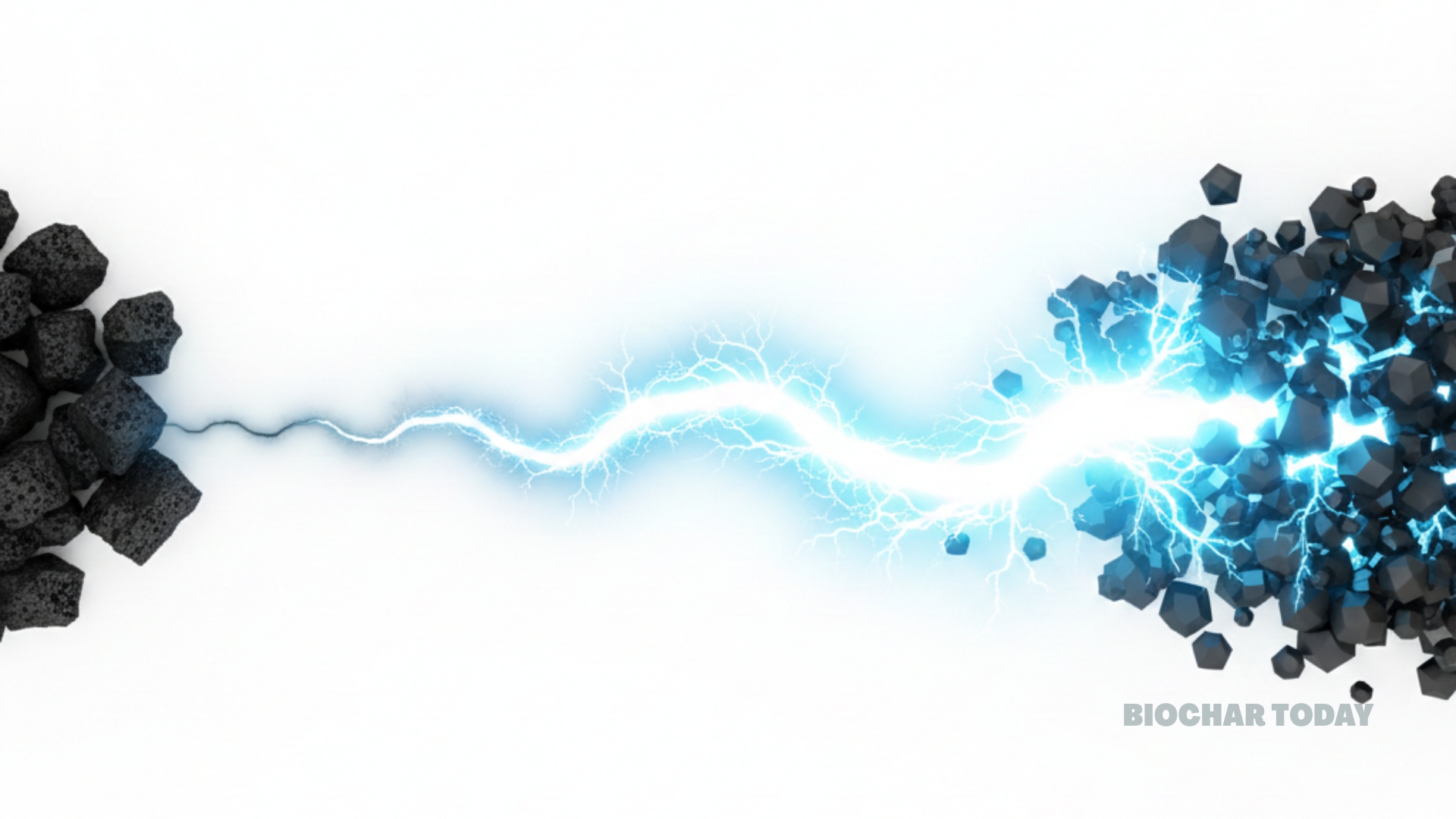
One of the most significant findings involves the dramatic transformation of biochar’s ability to transport electrical charges. At lower production temperatures, biochar acts as an insulator, but as heat exceeds 700 degrees Celsius, it develops highly conductive networks. The researchers highlighted that sugar-maple biochar can reach a peak conductivity of 343.2 siemens per meter when carbonized effectively. For materials heated to 1,500 degrees Celsius, conductivity can soar even higher, with wood-derived versions reaching 14,600 siemens per meter and bamboo-based versions hitting 21,000 siemens per meter. This massive range of conductivity makes biochar a versatile candidate for green electronic components and battery electrodes.
The material’s strength and structural resilience also undergo predictable changes during production. Using advanced testing at the nanoscale, the team found that the hardness of biochar typically ranges from 0.3 to 4.5 gigapascals. Pine sawdust, for example, achieved a high hardness of 4.29 gigapascals when processed at 900 degrees Celsius. These mechanical properties are crucial because they determine how well the material survives in harsh environments. The study found that while higher temperatures generally make the carbon skeleton harder and more stable, exceeding 900 degrees Celsius can sometimes lead to brittleness. Finding the perfect balance between strength and flexibility is key to using biochar as a reinforcement in sustainable construction materials.
Biochar also shows remarkable potential in managing heat and light. While most pristine biochar has low thermal conductivity, making it an excellent insulator, its heat-transfer capabilities can be improved by orders of magnitude through high-temperature graphitization. In certain wood-derived biochars, thermal conductivity rose from 0.1 to 0.4 watts per meter-kelvin as the structure became more ordered. Furthermore, biochar can be turned into a light-harvesting tool. By doping it with nitrogen, researchers created carbon dots that achieved a fluorescence quantum yield of 36.17 percent. These glowing nanoparticles can be used as sensitive sensors to detect heavy metals in water or as safe markers for medical imaging, proving that biochar is far more than just charred wood.
The ultimate goal of this research is to move away from trial-and-error methods toward a predictive design system. By using machine learning and data-driven models, scientists can now select the right biomassBiomass is a complex biological organic or non-organic solid product derived from living or recently living organism and available naturally. Various types of wastes such as animal manure, waste paper, sludge and many industrial wastes are also treated as biomass because like natural biomass these More “genes” to meet specific industrial needs. For instance, high-adsorption materials for cleaning up oil spills are best made from hemicellulose-rich waste, while energy storage devices benefit from lignin-heavy feedstocks. This shift from empirical carbonization to precision engineering will accelerate the transition to a circular economy. By valorizing waste products into high-tech tools, we can simultaneously reduce carbon emissions and create the advanced materials needed for a sustainable future.
Source: Ji, Y., Kirk, D. W., Cai, Z., & Jia, C. Q. (2026). Unraveling the physical genome of biochar. Biochar X, 2, e003.


Leave a Reply