
Key Takeaways
- Engineered biocharBiochar is a carbon-rich material created from biomass decomposition in low-oxygen conditions. It has important applications in environmental remediation, soil improvement, agriculture, carbon sequestration, energy storage, and sustainable materials, promoting efficiency and reducing waste in various contexts while addressing climate change challenges. More composites combine pyrolyzed plant matter with minerals to enhance carbon stability, nutrient delivery, and environmental cleanups.
- Combining agricultural waste with specific clay minerals like montmorillonite can boost the development of tiny pores within the material by up to forty percent.
- These specialized organo-mineral combinations alter key physical traits by significantly increasing the final ashAsh is the non-combustible inorganic residue that remains after organic matter, like wood or biomass, is completely burned. It consists mainly of minerals and is different from biochar, which is produced through incomplete combustion. Ash Ash is the residue that remains after the complete More content and surface polarity.
- Field and pilot-scale trials demonstrate that mineral-enhanced biochar effectively captures nutrients and filters contaminants in wastewater treatments.
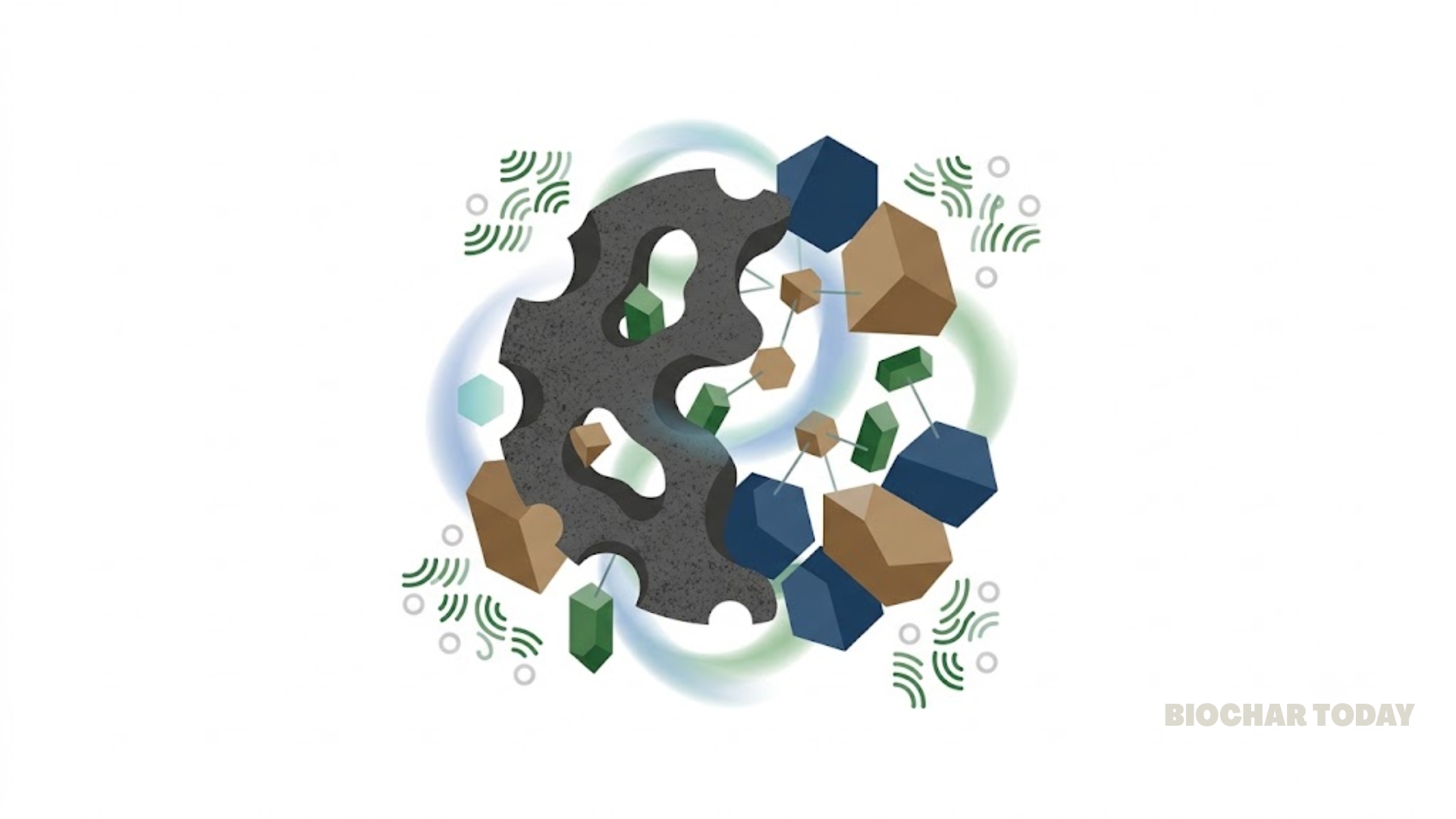
A recent study in Biochar by Liuwei Wang and a collaborative team of international researchers explored how combining biochar with natural mineral additives can significantly enhance its performance. Published in the journal Biochar, the comprehensive scientific review by Liuwei Wang, Jiale Yang, Xuanru Li, Liping Zhang, Lukas Van Zwieten, Ondřej Mašek, Stephen Joseph, Kaikai Zhang, and Kefu Yu examines the intricate interactions that occur when organic carbon matrices fuse with non-clay silicates, clay minerals, oxide minerals, or carbonates. The scientific community has long valued pristine pyrolyzed biomassBiomass is a complex biological organic or non-organic solid product derived from living or recently living organism and available naturally. Various types of wastes such as animal manure, waste paper, sludge and many industrial wastes are also treated as biomass because like natural biomass these More for its agricultural benefits, but raw biochar frequently falls short of satisfying precise demands for contaminant retention or nutrient delivery on its own. To resolve these limitations, modern researchers fabricate engineered biochar composites, using either co-pyrolysis or post-pyrolysis modifications to create tailored structural properties. By analyzing data across numerous trials, the authors map out the physical changes, structural formations, and long-term environmental outcomes associated with these advanced material pairings.
The findings show that the blending of raw organic feedstocks with mineral elements alters the fundamental chemistry of the resulting material, causing a quantitative surge in both ash content and overall surface polarity. When compounds like bentonite or montmorillonite are added to the biomass during the manufacturing process, they act as catalysts that inhibit volatile organic losses during thermal conversion below five hundred degrees Celsius. This unique interaction promotes intense devolatilization, which expands the development of essential internal micropores by thirty to forty percent compared to standard biomass heating alone. However, the researchers also observed that certain mineral combinations can result in a degraded porous framework under alternative thermal environments. For example, when bamboo waste is heated alongside kaolinite clay at higher temperatures, the clay transforms into non-porous metakaolin, which physically blocks the internal pathways and decreases the overall porosityPorosity of biochar is a key factor in its effectiveness as a soil amendment and its ability to retain water and nutrients. Biochar’s porosity is influenced by feedstock type and pyrolysis temperature, and it plays a crucial role in microbial activity and overall soil health. Biochar More of the composite. These contrasting results underscore the necessity of matching specific mineral traits with precise thermal windows to achieve the desired physical properties.
Beyond internal structures, the study details how these mineral additives modify surface functional groups to create powerful pathways for nutrient delivery and pollution control. Introducing clay minerals or iron oxides into the carbonaceous matrix sparks the creation of electron-donating phenolic groups and stable metallic complexes. These alterations enhance the cation exchange capacity and chemical reactivity of the material, making it far more efficient at binding to target molecules. For instance, certain iron-oxide-modified biochars applied to heavily contaminated industrial smuggling zones successfully bound toxic antimony and arsenic. Furthermore, the carbon matrix provided a protective, long-term energy source that supported specialized, inoculated bacteria, creating a dual chemical and biological system for cleansing the environment. Similar surface enhancements allow these composites to elevate pHpH is a measure of how acidic or alkaline a substance is. A pH of 7 is neutral, while lower pH values indicate acidity and higher values indicate alkalinity. Biochars are normally alkaline and can influence soil pH, often increasing it, which can be beneficial More levels and buffer acidic zones, turning hazardous or underutilized materials into safe options for complex conservation tasks.
Real-world field trials and pilot-scale experiments documented by the authors illustrate the practical success of these materials in both agricultural and aquatic settings. In open wheat and sorghum fields, application of a steam-treated mixture of wood char, clay, and organic matter improved plant nutrient uptake for crucial elements like nitrogen, phosphorus, potassium, and zinc. Outside of soil applications, pilot programs demonstrate that mineral-loaded biochars work efficiently as filtering components for urban stormwater management and wastewater treatment facilities. The added mineral particles decrease direct toxicity to nearby organisms while providing a sheltered surface that encourages helpful microbial colonization, which further boosts overall soil and water health. By presenting concrete examples of successful scaling, the research underscores that engineered biochar-mineral composites offer a stable, long-lasting method to trap carbon, clean water lines, and support global agricultural productivity.
Source: Wang, L., Yang, J., Li, X., Zhang, L., Van Zwieten, L., Mašek, O., Joseph, S., Zhang, K., & Yu, K. (2026). Engineered biochar composite with minerals: organo-mineral interactions, physicochemical changes, and implications for practical application. Biochar, 8(1), 53.




Leave a Reply