
Zhang, et al (2024) BiocharBiochar is a carbon-rich material created from biomass decomposition in low-oxygen conditions. It has important applications in environmental remediation, soil improvement, agriculture, carbon sequestration, energy storage, and sustainable materials, promoting efficiency and reducing waste in various contexts while addressing climate change challenges. More decreased N loss from paddy ecosystem under alternate wetting and drying in the Lower Liaohe River Plain, China. Agricultural Water Management. https://doi.org/10.1016/j.agwat.2024.109108
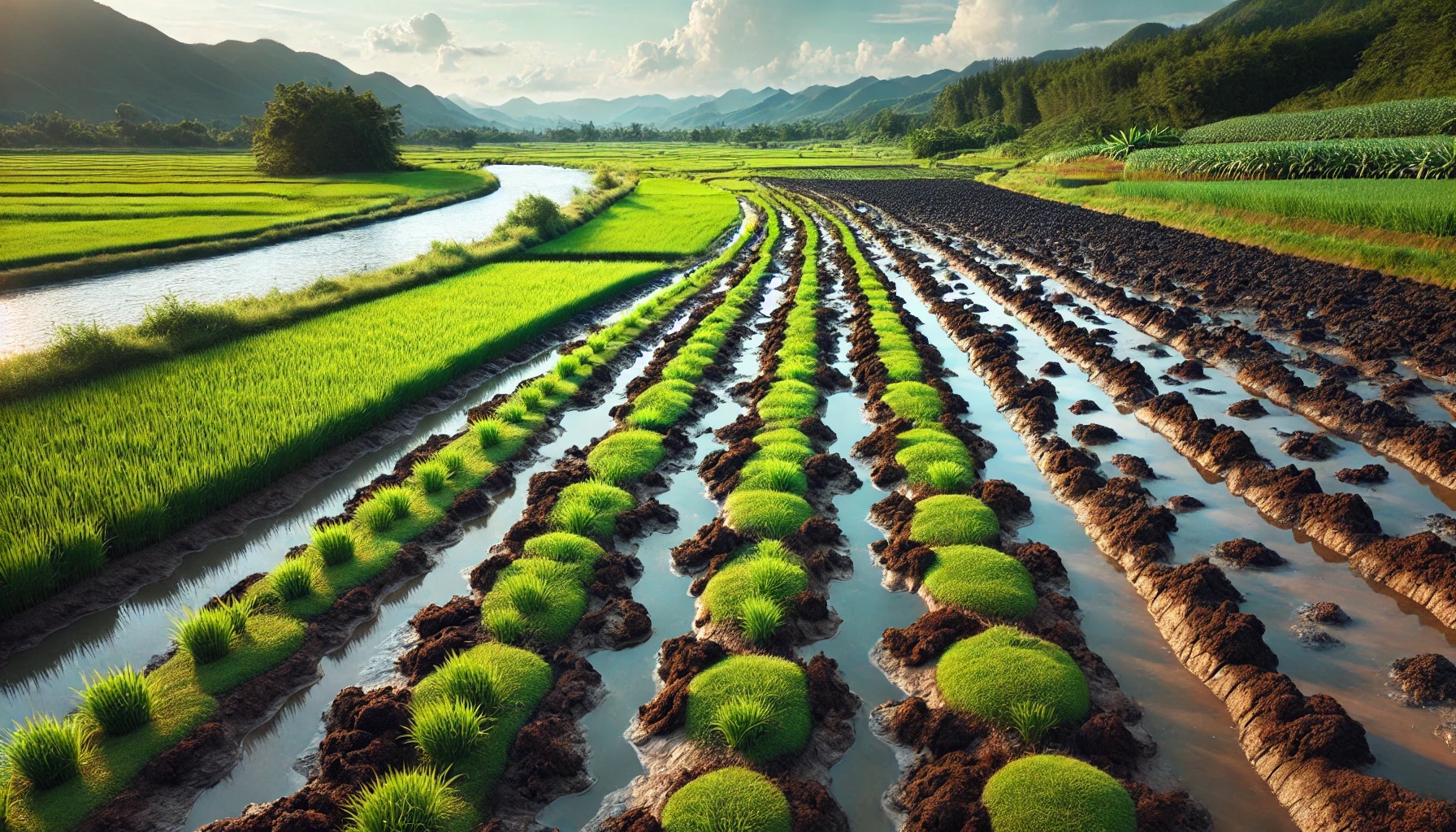
A study conducted in the Lower Liaohe River Plain, China, explores the potential of biochar to reduce nitrogen (N) losses in paddy ecosystems, especially under alternate wetting and drying (AWD) irrigation. Rice production often leads to significant N losses, including ammonia volatilization, nitrous oxide emissions, and N leachingLeaching is the process where nutrients are dissolved and carried away from the soil by water. This can lead to nutrient depletion and environmental pollution. Biochar can help reduce leaching by improving nutrient retention in the soil. More, contributing to both environmental pollution and decreased crop yield. AWD is a water-saving irrigation method, but it can exacerbate reactive N losses, making N management critical.
The two-year field experiment evaluated the effect of adding rice husk-derived biochar (20 t/ha) to soil, under both AWD and continuous flooding. The results showed that AWD reduced N leaching by 15.9% but increased N2O emissions and ammonia volatilization. However, biochar addition significantly mitigated these increases. In 2021, biochar reduced N2O emissions by 19.2%, ammonia volatilization by 20.7%, and reactive N losses by 14.1%. These reductions were attributed to biochar’s ability to enhance soil’s N retention and absorption capacity, offsetting the negative impacts of AWD on N emissions.
The findings suggest that combining biochar with AWD irrigation can be an effective strategy for reducing N losses while conserving water, making rice farming more sustainable. However, long-term studies are needed to further explore biochar’s effects on yield and N dynamics in varying environmental conditions.
By adopting these methods, farmers could potentially reduce both environmental impact and fertilizer costs, promoting more sustainable agricultural practices.




Leave a Reply