
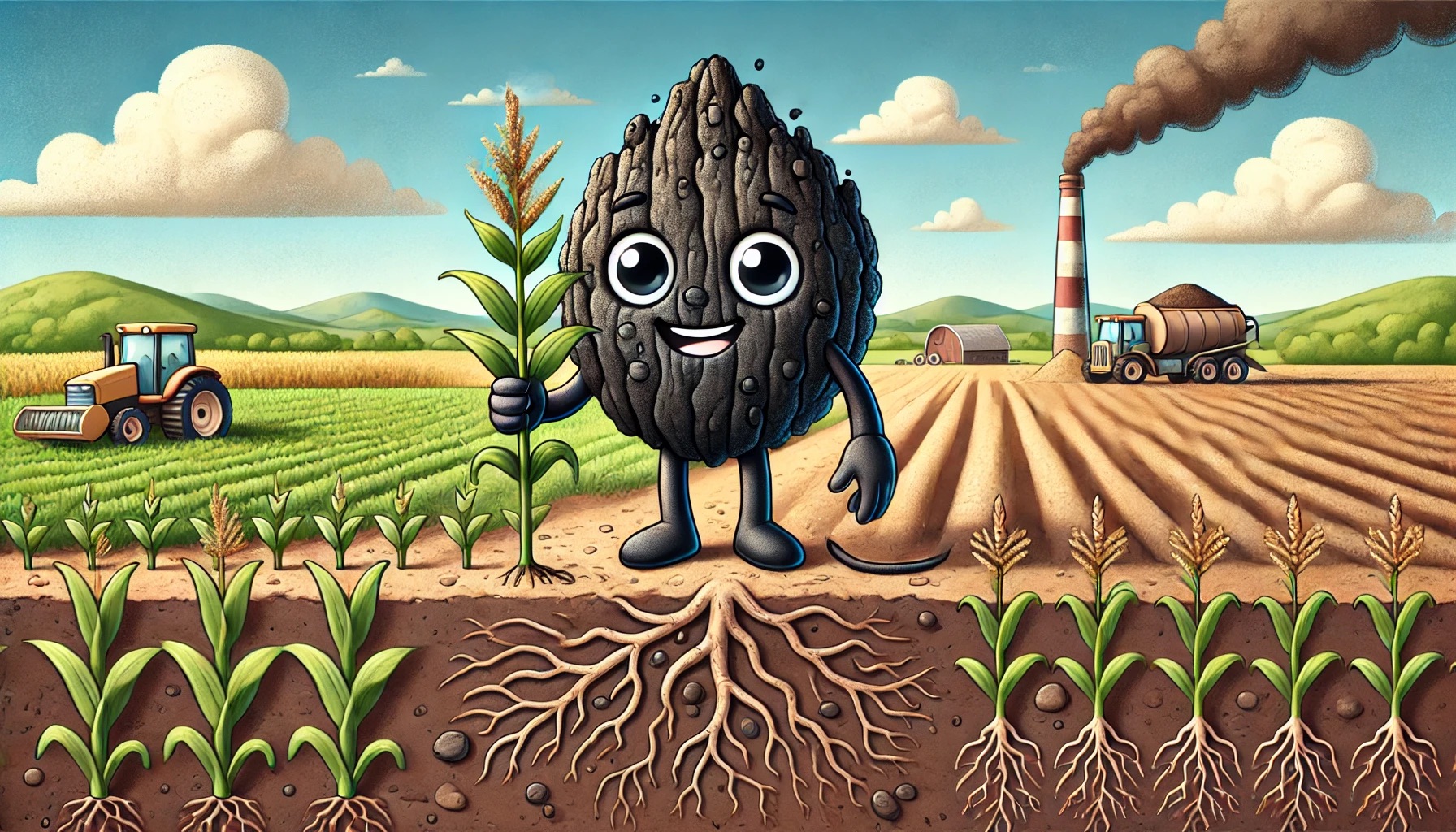
Cheng, et al (2025) BiocharBiochar is a carbon-rich material created from biomass decomposition in low-oxygen conditions. It has important applications in environmental remediation, soil improvement, agriculture, carbon sequestration, energy storage, and sustainable materials, promoting efficiency and reducing waste in various contexts while addressing climate change challenges. More application does not improve crop growth and yield in a semi-humid region in the HuangHuaiHai Plain of China: A 7-year consecutive field experiment. Soil and Tillage Research. https://doi.org/10.1016/j.still.2024.106367
A recent study published in Soil and Tillage Research sheds light on the complex relationship between biochar application and crop productivity. Conducted over seven years in China’s semi-humid Huang-Huai-Hai Plain, the field experiment evaluated biochar’s impact on soil health and crop yields across corn-wheat rotations.
Biochar, a carbon-rich material derived from biomassBiomass is a complex biological organic or non-organic solid product derived from living or recently living organism and available naturally. Various types of wastes such as animal manure, waste paper, sludge and many industrial wastes are also treated as biomass because like natural biomass these More, is often touted for its ability to improve soil fertility and crop production. In this study, straw-derived biochar was applied at varying rates (up to 60 tons per hectare) to sandy loam soil. Researchers monitored soil properties, crop growth metrics (e.g., plant height, root mass), and yields (e.g., grain weight).
Results showed that while biochar significantly improved soil physical and chemical properties—enhancing water retention, nutrient availability, and soil structure—these benefits did not translate into increased crop yields. Corn and wheat yields remained consistent across biochar application rates, suggesting that factors like crop genetics, irrigation, and fertilization practices played a more dominant role.
The findings highlight the need for tailored strategies when considering biochar as a soil amendmentA soil amendment is any material added to the soil to enhance its physical or chemical properties, improving its suitability for plant growth. Biochar is considered a soil amendment as it can improve soil structure, water retention, nutrient availability, and microbial activity. More. While biochar can improve degraded soils, its effectiveness in boosting yields depends on local conditions, including soil type, climate, and agricultural management practices. This long-term data provides valuable insights for regions grappling with soil degradation and the push for sustainable farming practices.
This research underscores that while biochar holds promise, its role in improving agricultural productivity is not a one-size-fits-all solution.





Leave a Reply