
Key Takeaways
- Potassium hydroxide activation prior to 400°C pyrolysisPyrolysis is a thermochemical process that converts waste biomass into bio-char, bio-oil, and pyro-gas. It offers significant advantages in waste valorization, turning low-value materials into economically valuable resources. Its versatility allows for tailored products based on operational conditions, presenting itself as a cost-effective and efficient More creates an ultra-microporous structure that boosts carbon dioxide capture.
- Sargassum biocharBiochar is a carbon-rich material created from biomass decomposition in low-oxygen conditions. It has important applications in environmental remediation, soil improvement, agriculture, carbon sequestration, energy storage, and sustainable materials, promoting efficiency and reducing waste in various contexts while addressing climate change challenges. More modified before pyrolysis achieved a high carbon dioxide uptake capacity of 120.5 milligrams per gram.
- The tailored algal biochar maintained 98.9 percent of its initial uptake capacity after nine consecutive regeneration cycles.
- Moderate pyrolysis temperatures preserve vital surface hydroxyl groups that enhance carbon dioxide adsorption via hydrogen bonding.
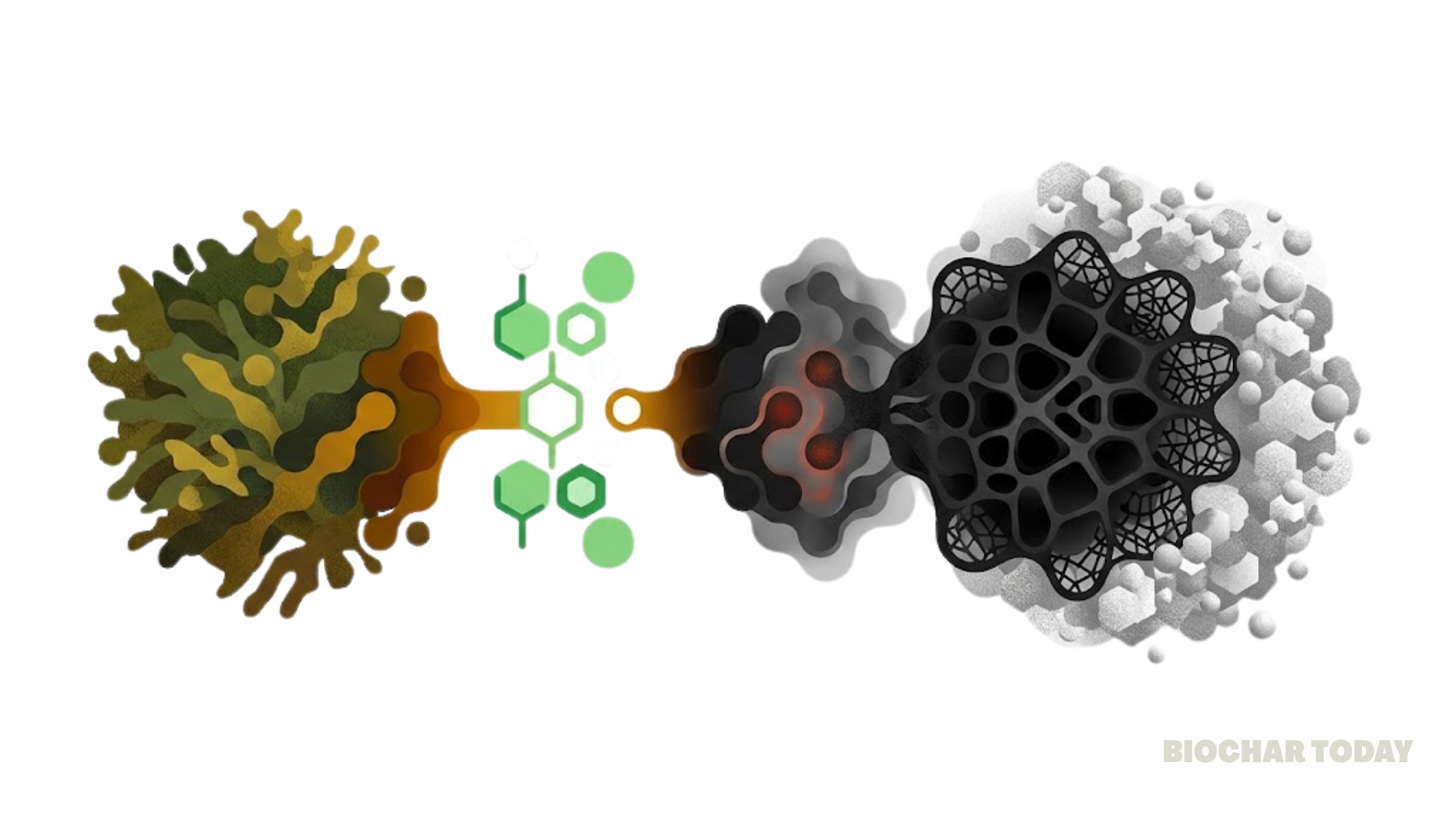
In a study published in Biochar X, authors Yuanling Li, Tao Wang, Jinyu Zhu, Siyu Duan, and Lina Liu addressed the urgent need for cost-effective carbon capture materials by converting harmful marine algal bloom waste into high-performance solid adsorbents. Macroalgal blooms generated by Sargassum present a major environmental challenge worldwide, but they also serve as an abundant, sustainable biomassBiomass is a complex biological organic or non-organic solid product derived from living or recently living organism and available naturally. Various types of wastes such as animal manure, waste paper, sludge and many industrial wastes are also treated as biomass because like natural biomass these More feedstockFeedstock refers to the raw organic material used to produce biochar. This can include a wide range of materials, such as wood chips, agricultural residues, and animal manure. More that does not compete with arable land or food production. Unmodified algae-derived biochars typically suffer from low specific surface areas and unfavorable surface chemistry due to their high ashAsh is the non-combustible inorganic residue that remains after organic matter, like wood or biomass, is completely burned. It consists mainly of minerals and is different from biochar, which is produced through incomplete combustion. Ash Ash is the residue that remains after the complete More and polysaccharide contents. To overcome these limitations, the researchers systematically investigated how varying pyrolysis temperatures between 400 and 700°C and altering the potassium hydroxide modification sequence could tailor both the pore architecture and surface functional groups of Sargassum-derived biochar.
The synthesis sequence proved to be a critical factor in determining the ultimate porosityPorosity of biochar is a key factor in its effectiveness as a soil amendment and its ability to retain water and nutrients. Biochar’s porosity is influenced by feedstock type and pyrolysis temperature, and it plays a crucial role in microbial activity and overall soil health. Biochar More and surface chemistry of the biochar materials. When potassium hydroxide premodification was combined with a moderate pyrolysis temperature of 400°C, the resulting biochar sample exhibited a dramatic structural transformation. The potassium species efficiently etched the carbon matrix during concurrent carbonization and activation, producing an interconnected network dominated by ultra-micropores smaller than 0.7 nanometers. This chemical activation increased the specific surface area from a modest 1.14 square meters per gram in the raw biochar to 569.66 square meters per gram in the pre-modified sample. In contrast, applying potassium hydroxide activation post-pyrolysis yielded a much lower specific surface area of 9.64 square meters per gram, demonstrating that pre-pyrolysis modification is vastly superior for generating optimal pore networks.
The choice of pyrolysis temperature revealed a vital trade-off between physical structure development and chemical site preservation. Lower thermal treatment temperatures preserved high densities of surface oxygen-containing functional groups, specifically hydroxyl, carbonyl, and amino groups. Higher thermal processing temperatures above 600°C caused severe thermal decomposition of these functional groups through dehydration, decarboxylation, and decarbonylation reactions. Although higher temperatures modestly increased physical surface area through devolatilization, the loss of active surface sites diminished chemical interactions. The moderate 400°C treatment struck an ideal balance by retaining crucial surface hydroxyl groups while enabling potassium hydroxide to etch micropores.
Detailed performance evaluations revealed that physical microporosity and chemical binding sites operate synergistically to capture carbon dioxide. The ultra-micropores provided confined physical spaces that maximized physisorption potential under ambient conditions, while the preserved surface hydroxyl groups facilitated weak chemisorption and hydrogen bonding with carbon dioxide molecules. Consequently, the pre-modified biochar achieved a peak carbon dioxide adsorption capacity of 120.5 milligrams per gram at ambient pressure, outperforming unmodified algal biochars by up to ten-fold. Kinetic analyses confirmed that the adsorption process followed pseudo-second-order behavior, indicating a combination of rapid physical diffusion into micropores and surface chemical interactions.
In addition to superior capture capacity, the optimized biochar demonstrated exceptional cyclic stability and regenerability. Multiple continuous adsorption and thermal desorption cycles revealed that the material retained 98.9 percent of its original carbon dioxide adsorption capacity after nine complete operations. Temperature-programmed desorption experiments confirmed that the adsorbed gases desorbed cleanly at modest temperatures without structural degradation. By successfully converting problematic marine waste into a durable, highly efficient adsorbent, this research offers a compelling framework for dual environmental remediation and sustainable carbon management.
Source: Li, Y., Wang, T., Zhu, J., Duan, S., & Liu, L. (2026). Tailoring the porosity and surface chemistry of Sargassum biochar for enhanced CO2 capture. Biochar X, 2, e021.





Leave a Reply