
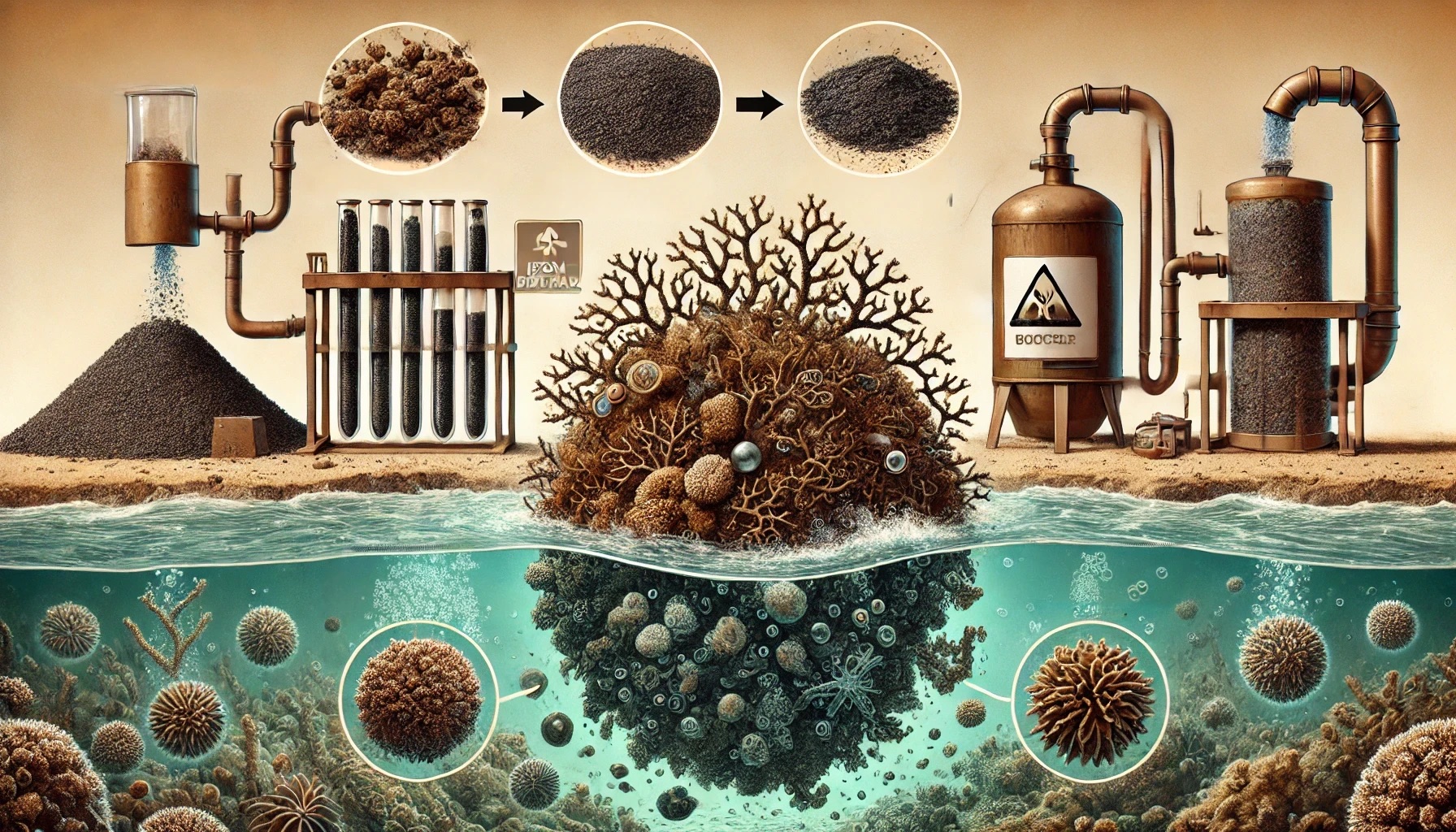
Devrajani, et al (2024) Mechanism of arsenic removal using brown seaweed derived impregnated with iron oxide biocharBiochar is a carbon-rich material created from biomass decomposition in low-oxygen conditions. It has important applications in environmental remediation, soil improvement, agriculture, carbon sequestration, energy storage, and sustainable materials, promoting efficiency and reducing waste in various contexts while addressing climate change challenges. More for batch and column studies. Scientific Reports. https://doi.org/10.1038/s41598-024-69117-9
Water contamination with arsenic poses serious health risks, necessitating effective and sustainable removal methods. Recent research highlights the use of biochar impregnated with iron oxide derived from brown seaweed (Sargassum polycystum) as a promising adsorbent for arsenic removal from water. The study focused on optimizing various factors, such as pHpH is a measure of how acidic or alkaline a substance is. A pH of 7 is neutral, while lower pH values indicate acidity and higher values indicate alkalinity. Biochars are normally alkaline and can influence soil pH, often increasing it, which can be beneficial More, contact time, initial arsenic concentration, and adsorbent dosage, to achieve maximum efficiency.
The biochar was created by pyrolyzing seaweed biomassBiomass is a complex biological organic or non-organic solid product derived from living or recently living organism and available naturally. Various types of wastes such as animal manure, waste paper, sludge and many industrial wastes are also treated as biomass because like natural biomass these More at 400°C, followed by iron oxide impregnation. This process enhanced the biochar’s adsorption capacity by increasing its surface area and functional groups, which bind arsenic ions effectively. Batch studies showed that under optimal conditions—pH 6, 100 mg of adsorbent, and 90 minutes contact time—the biochar could remove up to 96.7% of arsenic from water. The adsorption process followed a pseudo-second-order kinetic model, suggesting that chemisorption was the dominant mechanism.
Further tests in a column study demonstrated the potential for large-scale application, with the biochar maintaining its efficiency until complete saturation after 200 minutes. The primary removal mechanism involved surface complexation, supported by the enhanced porosityPorosity of biochar is a key factor in its effectiveness as a soil amendment and its ability to retain water and nutrients. Biochar’s porosity is influenced by feedstock type and pyrolysis temperature, and it plays a crucial role in microbial activity and overall soil health. Biochar More and surface area of the iron-modified biochar.
This study underscores the potential of using iron-oxide biochar from brown seaweed as an effective, sustainable solution for arsenic removal, providing a promising approach for addressing water contamination issues.




Leave a Reply