
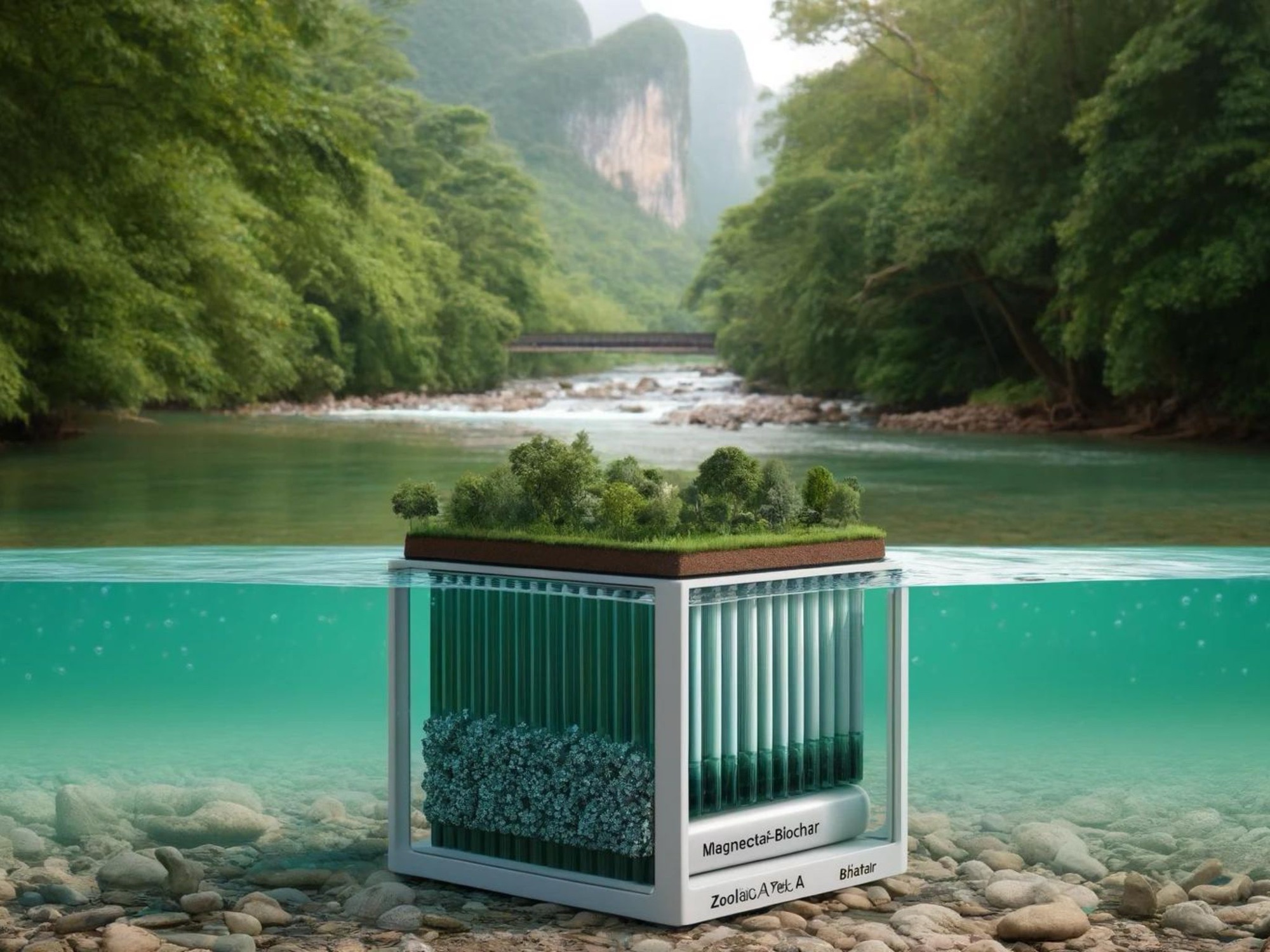
Derbe, et al (2024) Synthesis of zeolite-A/Fe3O4/biochar composite for removal of Cr(VI) from aqueous solution. International Journal of Environmental Science & Technology. https://doi.org/10.1007/s13762-024-05642-4
Industrial effluents containing hexavalent chromium (Cr(VI)) pose significant risks to human health and aquatic life. To mitigate these dangers, effective removal of Cr(VI) via adsorption processes is essential. Recent research has focused on a novel Zeolite-A/Fe3O4/Biochar (Z-A/Fe3O4/BC) composite for this purpose.
The Z-A/Fe3O4/BC adsorbent was synthesized and characterized using various techniques, including FT-IR, EDX, BET, SEM, and XRD, which provided insights into its functional groups, elemental composition, surface area, morphology, and crystallinity. Batch adsorption tests were conducted to optimize parameters such as initial Cr(VI) concentration, adsorbent dose, contact time, and pHpH is a measure of how acidic or alkaline a substance is. A pH of 7 is neutral, while lower pH values indicate acidity and higher values indicate alkalinity. Biochars are normally alkaline and can influence soil pH, often increasing it, which can be beneficial More level.
Results showed that the best adsorption capacity (46.93 mg/g) was achieved under specific conditions: an initial concentration of 15 mg/L, an adsorbent dose of 0.3 g/L, a contact time of 180 minutes, and a pH of 4. The adsorption process followed the Langmuir isotherm and pseudo-second-order kinetic models.
In practical applications, the Z-A/Fe3O4/BC composite demonstrated remarkable efficiency, achieving an adsorption capacity of 99.24 mg/g from a real sample taken from Batu Tannery PLC, which had an initial Cr(VI) concentration of 36.27 mg/L under optimized conditions.
Additionally, the composite exhibited good recyclability, with adsorption capacities of 46.93, 42.98, 41.09, 38.435, and 33.76 mg/g over five successive cycles.
This study suggests that the Z-A/Fe3O4/BC composite is a cost-effective and highly promising solution for Cr(VI) removal, with significant potential for practical applications in wastewater treatment.
-
adsorption isotherms, BET surface area, Cr(VI) adsorption, environmental remediation, FT-IR characterization, heavy metal removal, industrial effluent, kinetic models, optimized adsorption parameters, recyclability, SEM analysis, wastewater treatment, Water treatment, XRD analysis, Zeolite-A/Fe3O4/Biochar


Leave a Reply