
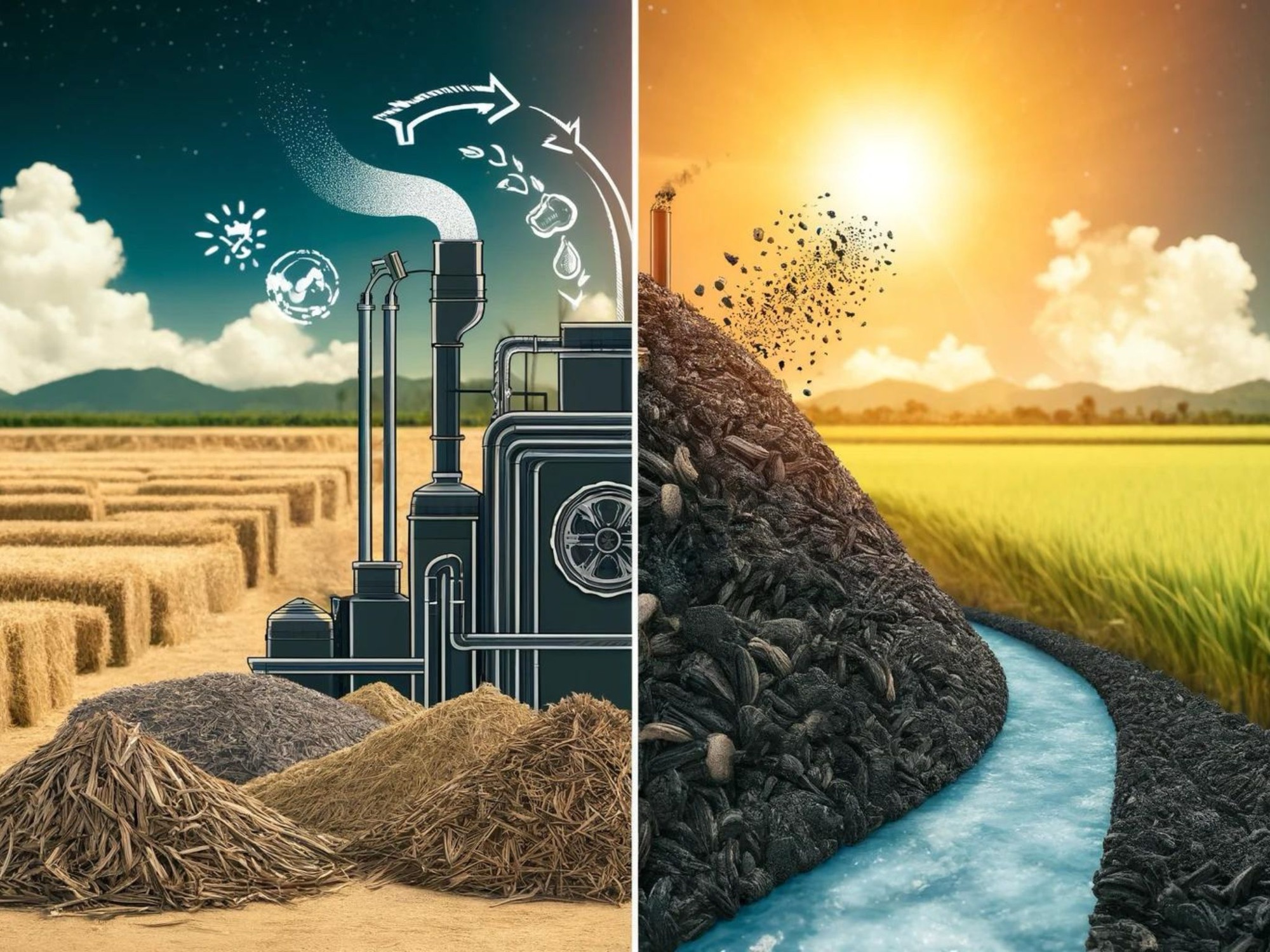
Li, et al (2024) Silica from rice husk for sludge-based biocharBiochar is a carbon-rich material created from biomass decomposition in low-oxygen conditions. It has important applications in environmental remediation, soil improvement, agriculture, carbon sequestration, energy storage, and sustainable materials, promoting efficiency and reducing waste in various contexts while addressing climate change challenges. More modification: As a novel adsorbent for lead. Journal of Water Process Engineering. https://doi.org/10.1016/j.jwpe.2024.105218
Researchers have developed a novel approach to enhance the adsorption capacity of biochar for removing lead (Pb2+) from wastewater by utilizing silica sourced from rice husk waste. This new type of silica-rich biochar (SiBC) demonstrates a significant improvement in lead adsorption efficiency compared to traditional biochar.
Traditionally, biochar is produced through the pyrolysisPyrolysis is a thermochemical process that converts waste biomass into bio-char, bio-oil, and pyro-gas. It offers significant advantages in waste valorization, turning low-value materials into economically valuable resources. Its versatility allows for tailored products based on operational conditions, presenting itself as a cost-effective and efficient More of municipal sludge, which transforms waste into a porous carbon material that can adsorb contaminants from water. However, pristine biochar often suffers from low adsorption efficiency. By modifying biochar with silica, specifically extracted from rice husk ashAsh is the non-combustible inorganic residue that remains after organic matter, like wood or biomass, is completely burned. It consists mainly of minerals and is different from biochar, which is produced through incomplete combustion. Ash Ash is the residue that remains after the complete More (RHA), the study introduces an effective and resourceful method to overcome this limitation. The optimal RHA to carbon ratio was found to be 1:2, achieving a lead adsorption capacity of 230.47 mg/g, which is more than six times higher than that of unmodified biochar.
The SiBC not only boasts a higher specific surface area and porosityPorosity of biochar is a key factor in its effectiveness as a soil amendment and its ability to retain water and nutrients. Biochar’s porosity is influenced by feedstock type and pyrolysis temperature, and it plays a crucial role in microbial activity and overall soil health. Biochar More but also features new functional groups on its surface that enhance lead adsorption through mechanisms such as electrostatic adsorption, ion exchange, functional group complexation, and precipitation. Furthermore, the SiBC shows strong resistance to interference from coexisting cations, a common challenge in real wastewater environments.
Lead is notoriously persistent in the environment due to its toxicity and tendency to accumulate biologically. With widespread industrial use, from battery manufacturing to paint spraying, the release of lead into water systems has become a critical environmental issue. The development of SiBC offers a promising solution to this problem by turning agricultural waste into a high-efficiency adsorbent.
This innovative study not only paves the way for effective lead removal strategies but also promotes the recycling of rice husk waste, aligning with sustainable waste management practices. By enhancing the functional properties of biochar through the incorporation of silica from rice husks, this research contributes a valuable method to the field of water purification, potentially mitigating lead pollution in aquatic ecosystems globally.


![Eucalyptus Wood Waste-Derived Biochar Achieves a Ninety-Eight Percent Removal Efficiency for Benzo[ghi]perylene in Vehicle-Wash Wastewater](https://biochartoday.com/wp-content/uploads/2026/10/SCIENCE-BLOGS-2026-2026-10-19T160523.703.jpg)

Leave a Reply