
Gezahegn, et al (2024) The impact of water hyacinth biocharBiochar is a carbon-rich material created from biomass decomposition in low-oxygen conditions. It has important applications in environmental remediation, soil improvement, agriculture, carbon sequestration, energy storage, and sustainable materials, promoting efficiency and reducing waste in various contexts while addressing climate change challenges. More on maize growth and soil properties: The influence of pyrolysisPyrolysis is a thermochemical process that converts waste biomass into bio-char, bio-oil, and pyro-gas. It offers significant advantages in waste valorization, turning low-value materials into economically valuable resources. Its versatility allows for tailored products based on operational conditions, presenting itself as a cost-effective and efficient More temperature. Journal of Sustainable Agriculture and Environment. https://doi.org/10.1002/sae2.12117
Water hyacinth (WH), known for its invasive nature, has become a major concern in tropical regions, including Lake Tana in Ethiopia. Managing WH involves significant costs and technical challenges. However, recent research suggests that converting WH biomassBiomass is a complex biological organic or non-organic solid product derived from living or recently living organism and available naturally. Various types of wastes such as animal manure, waste paper, sludge and many industrial wastes are also treated as biomass because like natural biomass these More into biochar can be an effective soil amendmentA soil amendment is any material added to the soil to enhance its physical or chemical properties, improving its suitability for plant growth. Biochar is considered a soil amendment as it can improve soil structure, water retention, nutrient availability, and microbial activity. More, improving soil fertility and crop yields.
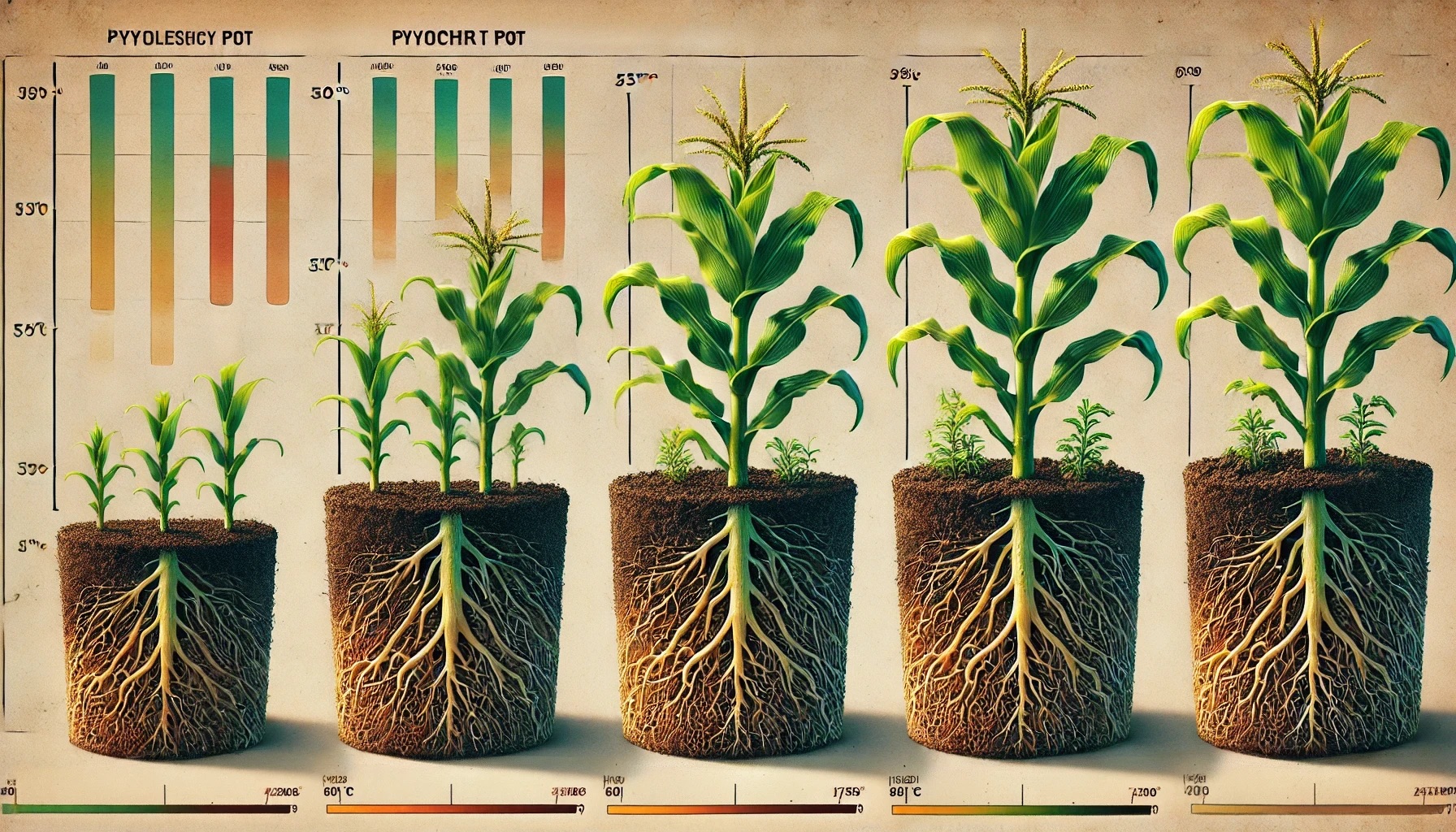
Biochar is produced by pyrolyzing biomass at high temperatures in limited oxygen conditions. The temperature at which biochar is produced significantly impacts its properties and effectiveness as a soil amendment. A study conducted by Gezahegn et al. investigated the effects of WH biochar (WHB) produced at three different temperatures (350°C, 550°C, and 750°C) and applied at two rates (5 and 20 t/ha) on maize growth and soil properties.
The study involved growing maize in pots under natural conditions for two months. The results showed that applying WHB at 20 t/ha significantly increased maize shoot and root biomass, especially when biochar was produced at 350°C and 550°C. Specifically, WHB at 350°C and 550°C increased shoot dry biomass by 47.7% to 17.6% and root dry biomass by 78.4% to 54.1%, respectively. However, higher pyrolysis temperatures (750°C) resulted in decreased maize growth.
Soil properties were also positively influenced by WHB application. Biochar produced at 350°C and 550°C and applied at 20 t/ha improved soil total nitrogen (TN), cation exchange capacity (CEC), and ammonium-nitrogen (NH4+-N) significantly compared to the control. Additionally, soil carbon content increased by 38.5% to 56.3% with WHB application. However, biochar produced at 750°C led to higher soil pHpH is a measure of how acidic or alkaline a substance is. A pH of 7 is neutral, while lower pH values indicate acidity and higher values indicate alkalinity. Biochars are normally alkaline and can influence soil pH, often increasing it, which can be beneficial More, electrical conductivity (EC), and available phosphorus (Pav), which can have mixed effects on soil health.
The study concluded that WHB produced at lower temperatures (350°C and 550°C) is optimal for improving maize growth and soil quality. These temperatures preserve more nitrogen and enhance soil properties like CEC, which are crucial for nutrient retention and plant growth. Conversely, biochar produced at higher temperatures (750°C) may adsorb too much water and nutrients, making them less available to plants.
One key takeaway from this research is the importance of selecting the appropriate pyrolysis temperature for producing biochar. Lower temperatures (350°C and 550°C) were more beneficial for soil and plant health compared to higher temperatures (750°C). This finding is significant for developing strategies to utilize WH biomass effectively, transforming a problematic invasive species into a valuable resource for agriculture.
Furthermore, applying biochar at higher rates (20 t/ha) generally resulted in better outcomes for both maize growth and soil properties. This suggests that sufficient quantities of biochar are necessary to achieve the desired improvements in soil fertility and crop yield.
Overall, converting WH into biochar and applying it to soils represents a sustainable and beneficial practice. It not only helps manage the invasive WH but also enhances soil health and agricultural productivity. Future research should explore the long-term effects of WHB on different soil types and under various field conditions to further validate these findings and develop comprehensive guidelines for biochar use in agriculture.


![Eucalyptus Wood Waste-Derived Biochar Achieves a Ninety-Eight Percent Removal Efficiency for Benzo[ghi]perylene in Vehicle-Wash Wastewater](https://biochartoday.com/wp-content/uploads/2026/10/SCIENCE-BLOGS-2026-2026-10-19T160523.703.jpg)

Leave a Reply