
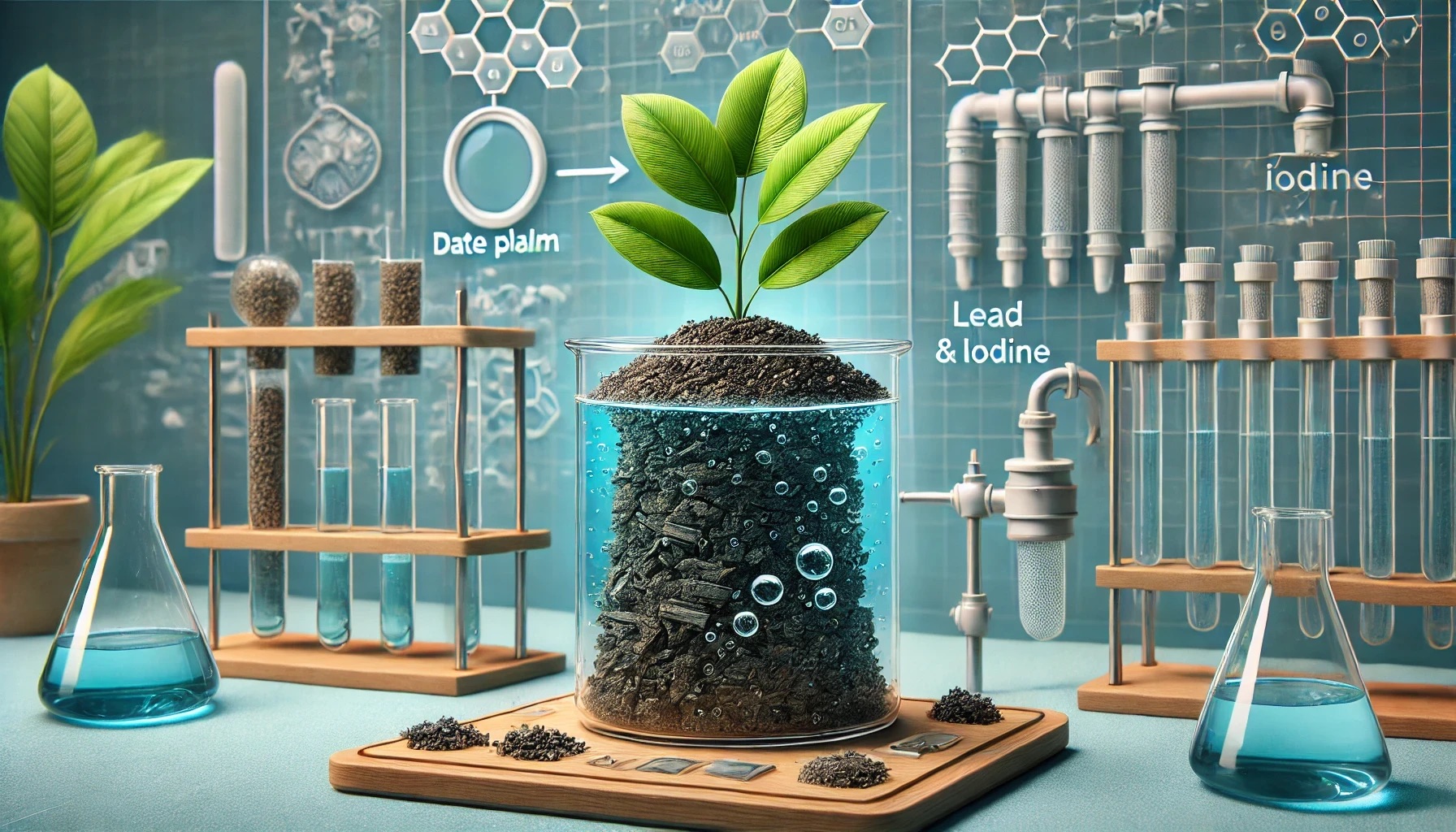
Mahmoud, et al (2024) Utilizing Date Palm Leaf BiocharBiochar is a carbon-rich material created from biomass decomposition in low-oxygen conditions. It has important applications in environmental remediation, soil improvement, agriculture, carbon sequestration, energy storage, and sustainable materials, promoting efficiency and reducing waste in various contexts while addressing climate change challenges. More for Simultaneous Adsorption of Pb(II) and Iodine from Aqueous Solutions. Processes. https://doi.org/10.3390/pr12071370
Recent research explores using biochar derived from date palm leaves to address environmental contaminants, specifically lead (Pb(II)) and iodine. Biochar, produced through slow pyrolysisPyrolysis is a thermochemical process that converts waste biomass into bio-char, bio-oil, and pyro-gas. It offers significant advantages in waste valorization, turning low-value materials into economically valuable resources. Its versatility allows for tailored products based on operational conditions, presenting itself as a cost-effective and efficient More of biomassBiomass is a complex biological organic or non-organic solid product derived from living or recently living organism and available naturally. Various types of wastes such as animal manure, waste paper, sludge and many industrial wastes are also treated as biomass because like natural biomass these More, offers a sustainable solution for water treatment due to its porous structure and surface functional groups.
The study involved creating biochar by heating date palm leaf midribs in two stages: first at 300°C, then at 600°C. This process results in a material with numerous pores and functional groups like O-H and C-H, enhancing its ability to adsorb contaminants.
Experiments tested biochar’s efficiency in removing Pb(II) and iodine from water. For lead, a solution containing 100 ppm of Pb(II) was treated with varying amounts of biochar. Results showed that 60 mg of biochar per 10 mL of solution achieved 100% lead removal. This high efficiency is attributed to the biochar’s porous structure and functional groups that facilitate adsorption through various mechanisms, including precipitation and complexation.
Iodine adsorption was less efficient, with a maximum of 39.7% removal achieved using 30-40 mg of biochar per 50 mL of solution. The difference in adsorption capacities between lead and iodine is due to their distinct chemical properties and interactions with the biochar surface.
Overall, the study highlights the potential of date palm-derived biochar as an effective, low-cost material for water purification, capable of significantly reducing Pb(II) levels and moderately adsorbing iodine. This approach not only utilizes agricultural waste but also offers a sustainable method for improving water quality, providing valuable insights for environmental remediation strategies.

Leave a Reply