
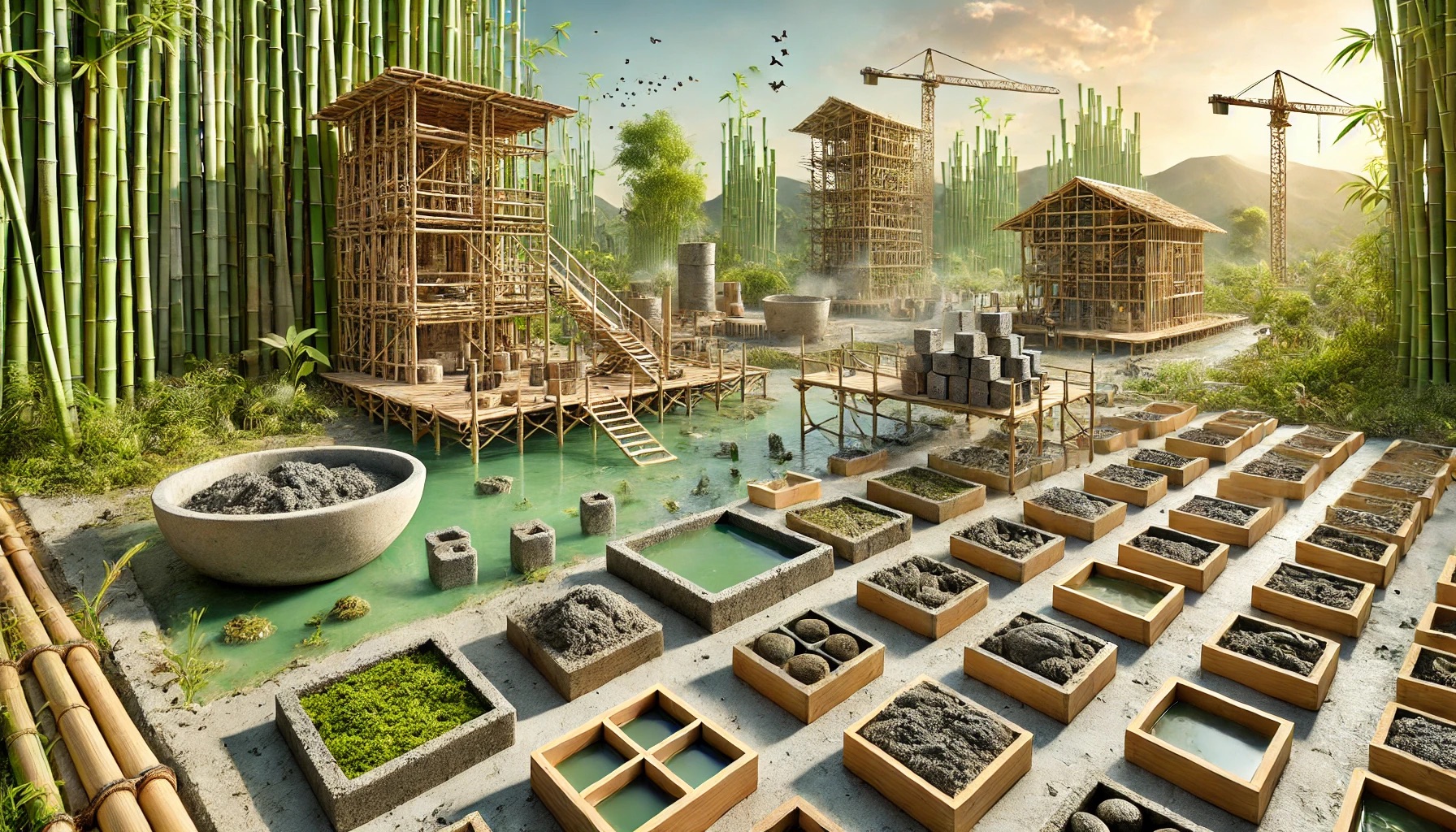
Selvanathan, et al (2024) Curing Effect on the Strength of Cement Mortar with Bamboo BiocharBiochar is a carbon-rich material created from biomass decomposition in low-oxygen conditions. It has important applications in environmental remediation, soil improvement, agriculture, carbon sequestration, energy storage, and sustainable materials, promoting efficiency and reducing waste in various contexts while addressing climate change challenges. More. International Journal on Nanoelectronics and Materials. https://ejournal.unimap.edu.my/index.php/ijneam/article/download/1170/749
The environmental impact of the cement industry, which is responsible for around 6% of global greenhouse gas emissions, has spurred research into eco-friendly alternatives. One promising solution is bamboo biochar, a byproduct of bamboo pyrolysisPyrolysis is a thermochemical process that converts waste biomass into bio-char, bio-oil, and pyro-gas. It offers significant advantages in waste valorization, turning low-value materials into economically valuable resources. Its versatility allows for tailored products based on operational conditions, presenting itself as a cost-effective and efficient More that has shown potential as a partial cement substitute in mortar mixes.
A recent study examined the effectiveness of bamboo biochar in enhancing the strength and sustainability of cement mortar. The researchers tested different percentages of biochar (1%, 2%, 3%) and curing methods (water, air, and heat) to assess the material’s performance in terms of compressive and flexural strength. Mortar samples were cured for 3, 7, and 28 days.
The study revealed that 2% bamboo biochar replacement yielded the best results in terms of compressive strength, especially with water curing, which significantly improved strength by up to 41% after 28 days. Flexural strength also improved across all biochar mixes, with 1% and 2% replacements providing the highest performance under water and air curing.
Bamboo biochar’s porous structure aids in water absorption, enhancing the hydration process and improving mortar strength. However, heat curing proved less effective due to biochar’s insulating properties, which hinder hydration.
These findings suggest that bamboo biochar could be an effective and sustainable alternative in construction, reducing cement consumption while maintaining structural integrity. The study recommends using a 2% biochar replacement for optimal compressive and flexural strength, particularly under water curing conditions.



Leave a Reply