
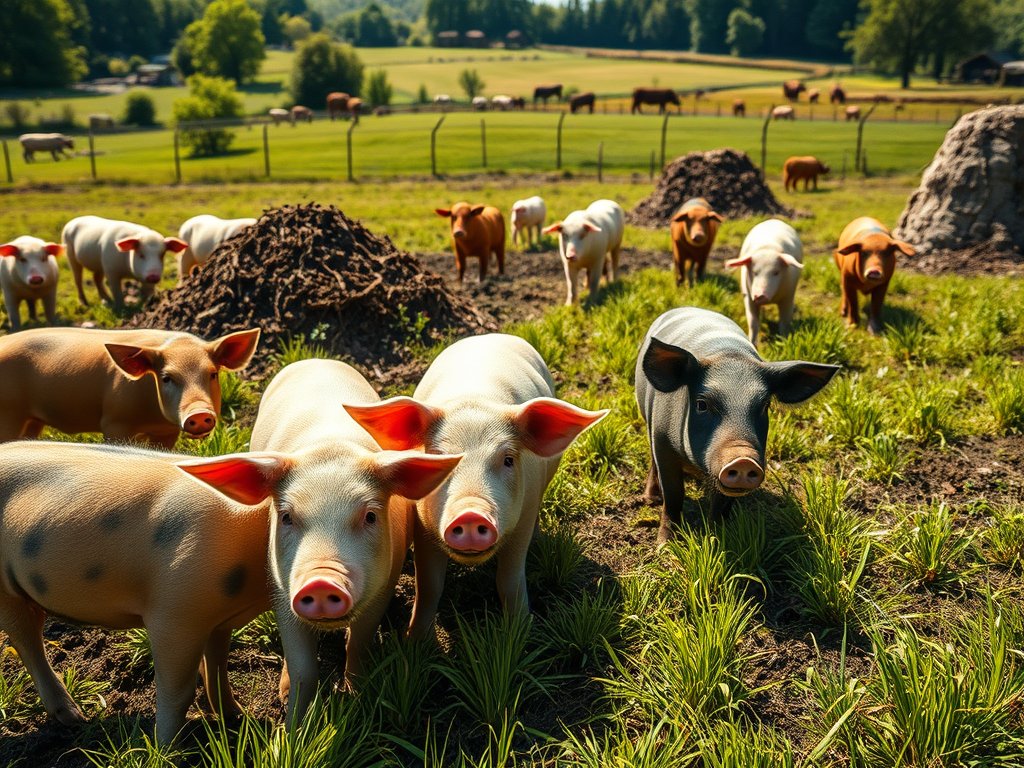
In a Master’s thesis by Jack Edgar, submitted to the Faculty of Land & Food Systems, University of British Columbia, the burgeoning role of biocharBiochar is a carbon-rich material created from biomass decomposition in low-oxygen conditions. It has important applications in environmental remediation, soil improvement, agriculture, carbon sequestration, energy storage, and sustainable materials, promoting efficiency and reducing waste in various contexts while addressing climate change challenges. More in animal agriculture is explored, highlighting its potential for cascading benefits and fostering resource circularity. While historically recognized as a soil amendmentA soil amendment is any material added to the soil to enhance its physical or chemical properties, improving its suitability for plant growth. Biochar is considered a soil amendment as it can improve soil structure, water retention, nutrient availability, and microbial activity. More, biochar, a form of charcoalCharcoal is a black, brittle, and porous material produced by heating wood or other organic substances in a low-oxygen environment. It is primarily used as a fuel source for cooking and heating. More produced through heating biomassBiomass is a complex biological organic or non-organic solid product derived from living or recently living organism and available naturally. Various types of wastes such as animal manure, waste paper, sludge and many industrial wastes are also treated as biomass because like natural biomass these More in a low-oxygen environment (pyrolysisPyrolysis is a thermochemical process that converts waste biomass into bio-char, bio-oil, and pyro-gas. It offers significant advantages in waste valorization, turning low-value materials into economically valuable resources. Its versatility allows for tailored products based on operational conditions, presenting itself as a cost-effective and efficient More), is gaining traction for its diverse applications within animal farming systems. This versatility offers significant promise for mitigating environmental impacts and improving overall agricultural sustainability.
One of the key advantages of integrating biochar lies in its ability to significantly reduce harmful emissions and enhance nutrient management. For instance, in animal bedding, biochar acts as a sorbent for gases and animal waste, capturing nitrogen that would otherwise be lost through leachingLeaching is the process where nutrients are dissolved and carried away from the soil by water. This can lead to nutrient depletion and environmental pollution. Biochar can help reduce leaching by improving nutrient retention in the soil. More or volatilization into potent greenhouse gases (GHGs)Greenhouse gases (GHGs) are gases in the atmosphere that trap heat, contributing to the warming of the planet. Carbon dioxide, methane, and nitrous oxide are examples of greenhouse gases. Biochar helps to mitigate the emission of GHGs through various mechanisms. More. Studies have shown that acidifying biochar or inoculating bedding with lactobacillus bacteria can further reduce ammonification.
In co-composting applications, biochar has demonstrated impressive results in mitigating GHGs. Research indicates that adding biochar to composting poultry litter can increase nitrogen retention by as much as 64% with a 20% pine biochar addition. Furthermore, cumulative nitrous oxide ( N2O) emissions were found to be 65-70% lower in poultry litter composted with biochar compared to controls. Beyond environmental benefits, biochar also expedites the composting process, with one study noting a 12% decrease in total compost time when composting swine manure with biochar.
Liquid manure management also sees substantial improvements with biochar integration. Biochar can reduce ammonia gas and odors while adsorbing plant-available nutrients. An experiment using biochar produced via slow pyrolysis at 600∘C from Douglas Fir hog fuel showed a remarkable 72-80% decrease in ammonia (NH3) in the headspace of manure lagoons. When mixed with liquid manure before soil application, biochar at a 1% concentration reduced nitrification by 68%, ammonification by 221%, CO2 flux by 67%, and N2O flux by 26%. Biochar also efficiently adsorbs up to 43% of ammonium (NH4+) and 65% of phosphate (PO43−) in liquid manure within 24 hours.
The use of manure as a feedstockFeedstock refers to the raw organic material used to produce biochar. This can include a wide range of materials, such as wood chips, agricultural residues, and animal manure. More for biochar production presents another compelling avenue for resource circularity. Pyrolyzing manure into biochar can reduce its volume and mass by 42-86%, making transportation more efficient. This manure-derived biochar boasts a higher nutrient content, particularly phosphorus, with retention rates ranging from 93-99%, making it an effective slow-release phosphorus fertilizer. Additionally, pyrolysis above 400∘C can eliminate antibiotic residuals in manure.
Finally, as a feed supplement, biochar has been shown to improve animal health, digestion efficiency, and weight gain, while reducing greenhouse gas emissions and nutrient loss. A review of 112 scientific publications concluded largely positive outcomes. Studies have even demonstrated methane reductions of 10% with 0.5% biochar feed and 12.7% with 1% biochar feed. One study reported a 34% decrease in methane when biochar acidified to pHpH is a measure of how acidic or alkaline a substance is. A pH of 7 is neutral, while lower pH values indicate acidity and higher values indicate alkalinity. Biochars are normally alkaline and can influence soil pH, often increasing it, which can be beneficial More 4.8 was added to feed at 0.5%. The economic viability of feeding biochar has also been highlighted, with one Australian cattle ranch replacing fertilizers and insecticides with a daily biochar and molasses supplement, leading to improved soil properties, pasture health, and increased profitability.
While the benefits are clear, it is crucial to consider biochar’s properties, including feedstock and production temperature, for optimal application. The findings underscore that biochar is not a singular solution but a versatile component within a holistic resource management strategy, offering a cascade of benefits for a more sustainable and resilient animal agriculture system.
Source: Edgar, J. (2022). Biochar in Animal Agriculture: The Potential for Cascading Benefits and Resource Circularity. Masters of Land and Water Systems, Faculty of Land & Food Systems, University of British Columbia.



Leave a Reply