
Key Takeaways
- Applying carbon materials derived from agricultural waste provides a multi-beneficial approach to restore heavily degraded soil zones while permanently storing stable atmospheric carbon.
- Adjusting production temperatures can shift the average chemical balance of these protective amendments up to an alkaline level of ten point one.
- Specialized biogenic filters trap and hold minute plastic particles to achieve pollutant removal efficiencies ranging from sixty to over ninety-five percent.
- Incorporating these treated organic amendments into modern cultivation strategies actively counteracts environmental stress and limits greenhouse gas discharge.
- Certain high-temperature carbon variations introduce electrical salinity risks that require careful structural alignment before application in alkaline field systems.
The extensive historical accumulation of microplastics and nanoplastics within modern agricultural soils has rapidly emerged as a critical global threat to long-term ecosystem stability, food security, and human health. These microscopic plastic fragments primarily originate from widely deployed agricultural mulching films, contaminated wastewater irrigation networks, and persistent sewage sludge disposal practices across rural farmlands. Once deeply embedded within the terrestrial matrix, plastic particles severely disrupt natural soil aggregation, impair root development systems, and alter vital subterranean microbial community structures. Furthermore, the exceptionally small size and high colloidal mobility of nanoplastics allow them to easily bypass natural botanical root barriers, accumulate directly in food crop grains, and threaten subsequent transfer to humans. Compounding this environmental hazard, these persistent plastic fragments function as active chemical vectors that absorb and transport dangerous co-contaminants, including antibiotics, heavy metals, and toxic agricultural pesticides. To resolve these complex multi-pollutant issues, modern environmental research has prioritized climate-smart structural strategies that simultaneously restore agricultural health and trap emerging soil toxins.
Synthesizing biomassBiomass is a complex biological organic or non-organic solid product derived from living or recently living organism and available naturally. Various types of wastes such as animal manure, waste paper, sludge and many industrial wastes are also treated as biomass because like natural biomass these More via oxygen-limited thermal processing yields a highly stable, carbon-rich material possessing a distinct honeycomb configuration perfectly optimized for advanced environmental remediation. The foundational physical and chemical attributes of these biogenic carbon amendments, specifically internal fluid conductivity and baseline alkalinity, shift dynamically depending on chosen manufacturing temperatures and raw organic inputs. Systematic laboratory testing confirms that elevating production temperatures concentrates alkaline ashAsh is the non-combustible inorganic residue that remains after organic matter, like wood or biomass, is completely burned. It consists mainly of minerals and is different from biochar, which is produced through incomplete combustion. Ash Ash is the residue that remains after the complete More minerals, forms key carbonate molecules, and systematically burns off residual acidic groups. Consequently, moving the thermal processing boundary causes a linear expansion in average material alkalinity alongside a parallel increase in electrical salt conductivity. While these alkaline characteristics make high-temperature variations exceptionally effective for reversing nutrient depletion in highly acidic agricultural zones, they introduce definite over-salinity and structural restriction risks if deployed within inherently saline-sodic soil types.
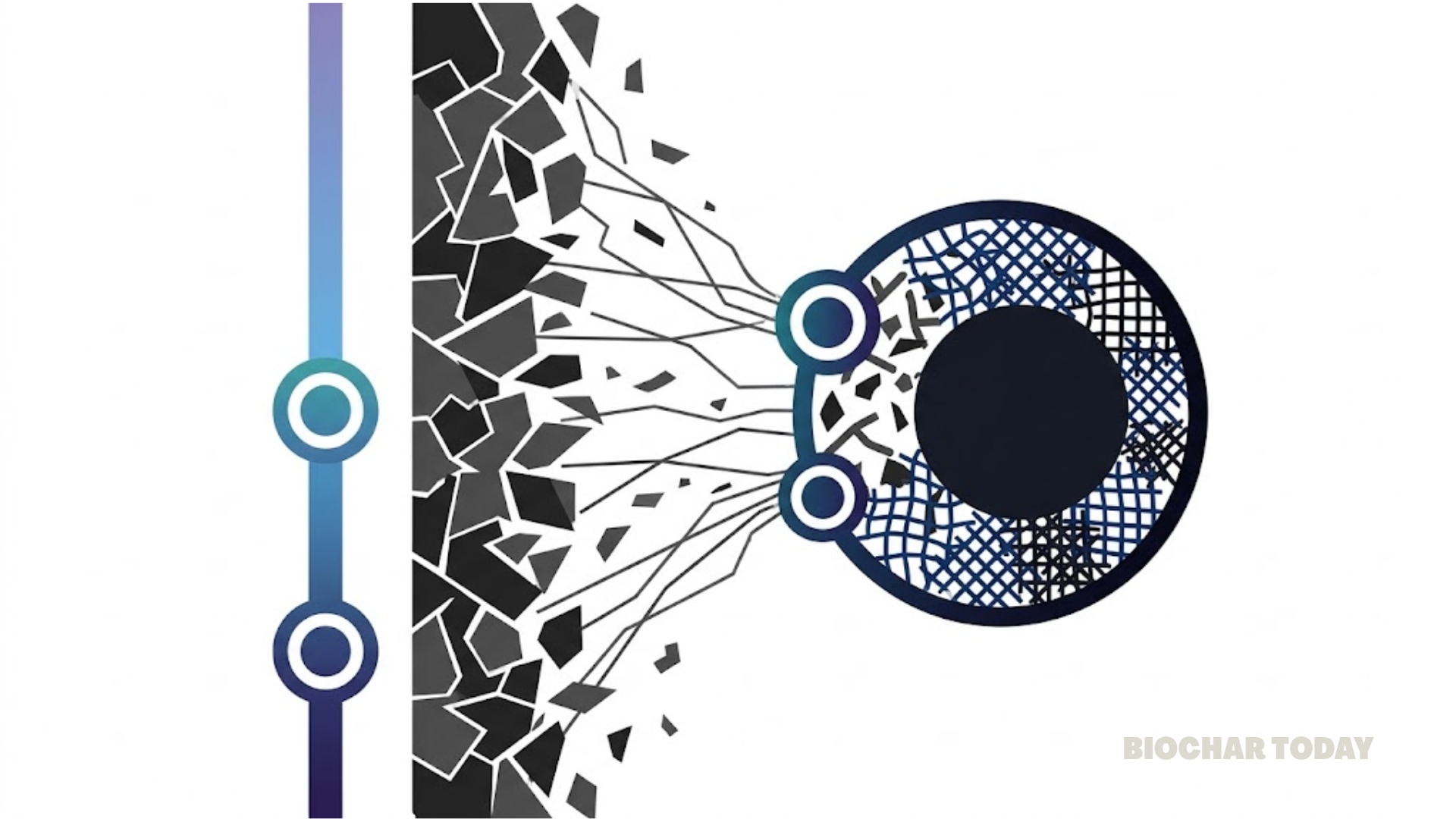
The highly porous surface architecture and abundant functional groups of optimized biogenic amendments extract plastic particles from surrounding soil waters through multiple overlapping mechanical capture pathways. The carbon material initiates strong hydrophobic bonds, aromatic stacking interactions, and precise electrostatic attractions directly along the outer contours of incoming plastic pollutants. Simultaneously, the intricate internal pore network acts as a physical screening matrix that catches, filters, and permanently traps moving microplastic spheres inside the honeycomb core. Empirical evaluation of various biogenic feedstocks reveals that wheat straw variations remove over eighty-six percent of polystyrene particles, while cow dung iterations achieve a ninety-two point four percent removal efficiency. Additionally, corn stover alternatives demonstrate a ninety-five percent plastic immobilization rate, while customized sawdust formulas capture up to sixty percent of highly mobile nanoplastics via intense aromatic grid trapping.
Integrating these specialized carbon amendments into large-scale sustainable agricultural frameworks delivers critical, interlocking environmental resilience and climate change mitigation benefits. Beyond executing direct physical contaminant remediation, applying these materials stimulates native soil microbial biomass and encourages the secretion of natural binding substances that trap plastics inside healthy soil clusters. This stabilization mechanism dramatically decreases the downward leachingLeaching is the process where nutrients are dissolved and carried away from the soil by water. This can lead to nutrient depletion and environmental pollution. Biochar can help reduce leaching by improving nutrient retention in the soil. More of nanoplastics, successfully protecting deep regional groundwater reserves from plastic infiltration during heavy rainfall or irrigation events. From a climate-smart perspective, the highly stable molecular structure of the amendment permanently traps biogenic carbon inside the ground for hundreds of years, transforming agricultural farmlands into long-term carbon sinks. By actively regulating subterranean nitrogen cycling and optimizing overall nutrient metabolism, these multi-functional carbon applications reduce local nitrous oxide gas discharges while safely reinforcing future crop grain yields.
Source: Aly, A. A. (2026). BiocharBiochar is a carbon-rich material created from biomass decomposition in low-oxygen conditions. It has important applications in environmental remediation, soil improvement, agriculture, carbon sequestration, energy storage, and sustainable materials, promoting efficiency and reducing waste in various contexts while addressing climate change challenges. More as a climate-smart approach for soil health improvement and nano-/microplastic mitigation in sustainable agriculture: A review. Preprints.org.




Leave a Reply