
Key Takeaways
- BiocharBiochar is a carbon-rich material created from biomass decomposition in low-oxygen conditions. It has important applications in environmental remediation, soil improvement, agriculture, carbon sequestration, energy storage, and sustainable materials, promoting efficiency and reducing waste in various contexts while addressing climate change challenges. More made from common garden plant waste effectively captures toxic dyes and organic pollutants from real textile factory wastewater.
- Combining plant charcoalCharcoal is a black, brittle, and porous material produced by heating wood or other organic substances in a low-oxygen environment. It is primarily used as a fuel source for cooking and heating. More with ozone gas treatment cleans heavily polluted water far better than using either method alone.
- Mildly alkaline water conditions play the biggest role in maximizing pollutant capture, matching the natural chemistry of textile waste.
- Treating the plant charcoal with potassium hydroxide creates microscopic honeycomb pores that trap large amounts of dye molecules.
- This combined approach cuts ozone gas requirements significantly, offering a lower-cost water purification option for textile manufacturers.
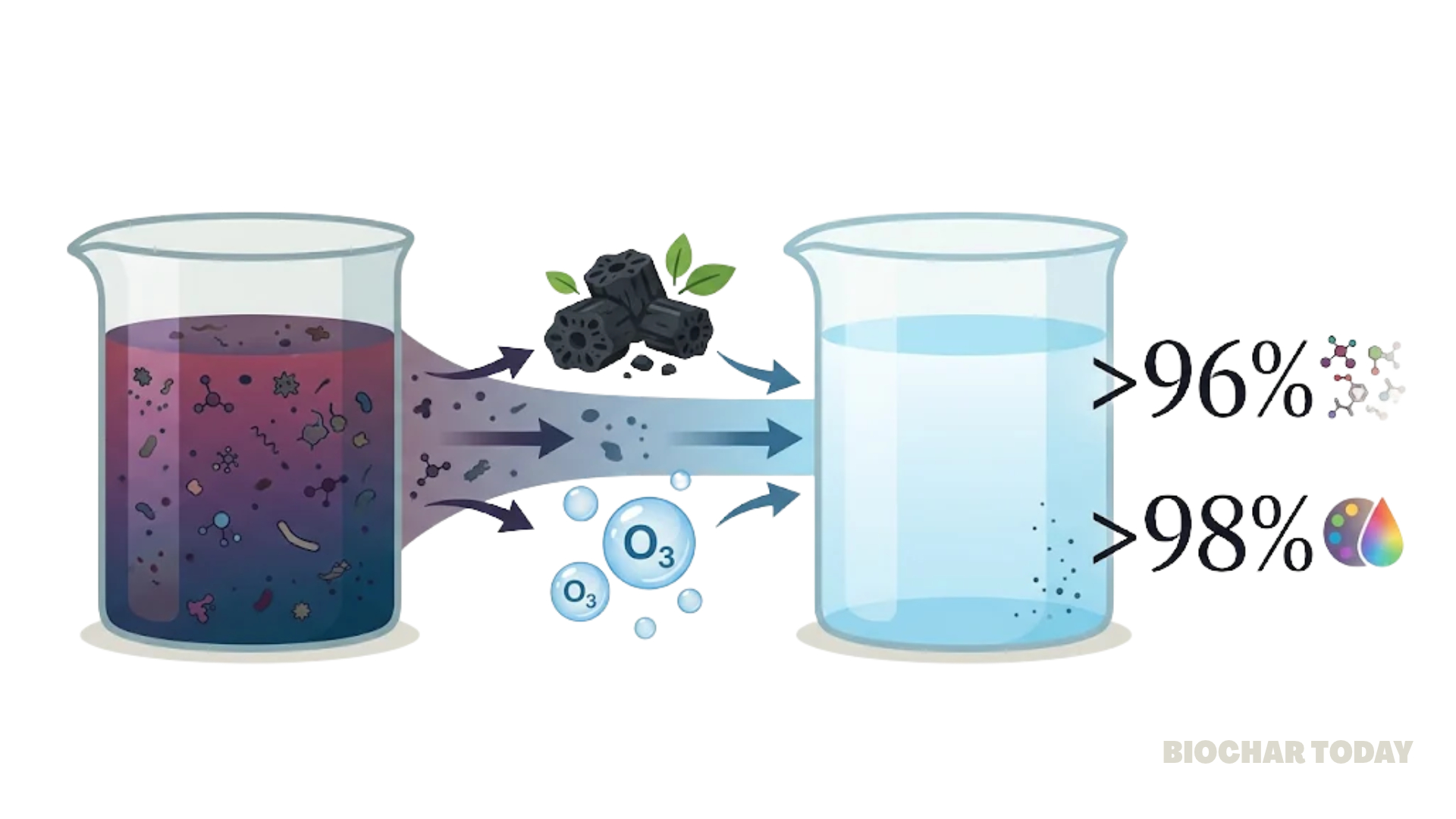
A recent study published in Scientific Reports by Vishal Kumar U. Shah, Pratima Gajbhiye, Anand Mohan Yadav, Jay B. Trivedi, Aparna Singh, Aditee Pandya, Xu Yong, Choon Kit Chan, Saurav Dixit, Anand Patel, and Md irfanul Haque Siddiqui presents a combined water treatment system that cleans heavily polluted textile factory wastewater. Textile dyeing and printing operations discharge massive volumes of wastewater containing toxic dyes, detergents, and synthetic chemicals that block sunlight and harm aquatic ecosystems. Roughly 10 to 15 percent of industrial dyes escape into waterways untreated, and conventional purification methods often struggle to remove these complex chemical mixtures at a reasonable cost. To solve this problem, the researchers turned leaves and stems from Canna indica, a fast-growing tropical plant, into porous activated charcoal and paired it with ozone gas treatment.
Unlike many laboratory studies that test simplified synthetic dye solutions, this research evaluated real wastewater collected directly from a commercial dyeing and printing facility in Gujarat, India. The raw factory effluent was alkaline and heavily contaminated with organic pollutants and dark pigments. By heating Canna indica plant waste and treating the resulting charcoal with either potassium hydroxide or sodium hydroxide, the team created a sponge-like material filled with microscopic honeycomb pores. Potassium hydroxide activation produced a much larger internal surface area of 785.23 square meters per gram, giving dye molecules abundant space to attach.
When tested in the factory wastewater, the combined adsorption and ozone process delivered exceptional purification results. Potassium hydroxide-activated biochar reduced chemical oxygen demand, a standard measure of organic water pollution, by 96.90 percent while eliminating up to 99.10 percent of color at a dose of 2.5 grams per liter. Sodium hydroxide-activated biochar performed nearly as well, achieving 95.48 percent organic pollutant reduction and up to 98.57 percent color removal. Statistical optimization confirmed that potassium-treated biochar reached a maximum pollutant-holding capacity of 357.14 milligrams per gram, outperforming the sodium-treated version at 333.33 milligrams per gram.
Detailed chemical analysis showed that water acidity was the single most important factor controlling treatment success, followed by charcoal dosage, contact time, and ozone flow rate. Both biochars worked best under slightly alkaline conditions between pHpH is a measure of how acidic or alkaline a substance is. A pH of 7 is neutral, while lower pH values indicate acidity and higher values indicate alkalinity. Biochars are normally alkaline and can influence soil pH, often increasing it, which can be beneficial More 7 and 9, where negative electrical charges on the charcoal surface strongly attracted positively charged dye molecules. Because real textile effluent naturally has a pH around 9.2, factories would need minimal chemical adjustments to run the system. Furthermore, kinetic modeling revealed that chemical bonding between oxygen-rich groups on the charcoal and the dye molecules drove the capture process. Adding ozone gas after filtration broke down stubborn chemical double bonds and oxidized remaining contaminants that charcoal alone could not trap.
Beyond high removal rates, the integrated design offers practical economic advantages for industrial wastewater plants. Using Canna indica agricultural waste eliminates raw material costs, while pairing adsorption with ozonation cuts required ozone gas flow rates from typical standalone levels of 150 to 200 milliliters per minute down to roughly 50 to 70 milliliters per minute. The researchers note that future work will focus on regenerating and reusing the spent biochar across multiple treatment cycles and evaluating full-scale operating costs. By transforming abundant plant waste into a high-capacity filter, this two-step process provides a cleaner, more efficient path toward meeting strict industrial water discharge standards.
Source: Shah, V. K. U., Gajbhiye, P., Yadav, A. M., Trivedi, J. B., Singh, A., Pandya, A., Yong, X., Chan, C. K., Dixit, S., Patel, A., & Siddiqui, M. I. H. (2026). Integrated adsorption-ozonation process using activated canna indica biochar for enhanced COD and color removal from real textile effluent. Scientific Reports.




Leave a Reply