
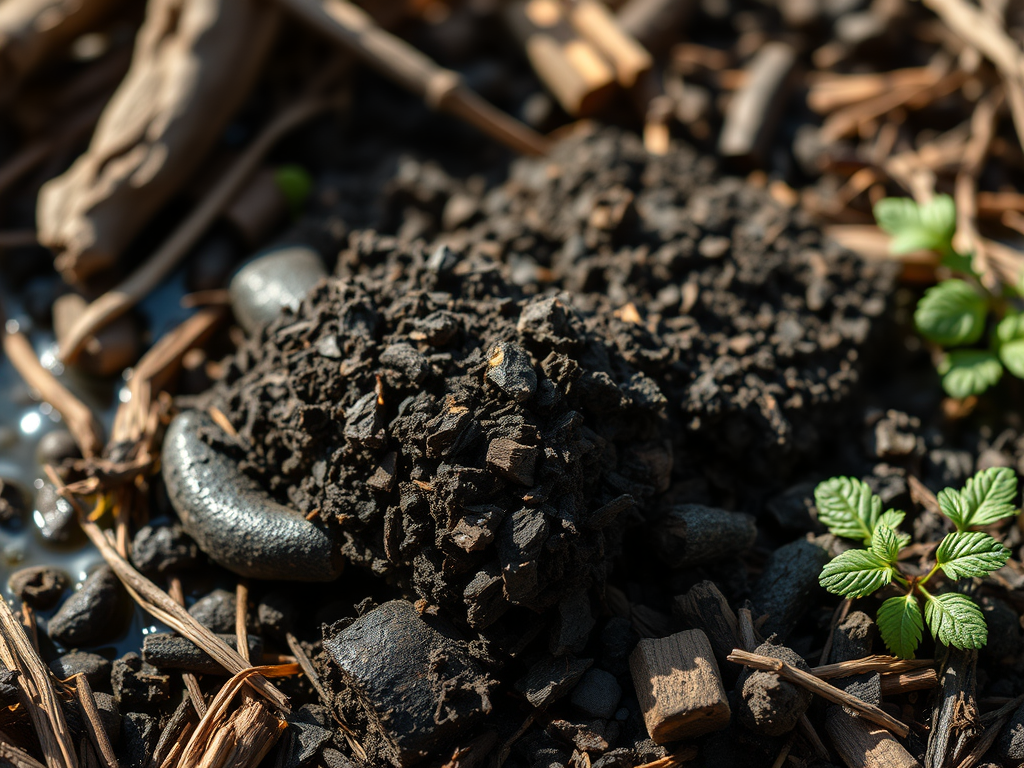
The valorization of forest biomassBiomass is a complex biological organic or non-organic solid product derived from living or recently living organism and available naturally. Various types of wastes such as animal manure, waste paper, sludge and many industrial wastes are also treated as biomass because like natural biomass these More and agricultural residues into high-value products like biocharBiochar is a carbon-rich material created from biomass decomposition in low-oxygen conditions. It has important applications in environmental remediation, soil improvement, agriculture, carbon sequestration, energy storage, and sustainable materials, promoting efficiency and reducing waste in various contexts while addressing climate change challenges. More aligns with circular economy principles and modern sustainability goals. A primary goal for biochar is its use as a soil amendmentA soil amendment is any material added to the soil to enhance its physical or chemical properties, improving its suitability for plant growth. Biochar is considered a soil amendment as it can improve soil structure, water retention, nutrient availability, and microbial activity. More, but in a recent study published in the journal Biomass, researchers Óscar González-Prieto, Luis Ortiz Torres, and María Esther Costas Costas explore a novel application: its use as a static floating material. Their research investigates the feasibility of biochar to create floating barriers for preventing water evaporation in open storage systems and managing slurry pits, which must be used for agriculture without introducing new contaminants.
The study created five types of biochar from various forest biomass sources: pine chips, pine bark, and pine pellets, as well as two types of acacia species. The biochars were produced using a simple double-chamber reactor with pyrolysisPyrolysis is a thermochemical process that converts waste biomass into bio-char, bio-oil, and pyro-gas. It offers significant advantages in waste valorization, turning low-value materials into economically valuable resources. Its versatility allows for tailored products based on operational conditions, presenting itself as a cost-effective and efficient More temperatures between 380 and 690∘C and residence times ranging from 60 to 120 minutes. Biochar production from low-moisture-content biomass through slow pyrolysis is considered a suitable route for producing a high yield of solid char, which is a carbon-rich material. The study’s most significant finding regarding composition was that all of the biochar materials exceeded a fixed carbon content of 50%. The highest fixed carbon content was observed in pine bark biochar at 69.5%, followed by pine pellets at 67.4% and pine chips at 63.4%. These fixed carbon levels were achieved using moderate temperatures and times, indicating an efficient conversion process.
To test the suitability of biochar as a floating material, the study conducted a floatability test over a period of 27 days (648 h) in distilled water. The results showed a clear distinction between the different biochar types. Pine bark biochar and ground pine chip biochar exhibited superior static floatage, with minimal settling throughout the entire test period. The ground pine chip biochar, in particular, was found to be unsinkable even under agitated, dynamic conditions, behaving similarly to the pine bark biochar. In stark contrast, the pine pellets, despite their high fixed carbon content, demonstrated the lowest floatability, with a large proportion settling to the bottom of the cylinder instantly.
The research concluded that bulk density and particle size are the most significant factors influencing biochar’s floatability. The superior performance of pine bark biochar and wood chip biochar is directly linked to the use of a low-density original biomass. The high bulk density of pine pellets, due to the densification process, contributed to their low floatability. Additionally, the study confirmed that particle size reduction significantly improves floatability. Grinding the pine chip biochar into a powder format resulted in an unsinkable material that maintained its floating state even when the water was agitated, whereas the original, larger particles showed minimal settling. These findings suggest that biochar produced from low-density biomass like bark and wood chips is suitable for use in water management systems.
SOURCE: González-Prieto, O., Torres, L. O., & Costas, M. E. C. (2025). Valorization of Forest Biomass Through Biochar for Static Floating Applications in Agricultural Uses. Biomass, 5(3), 44.



Leave a Reply