
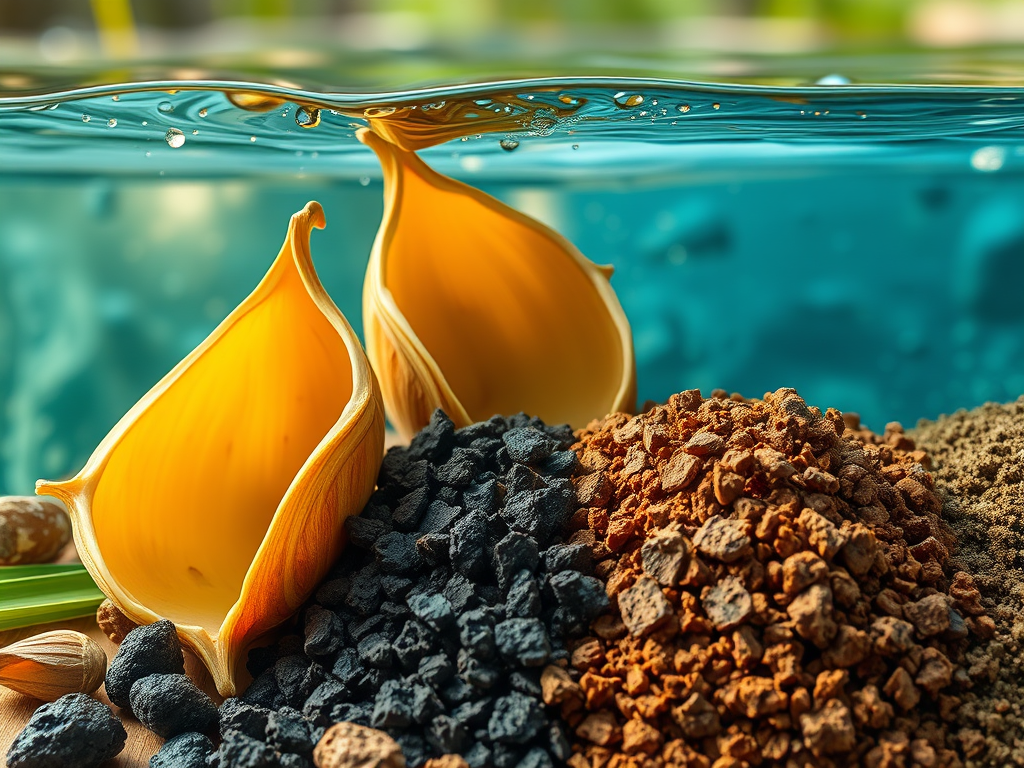
In a promising development for environmental cleanup, a new study reveals that a specialized biocharBiochar is a carbon-rich material created from biomass decomposition in low-oxygen conditions. It has important applications in environmental remediation, soil improvement, agriculture, carbon sequestration, energy storage, and sustainable materials, promoting efficiency and reducing waste in various contexts while addressing climate change challenges. More produced from agricultural waste can effectively remove zinc from contaminated water. Researchers Yacouba Zoungranan, Djè Daniel Yannick, Assouma Dagri Cyrille, Ouattara Daouda, and Ekou Lynda, in a study published in the Earthline Journal of Chemical Sciences, synthesized a graphene-like biochar (BGp) and its oxidized counterpart (BOGp) from oil palm seed shells. Their research highlights a sustainable and value-added use for agricultural byproducts. The findings show that BOGp achieved a remarkable 98% zinc removal efficiency, positioning it as an effective and eco-friendly adsorbent for water treatment.
The contamination of water by trace metals like zinc poses a serious threat to human health and aquatic ecosystems. While zinc is an essential micronutrient at low concentrations, it becomes toxic at elevated levels, and the World Health Organization has set a maximum permissible concentration of 5 mg/L in drinking water. Conventional water treatment methods often have drawbacks, such as high operational costs or the generation of sludge. Adsorption, particularly with low-cost materials like biochar, has emerged as a promising alternative. Graphene-like biochar is particularly effective due to its high specific surface area and microporous structure, which enhance its ability to capture contaminants.
To create the adsorbents, the researchers started with oil palm seed shells. They synthesized the graphene-like biochar (BGp) through a modified graphitization-activation process. A portion of the BGp was then partially oxidized to create oxidized biochar (BOGp). Characterization tests confirmed that the oxidation process significantly altered the material. BOGp had a higher BET specific surface area (340.32 m2/g) compared to BGp (228.20 m2/g), and its point of zero charge (pHpzc) was 4, making its surface charges negative at lower pHpH is a measure of how acidic or alkaline a substance is. A pH of 7 is neutral, while lower pH values indicate acidity and higher values indicate alkalinity. Biochars are normally alkaline and can influence soil pH, often increasing it, which can be beneficial More values than BGp, which had a pHpzc of 7.3. These changes were confirmed by X-ray diffraction and Fourier transform infrared spectroscopy, which showed peaks characteristic of oxidized graphitic carbon.
The materials were then tested for their ability to remove zinc from an aqueous solution. Using just 0.1 g of adsorbent in 50 mL of a 1 mg/L zinc sulfate solution, BGp removed 73.4% of the zinc, while BOGp achieved a higher removal rate of 90.11%. The study also showed that removal efficiency increased with the amount of adsorbent used, rising to a peak of 92.64% for BGp and 97.85% for BOGp with a mass of 600 mg. A gradual increase in removal efficiency was observed with an increase in initial zinc concentration, reaching 96% for BGp and 98% for BOGp. This is attributed to the increased driving force from the concentration gradient, which facilitates the passive transport of zinc ions toward the adsorbent surface.
Kinetic analysis revealed that the adsorption process followed pseudo-second-order kinetics, indicating that chemical interactions, rather than physical ones, were the primary mechanism for zinc adsorption. Furthermore, the Freundlich and Temkin isotherm models provided the best fit for the experimental data. The Temkin model showed that zinc chemisorption was an exothermic process for both adsorbents. BOGp demonstrated a stronger affinity for zinc than BGp, likely due to favorable chemical interactions resulting from its oxidative treatment.
This research successfully demonstrates the potential of turning a common agricultural waste product into a valuable tool for water purification. By leveraging the unique properties of graphene-like biochar and enhancing them through oxidation, the study offers a sustainable and highly effective solution for removing hazardous trace metals from water.
SOURCE: Zoungranan, Y., Yannick, D. D., Cyrille, A. D., Daouda, O., & Lynda, E. (2025). Removal of zinc from water using graphene-like biochar produced from palm seed shells. Earthline Journal of Chemical Sciences, 12(3), 343-357.



Leave a Reply