
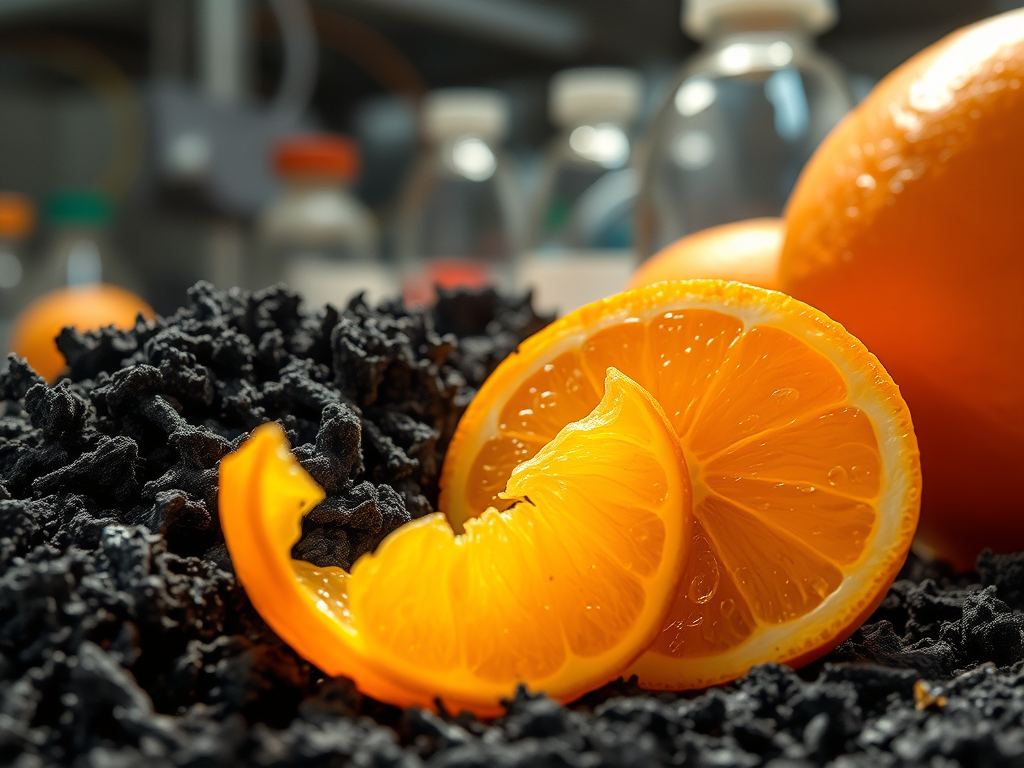
In a recent study published in the journal Results in Engineering, researchers Aairah Tanveer, Snigdhendubala Pradhan, Yongfeng Tong, Mujaheed Pasha, Akshath Raghu Shetty, Abdulaziz Al Emadi, Tareq Al-Ansari, and Gordon McKay explored a new way to combat wastewater pollution by turning orange peel waste into a powerful adsorbent. The research focused on converting orange peel biomassBiomass is a complex biological organic or non-organic solid product derived from living or recently living organism and available naturally. Various types of wastes such as animal manure, waste paper, sludge and many industrial wastes are also treated as biomass because like natural biomass these More into micro- and nanobiochar using a process called slow pyrolysisPyrolysis is a thermochemical process that converts waste biomass into bio-char, bio-oil, and pyro-gas. It offers significant advantages in waste valorization, turning low-value materials into economically valuable resources. Its versatility allows for tailored products based on operational conditions, presenting itself as a cost-effective and efficient More. This method involves heating the organic waste in the absence of oxygen to create a carbon-rich material. This innovative approach offers a promising, eco-friendly solution for managing the significant amount of food waste generated annually and promoting a circular economy.
The study examined the effect of pyrolysis temperature and particle size on the biochar’s properties. Orange peels were subjected to pyrolysis at three different temperatures: 500°C, 600°C, and 700°C. While increasing the temperature from 500°C to 700°C reduced the biocharBiochar is a carbon-rich material created from biomass decomposition in low-oxygen conditions. It has important applications in environmental remediation, soil improvement, agriculture, carbon sequestration, energy storage, and sustainable materials, promoting efficiency and reducing waste in various contexts while addressing climate change challenges. More yield from 28% to 13.5%, it significantly enhanced the material’s characteristics, making it a better adsorbent. The researchers found that higher temperatures led to increased carbonization and the development of a more porous structure, which is crucial for capturing pollutants.
A key finding was the superior performance of nanobiochar over microbiochar. The nanobiochar was created by further processing the microbiochar through a high-energy ball milling technique. This size reduction dramatically increased the material’s surface area. For instance, nanobiochar produced at 700°C had a BET surface area of 295.7 m2/g, which is notably higher than the typical range of 50−150 m2/g for most orange peel-derived biochars. A larger surface area provides more sites for pollutants to attach, thereby increasing the adsorption capacity.
In addition to a higher surface area, the pyrolysis process also changed the biochar’s surface chemistry. As the temperature increased, the biochar’s pHpH is a measure of how acidic or alkaline a substance is. A pH of 7 is neutral, while lower pH values indicate acidity and higher values indicate alkalinity. Biochars are normally alkaline and can influence soil pH, often increasing it, which can be beneficial More became more alkaline and its zeta potential became more negative. The raw orange peel biomass was acidic with a pH of 4.21±0.2, but the biochar became alkaline, with pH values ranging from 8.03 to 9.05 as the temperature increased from 500°C to 700°C. The zeta potential, which measures the surface charge, became increasingly negative, reaching −44.03±0.5 mV for the nanobiochar produced at 700°C. This highly negative charge is advantageous for attracting and adsorbing positively charged pollutants, such as heavy metal ions and dyes, from wastewater. The study also revealed that essential minerals like calcium, potassium, magnesium, and phosphorus became more concentrated in the biochar, particularly in the nanobiochar produced at higher temperatures.
To test its practical application, the nanobiochar produced at 700°C was used in small-scale adsorption tests to remove lithium, methylene blue, and Eriochrome Black T from water. The results were impressive: the nanobiochar effectively removed 58.5±3.7 mg/g of lithium, 45.3±2.4 mg/g of methylene blue, and 46.1±3.5 mg/g of Eriochrome Black T. These adsorption capacities are higher than those reported in other studies, which the researchers attribute to the nanobiochar’s superior properties, including its high surface area, pore volume, and negative surface charge.
While nanobiochar offers superior performance, the study also addressed the economic and environmental trade-offs. The production of nanobiochar requires additional energy for ball milling, which increases both cost and carbon footprint compared to producing microbiochar. However, its higher efficiency means less material is needed to achieve the same results, potentially offsetting the higher production costs and environmental impact. The study concludes that orange peel-derived nanobiochar is a promising, high-performance adsorbent for wastewater treatment, but more research is needed, including comprehensive pilot-scale and field studies, to validate its use in real-world scenarios.
Source: Tanveer, A., Pradhan, S., Tong, Y., Pasha, M., Shetty, A. R., Al Emadi, A., Al-Ansari, T., & McKay, G. (2025). Valorization of orange peel via slow pyrolysis: Effect of particle size on biochar characteristics for wastewater remediation. Results in Engineering.

Leave a Reply