
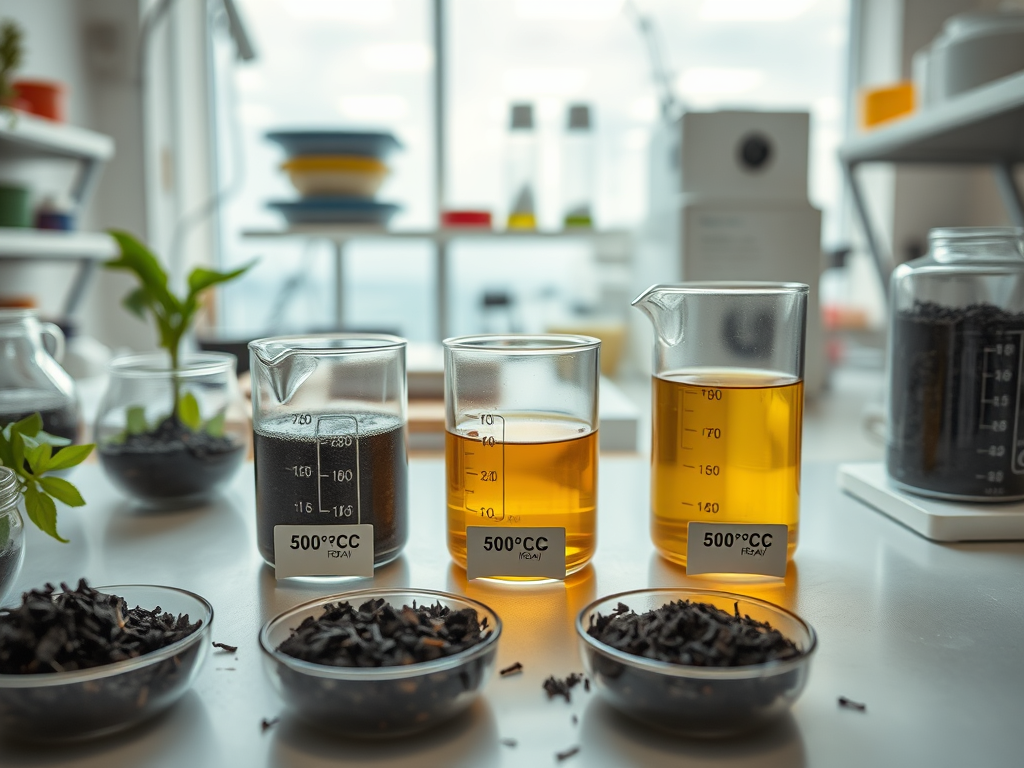
In an article published in RSC Advances, Stuti Jha, Rama Gaur, Syed Shahabuddin, and their team explore a promising method for tackling water pollution by using biocharBiochar is a carbon-rich material created from biomass decomposition in low-oxygen conditions. It has important applications in environmental remediation, soil improvement, agriculture, carbon sequestration, energy storage, and sustainable materials, promoting efficiency and reducing waste in various contexts while addressing climate change challenges. More derived from tea waste. Water pollution is a severe global crisis, and developing simple, effective, and economical solutions is a major priority. The authors highlight adsorption as a highly effective method for wastewater treatment, and in their study, they focus on using biochar from a widely available biowaste—tea waste—for the simultaneous removal of multiple organic pollutants. This is an area that, according to the authors, has lacked sufficient investigation, particularly regarding the simultaneous adsorption of diverse categories of pollutants.
The researchers prepared biochar from tea waste at three different pyrolysisPyrolysis is a thermochemical process that converts waste biomass into bio-char, bio-oil, and pyro-gas. It offers significant advantages in waste valorization, turning low-value materials into economically valuable resources. Its versatility allows for tailored products based on operational conditions, presenting itself as a cost-effective and efficient More temperatures: 300°C (TW3), 500°C (TW5), and 700°C (TW7). They found that the properties of the biochar, such as its surface area, pore size, and surface charge, were significantly influenced by the pyrolysis temperature. For instance, TW5, prepared at 500°C, was identified as the most efficient adsorbent for simultaneous pollutant removal, achieving an overall removal percentage of 53.45% in 60 minutes, compared to 49.65% for TW3 and 47.48% for TW7. The study focused on removing a mixture of pollutants including a dye (malachite green), an agrochemical (chlorpyrifos), and an aromatic compound (4-nitroaniline).
The adsorption process was optimized by examining various parameters, including contact time, pHpH is a measure of how acidic or alkaline a substance is. A pH of 7 is neutral, while lower pH values indicate acidity and higher values indicate alkalinity. Biochars are normally alkaline and can influence soil pH, often increasing it, which can be beneficial More, dosage, and temperature. Under optimized conditions—a pH of 2, a 60-minute contact time, and an adsorbent dosage of 5 mg ml−1—the tea waste biochar (TW5) achieved a maximum overall removal efficiency of 82.66%. This high efficiency was attributed to various mechanisms, including π-π interaction, hydrophobic interactions, hydrogen bonding, and pore-filling, all of which are influenced by the charge and functional groups on the biochar’s surface.
A key aspect of this research was the use of machine learning (ML) models to predict the pollutant removal efficiency. The study compared two advanced ML models—Recurrent Neural Network (RNN) and CatBoost—both with and without Bayesian optimization to fine-tune their hyperparameters. Without optimization, CatBoost outperformed RNN in training and cross-validation, with a training R2 of 0.99 and a cross-validation R2 of 0.91. However, after applying Bayesian optimization, the RNN model demonstrated superior generalization ability on new, unseen data. In the ten-fold cross-validation phase with optimization, RNN achieved an R2 value of 0.960, which was 5.10% higher than CatBoost’s R2 value of 0.911. Additionally, RNN’s Mean Absolute Error (MAE) and Root Mean Square Error (RMSE) values in the cross-validation phase were 22.88% and 31.69% lower than CatBoost’s, respectively, confirming its greater reliability for prediction on unknown data.
This study’s findings confirm that tea waste-derived biochar is a viable and cost-effective adsorbent for complex wastewater treatment. The integration of advanced machine learning techniques, particularly the RNN model with Bayesian optimization, provides a powerful tool for accurately predicting the performance of biochar filtration systems. The authors also demonstrated the fabrication of a portable column filtration device for large-scale applications, which showed an impressive removal efficiency of up to 87.11% for 400 ml of the pollutant mixture. This dual approach of experimental validation and ML-driven prediction offers a promising and sustainable path for developing real-time, scalable solutions for water pollution.
Source: Jha, S., Gaur, R., Shahabuddin, S., Vakhariab, V., & Mohsin, M. E. A. (2025). Integration of RNN and CatBoost models in a tea-waste biochar filtration system for toxic organic pollutant removal efficiency prediction. RSC Advances, 15, 27260-27278.


![Eucalyptus Wood Waste-Derived Biochar Achieves a Ninety-Eight Percent Removal Efficiency for Benzo[ghi]perylene in Vehicle-Wash Wastewater](https://biochartoday.com/wp-content/uploads/2026/10/SCIENCE-BLOGS-2026-2026-10-19T160523.703.jpg)

Leave a Reply