
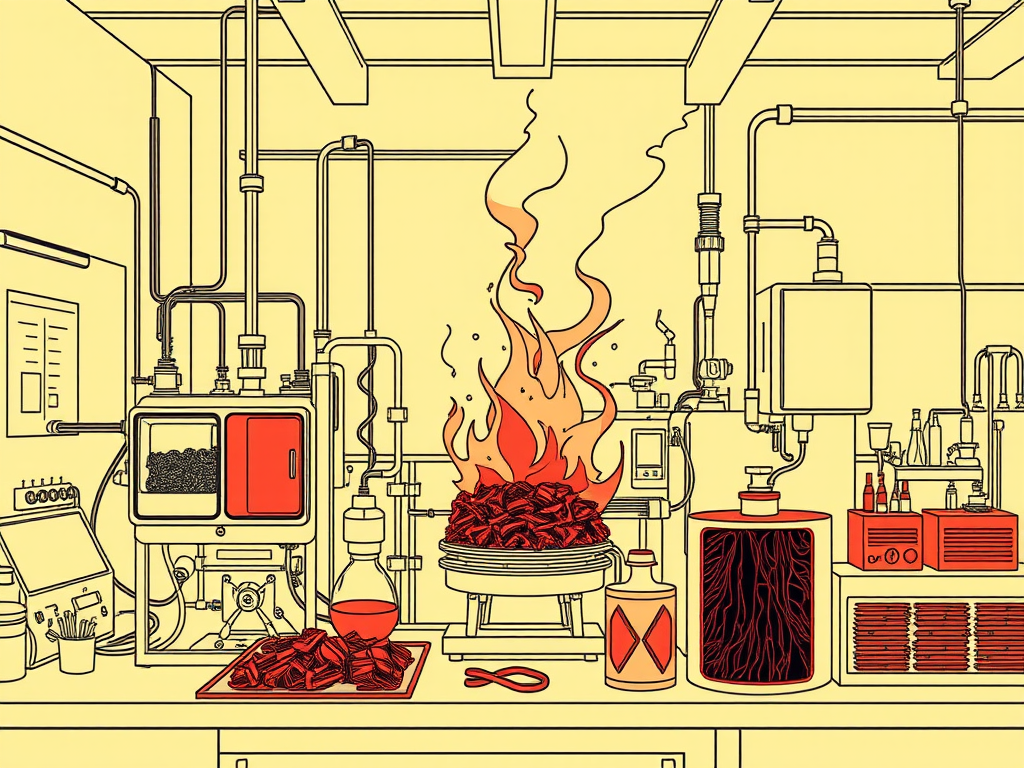
The escalating demand for fuel oil and dwindling petroleum reserves necessitate the exploration of new and renewable energy sources. BiomassBiomass is a complex biological organic or non-organic solid product derived from living or recently living organism and available naturally. Various types of wastes such as animal manure, waste paper, sludge and many industrial wastes are also treated as biomass because like natural biomass these More, an abundant and environmentally friendly alternative, holds significant promise. A study published in Jurnal Ilmiah JURUTERA by Viviany Rouli Pasaribu, Nasruddin A Abdullah, and Syamsul Bahri Widodo delves into the thermal characteristics of bio-oil and biocharBiochar is a carbon-rich material created from biomass decomposition in low-oxygen conditions. It has important applications in environmental remediation, soil improvement, agriculture, carbon sequestration, energy storage, and sustainable materials, promoting efficiency and reducing waste in various contexts while addressing climate change challenges. More derived from the pyrolysisPyrolysis is a thermochemical process that converts waste biomass into bio-char, bio-oil, and pyro-gas. It offers significant advantages in waste valorization, turning low-value materials into economically valuable resources. Its versatility allows for tailored products based on operational conditions, presenting itself as a cost-effective and efficient More of red Calliandra wood. This research aims to optimize the pyrolysis process to yield high-quality renewable energy products.
Pyrolysis, a thermochemical conversion process carried out in the absence of oxygen, transforms biomass into bio-oil and biochar. Red Calliandra wood (Calliandra calothyrsus) was selected as the feedstockFeedstock refers to the raw organic material used to produce biochar. This can include a wide range of materials, such as wood chips, agricultural residues, and animal manure. More for this study due to its high energy content, ranging from 4600 to 7200 kcal/kg after pyrolysis, and its abundant availability in Indonesia. The pyrolysis experiments were conducted at varying temperatures of 300circC, 400circC, and 500circC, each for a duration of 60 minutes.
The findings indicate that an optimal pyrolysis temperature of 500circC yields the best results. At this temperature, the biochar produced exhibited the highest calorific value of 7145.17c˜al/g. The bio-oil obtained at 500circC also showed a significant calorific value of 3276.21c˜al/g. The study observed a direct correlation between increasing pyrolysis temperature and the calorific values of both biochar and bio-oil, suggesting a more optimal conversion process at higher temperatures.
Thermal analysis, utilizing techniques like Differential Scanning Calorimetry (DSC) and Simultaneous Thermogravimetric Analysis (TGA)-Differential Thermal Analysis (DTA), provided crucial insights into the decomposition of red Calliandra. Significant thermal decomposition activity was noted at approximately 283circC, indicating a peak in heat flow. This temperature marks the point where the main organic materials in the wood begin to break down, releasing heat. As the temperature further increased from 300circC to 500circC, a substantial weight loss was observed in the TGA graph, signifying further decomposition of more complex carbon structures. The DTA graph showed a more significant heat release at higher temperatures, pointing to further oxidation or pyrolysis.
The quality of the biochar produced was also assessed through proximate analysis, which included determining moisture content, ashAsh is the non-combustible inorganic residue that remains after organic matter, like wood or biomass, is completely burned. It consists mainly of minerals and is different from biochar, which is produced through incomplete combustion. Ash Ash is the residue that remains after the complete More content, volatile matterVolatile matter refers to the organic compounds that are released as gases during the pyrolysis process. These compounds can include methane, hydrogen, and carbon monoxide, which can be captured and used as fuel or further processed into other valuable products. More, and fixed carbon content. The research showed that higher pyrolysis temperatures led to better quality biochar. Specifically, the moisture content decreased with increasing pyrolysis temperature, with the lowest value of 6.87% achieved at 500circC. Similarly, the ash content also decreased as the temperature rose, reaching a minimum of 5.65% at 500circC. Lower volatile matter content was also observed at higher temperatures, with 10.12 at 500circC being the lowest, indicating a better quality briquette. Consequently, the fixed carbon content, which directly influences calorific value and burning time, was highest at 77.36 at 500circC.
These thermal characteristics collectively demonstrate that red Calliandra wood is a promising raw material for renewable energy production. The study contributes valuable data to the field of biomass-based renewable energy and opens avenues for further research in optimizing the pyrolysis process for enhanced energy conversion.
Source: Pasaribu, V. R., Abdullah, N. A., & Widodo, S. B. (2025). Thermal Characteristics Analysis of Bio-Oil and Biochar from Pyrolysis Process Using Red Calliandra Feedstock. Jurnal Ilmiah JURUTERA, 12(01), 48-56.



Leave a Reply