
Key Takeaways
- Spent tea leaves from beverage factories can be converted into high-performing magnetic biocharBiochar is a carbon-rich material created from biomass decomposition in low-oxygen conditions. It has important applications in environmental remediation, soil improvement, agriculture, carbon sequestration, energy storage, and sustainable materials, promoting efficiency and reducing waste in various contexts while addressing climate change challenges. More.
- The synthesized biochar achieves a hexavalent chromium removal efficiency of 96.90 percent in laboratory solutions and 96.55 percent in real agricultural water samples.
- Dual modification using nitrogen and iron expands the material surface area and introduces active chemical sites.
- The primary remediation mechanism combines initial surface attraction, chemical reduction of toxic chromium, and stable surface binding.
- The material retains an 84.49 percent removal efficiency after undergoing five consecutive reuse cycles.
The rapid global expansion of the tea and new-style tea beverage industries has created an environmental waste management issue. Enormous quantities of spent tea leaves are discarded annually from beverage extraction factories, instant tea manufacturing plants, and household consumption. When left untreated, this organic agricultural waste contributes to secondary environmental pollution and represents a loss of valuable carbon resources. Concurrently, industrial discharge containing hexavalent chromium poses severe ecological and human health hazards due to the metal’s high mobility, toxicity, and persistence in aquatic environments. While biochar represents a cost-effective and renewable adsorbent for heavy metal remediation, pristine biomassBiomass is a complex biological organic or non-organic solid product derived from living or recently living organism and available naturally. Various types of wastes such as animal manure, waste paper, sludge and many industrial wastes are also treated as biomass because like natural biomass these More biochars often lack sufficient porous networks and chemical functional groups required for high-capacity contaminant uptake. Conventional high-temperature pyrolysisPyrolysis is a thermochemical process that converts waste biomass into bio-char, bio-oil, and pyro-gas. It offers significant advantages in waste valorization, turning low-value materials into economically valuable resources. Its versatility allows for tailored products based on operational conditions, presenting itself as a cost-effective and efficient More also demands energy-intensive feedstockFeedstock refers to the raw organic material used to produce biochar. This can include a wide range of materials, such as wood chips, agricultural residues, and animal manure. More pre-drying. Developing energy-efficient processing pathways that convert wet agricultural residues into engineered adsorbents with high target pollutant affinities remains a priority for sustainable wastewater treatment.
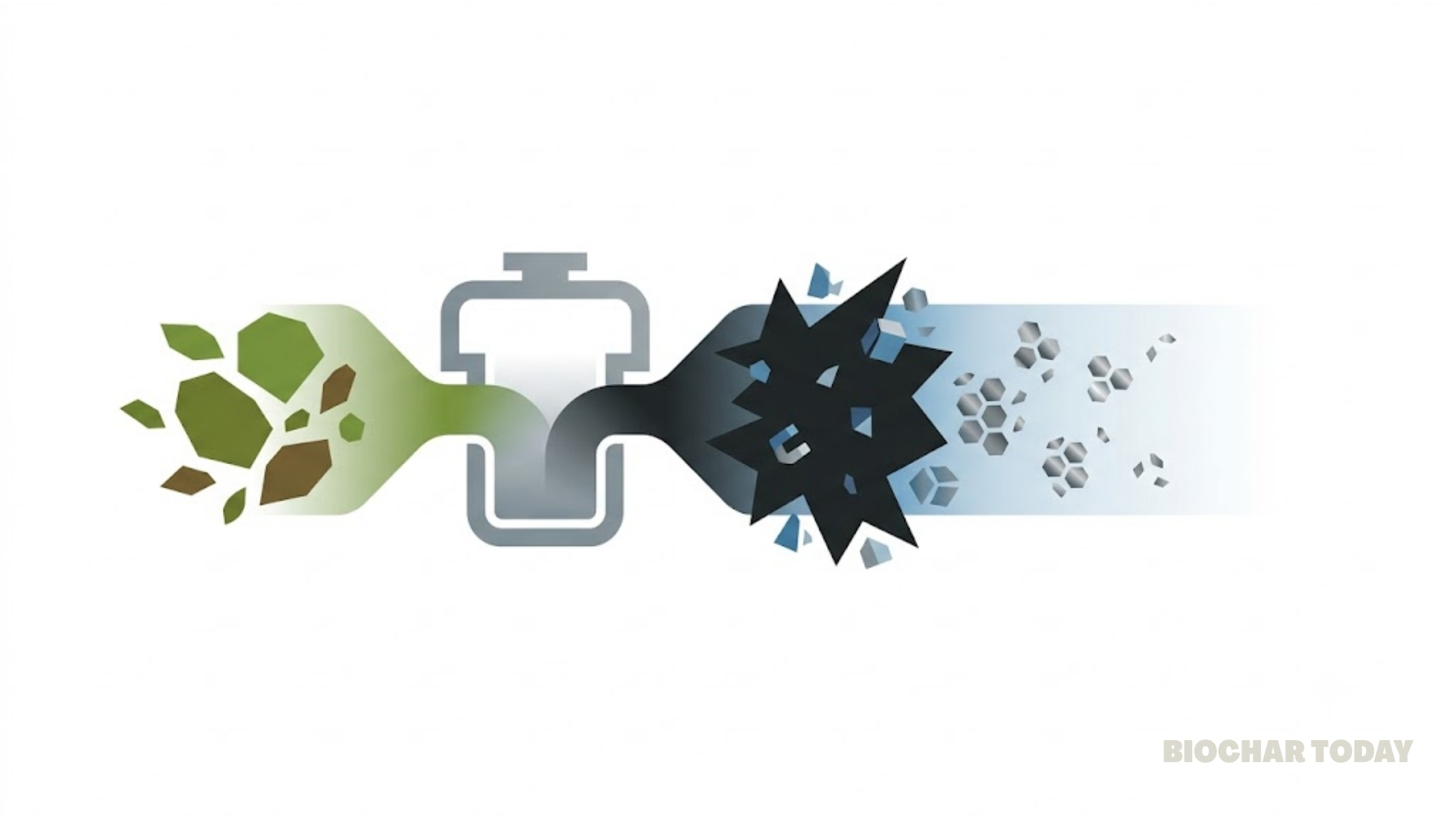
To address these challenges, researchers utilized a one-step hydrothermal carbonization method to convert discarded tea residues into a functionalized nitrogen and iron co-doped magnetic biochar. Spent green and black tea leaves collected from a commercial beverage facility served as the raw carbon precursor. The wet tea powder was combined with urea and ferric chloride in an aqueous solution, followed by hydrothermal processing in a sealed vessel. Using response surface methodology based on a central composite design, the team systematic optimized the preparation conditions, determining that a hydrothermal temperature of 200 degrees Celsius and a residence timeResidence time refers to the duration that the biomass is heated during the pyrolysis process. The residence time can influence the properties of the biochar produced. More of 4 hours yielded the optimal physical structure and adsorption performance. The simultaneous inclusion of urea and ferric chloride promoted pore development and surface functionalization. Nitrogen atoms incorporated into the carbon framework alongside iron oxides, including magnetite and hematite, anchored directly to the biochar matrix. This one-step synthesis eliminated the need for raw material pre-drying while conferring magnetic properties that allow for convenient magnetic separation from treated water.
Analytical characterization confirmed that the nitrogen and iron modification enlarged the specific surface area of the biochar from 7.185 square meters per gram in the pristine form to 21.335 square meters per gram in the co-doped magnetic composite. Scanning electron microscopy and energy-dispersive X-ray spectroscopy revealed a porous, rough architecture with uniformly distributed nitrogen and iron elements. In batch adsorption experiments, the optimized biochar achieved a maximum theoretical monolayer adsorption capacity of 63.03 milligrams per gram for hexavalent chromium under optimal acidic conditions. Experimental data closely matched the Langmuir isotherm and pseudo-second-order kinetic models, indicating that monolayer chemisorption governs the overall uptake process. Reusability testing demonstrated that the biochar maintained an 84.49 percent removal efficiency after five sequential adsorption-desorption cycles, with minimal iron leachingLeaching is the process where nutrients are dissolved and carried away from the soil by water. This can lead to nutrient depletion and environmental pollution. Biochar can help reduce leaching by improving nutrient retention in the soil. More observed across all runs. When applied to real farmland surface water samples, the material reduced hexavalent chromium levels from 0.0454 milligrams per liter to 0.0016 milligrams per liter, achieving a 96.55 percent removal efficiency.
Mechanistic evaluations utilizing X-ray photoelectron spectroscopy, Fourier-transform infrared spectroscopy, zeta potential measurement, and density functional theory calculations established a three-step removal pathway. Under acidic solution conditions below the material point of zero charge, protonated surface groups generate positive charges that drive the rapid electrostatic attraction of anionic hexavalent chromium species. Once accumulated on the surface, hexavalent chromium undergoes electron transfer facilitated by iron and nitrogen sites, reducing the toxic metal into less toxic trivalent chromium. Finally, the resulting trivalent chromium coordinates with surface oxygen and nitrogen functional groups through stable complexation. Density functional theory calculations confirmed a strong adsorption energy of negative 3.409 electron volts at the active iron and nitrogen sites, confirming that chemical binding dominates the process. This single-step hydrothermal conversion provides a sustainable strategy for upcycling beverage industry residues into high-value environmental remediation materials.
Source: Guo, S., Wang, P., Zhu, Y., Zhou, Y., Li, M., Lin, X., Xu, P., & Sun, M. (2026). One-step synthesis of magnetic tea waste biochar for efficient hexavalent chromium adsorption: Process optimization, characterization, and adsorption mechanism. Journal of Saudi Chemical Society, 30, Article 101145.


![Eucalyptus Wood Waste-Derived Biochar Achieves a Ninety-Eight Percent Removal Efficiency for Benzo[ghi]perylene in Vehicle-Wash Wastewater](https://biochartoday.com/wp-content/uploads/2026/10/SCIENCE-BLOGS-2026-2026-10-19T160523.703.jpg)

Leave a Reply