
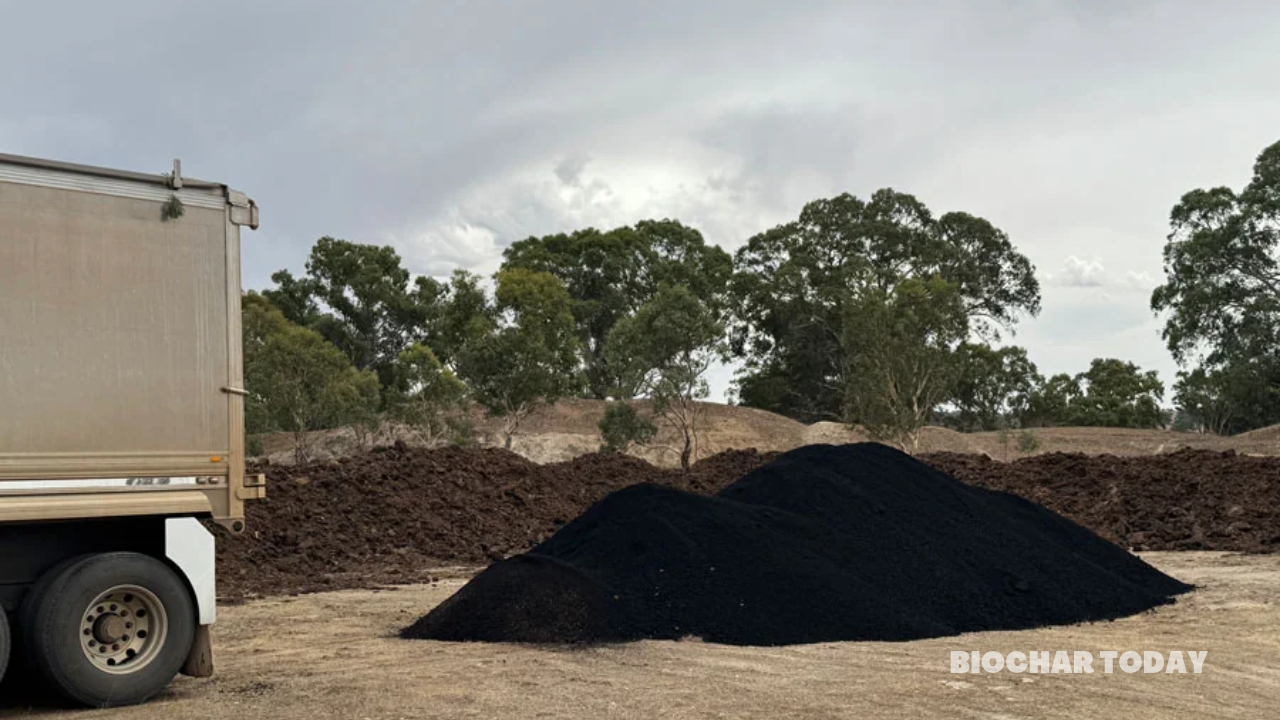
South Australian Nuffield Scholar Paul McGorman has released a comprehensive report examining how agricultural enterprises can integrate biocharBiochar is a carbon-rich material created from biomass decomposition in low-oxygen conditions. It has important applications in environmental remediation, soil improvement, agriculture, carbon sequestration, energy storage, and sustainable materials, promoting efficiency and reducing waste in various contexts while addressing climate change challenges. More production to establish multiple income streams. The research outlines that modern pyrolysisPyrolysis is a thermochemical process that converts waste biomass into bio-char, bio-oil, and pyro-gas. It offers significant advantages in waste valorization, turning low-value materials into economically valuable resources. Its versatility allows for tailored products based on operational conditions, presenting itself as a cost-effective and efficient More systems, which thermally degrade biomassBiomass is a complex biological organic or non-organic solid product derived from living or recently living organism and available naturally. Various types of wastes such as animal manure, waste paper, sludge and many industrial wastes are also treated as biomass because like natural biomass these More under low-oxygen conditions, offer viable commercial pathways for farm operations in Australia. However, the evaluation stresses that realizing these economic gains requires careful operational planning and risk management.
A primary challenge identified in the research is navigating the economic and logistical complexities associated with implementing pyrolysis technology on a farm scale. Producers face significant capital expenditure and must secure consistent, high-volume biomass feedstocks while managing variable energy markets. Additionally, integrating complex processing systems into established broadacre or mixed-farming operations demands technical expertise and thorough regulatory compliance.
To address these hurdles, the scholar investigated innovative applications of pyrolysis reactors that go beyond basic soil amelioration. The solution involves leveraging modern reactor technologies to simultaneously capture multiple value outputs, specifically carbon sequestration credits, processed thermal or electrical energy, and high-grade soil enhancement products. By diversifying output channels, farm businesses can offset initial capital costs and stabilize operational returns.
The findings indicate that adopting these integrated systems can successfully generate up to three distinct revenue streams for agricultural producers. Ultimately, the report provides a clear framework for Australian growers to assess the commercial feasibility of biochar production, helping farm managers transform agricultural residues into valuable commercial commodities while improving long-term soil health.


Leave a Reply