
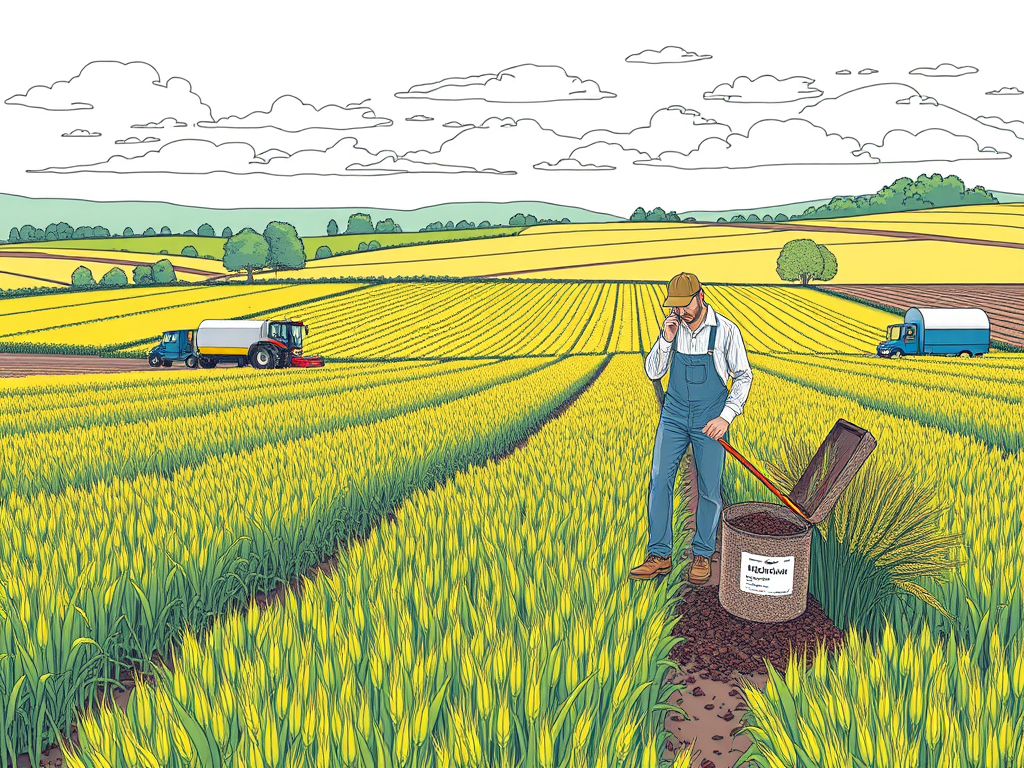
Despite extensive global research on biochar’s agricultural effects, key questions remain regarding its impact on crop yield, nitrogen (N) turnover, and N use efficiency, especially in soils with high nutrient content and fertility. There is also a need for more comprehensive analysis of biocharBiochar is a carbon-rich material created from biomass decomposition in low-oxygen conditions. It has important applications in environmental remediation, soil improvement, agriculture, carbon sequestration, energy storage, and sustainable materials, promoting efficiency and reducing waste in various contexts while addressing climate change challenges. More combined with organic and mineral fertilizers, with most studies conducted under controlled laboratory conditions or short-term field trials. A multi-year field experiment conducted in southern Germany aimed to bridge this research gap, investigating the effects of biochar mixed with digestate on crop yield, N use efficiency, and nitrate leachingLeaching is the process where nutrients are dissolved and carried away from the soil by water. This can lead to nutrient depletion and environmental pollution. Biochar can help reduce leaching by improving nutrient retention in the soil. More in a practical farm setting.
After three years, the results show that adding medium quantities of biochar, either purely or in combination with digestate, to a site with high soil fertility had no statistically significant effect on crop yield, N use efficiency, or nitrate leaching. High dry matter yields of silage maize (max. 24.2 t/ha), grain yields of winter wheat (max. 10.5 t/ha), and winter barley (max. 8.1 t/ha) were observed, primarily with organic-mineral fertilization.
The sole application of biochar had no significant effect on crop yield or N uptake compared to the control treatment. When digestate was mixed with biochar without additional mineral N fertilization, a noticeable but not statistically significant reduction in N uptake and N use efficiency was observed. Nitrogen fertilization significantly increased nitrate stocks in the 1-3 m soil layer, but biochar itself had no significant effect on these stocks. Even in treatments with intensive N fertilization, the nitrate concentration in the leachate remained at 23.0 mg/L, which is below the drinking water limit.
For silage maize in 2022, the unfertilized control yielded 16.5 t/ha of dry matter, with biochar alone showing no significant impact. Digestate application led to a notable increase in dry matter yield to over 20 t/ha, but adding biochar to digestate resulted in a slight, non-significant yield reduction. The highest yield (24.2 t/ha) was achieved with a combination of organic and mineral fertilization. Biochar addition did not significantly affect the crude protein content.
In winter wheat in 2023, grain yield increased from 4.85 t/ha in the control to 10.48 t/ha with the highest organic-mineral fertilization. Digestate alone significantly increased yield to 8.37 t/ha, but biochar addition at this level caused a slight, non-significant reduction. At high N fertilization levels, biochar addition made no difference to yield. Similarly, biochar did not significantly affect the crude protein content or N uptake in winter wheat.
For winter barley in 2024, grain yield ranged from 4.32 t/ha (biochar alone) to 8.10 t/ha (digestate with highest mineral N). Digestate significantly increased yield, but additional mineral N fertilization had only a small, non-significant effect. Biochar mixed with digestate also showed no significant effect on grain yield.
The study’s findings suggest that the extremely positive results seen in biochar trials on soils in tropical/subtropical regions cannot be directly transferred to temperate latitudes with high natural soil fertility. While this initial three-year phase did not show significant benefits, the authors note that longer trial periods are necessary to conclusively evaluate biochar’s long-term effects on soils, yield formation, and N use efficiency, as changes may occur over several years of continuous application.
Source: Sixt, T., Amann, M., Schuster, J., & Hülsbergen, K.-J. (2025). Does biochar mixed with digestate affect crop yield, nitrogen use efficiency, and nitrate leaching? European Journal of Agronomy, 169, 127698.




Leave a Reply