
Key Takeaways
- Mixing is Better than Spreading: Simply spreading biocharBiochar is a carbon-rich material created from biomass decomposition in low-oxygen conditions. It has important applications in environmental remediation, soil improvement, agriculture, carbon sequestration, energy storage, and sustainable materials, promoting efficiency and reducing waste in various contexts while addressing climate change challenges. More on the surface of broiler litter does little to reduce harmful ammonia gas. However, physically mixing it into the litter drastically lowers ammonia emissions, with the highest mixed rates cutting NH3 by 24% compared to no treatment.
- Biochar is a Step Down from PLT (for NH3): While mixing biochar helps, it is not as effective as the common commercial product PLT, which reduced NH3 emissions by more than half compared to the best biochar treatment.
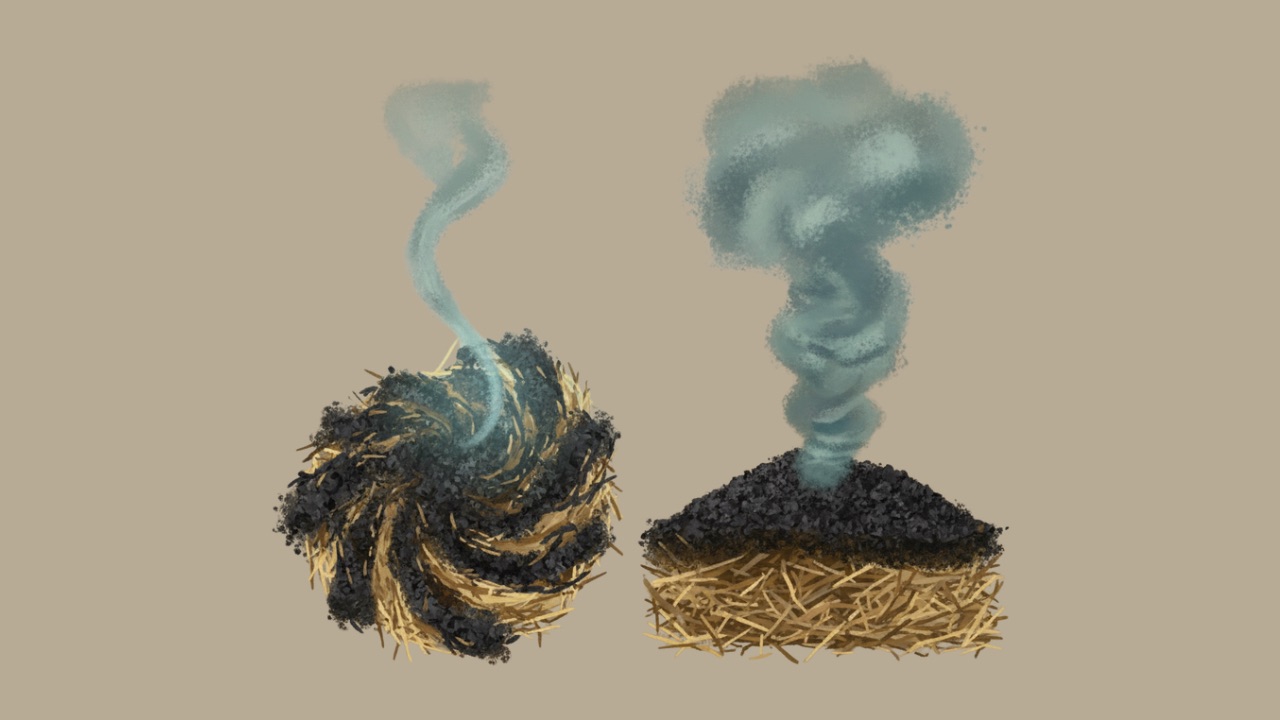
- The NH3 Trapping Mechanism: Mixing works because it allows the porous biochar particles to fully interact with the nitrogen compounds deep inside the litter, trapping them before they can volatilize as NH3 gas. Surface application only provides a temporary, ineffective cap.
- More Than Just Gas Control: Beyond ammonia, adding biochar to poultry litter, even at a 20% rate, has the benefit of improving the litter’s ability to hold water by 32.2%. This helps reduce caking, making the litter drier and potentially improving the health of the birds’ feet.
Ammonia (NH3) emissions from poultry litter pose a significant concern in modern broiler production, negatively affecting bird performance and welfare. While traditional amendments are effective, their short duration has fueled interest in biochar as a sustainable alternative. Biochar has shown potential to reduce NH3 volatilization by binding ammonium ions (NH4+) through cation exchange, physically adsorbing NH3 gas due to its high surface area (110.7 m2/g in this study), and modifying litter pHpH is a measure of how acidic or alkaline a substance is. A pH of 7 is neutral, while lower pH values indicate acidity and higher values indicate alkalinity. Biochars are normally alkaline and can influence soil pH, often increasing it, which can be beneficial More and moisture. However, previous live bird trials using biochar have mostly involved surface application, yielding conflicting results on NH3 reduction. The study by John E. Linhoss, Jordan D. Gruber, and colleagues, published in the Journal of Applied Poultry Research in 2025, investigates whether the application method—surface-applied versus mixed—affects NH3 volatilization from used broiler litter.
The researchers used a bench-top system called GASDAQ with 13.2 L plastic vessels to test the effect of different application methods over a 12 d period. Biochar was either surface-applied at rates of 0.48, 0.97, 1.46, and 1.95 kg/m2 or mixed into the litter at 7.5, 15.0, 22.5, and 30.0% v/v. A common commercial amendment, Poultry Litter Treatment (PLT), was surface-applied at 0.73 kg/m2, and a non-amended control were also included.
The results demonstrated a significant advantage for the mixed application. When analyzing the data across all tested rates, the mixed biochar application achieved significantly lower overall mean NH3 concentrations (126.0 ppm) compared to the surface-applied application (146.6 ppm) and the control (148.3 ppm). The mixed method’s success is attributed to the enhanced contact between the biochar and the ammonium-rich zones throughout the litter profile, which boosts NH3 capture efficiency.
Drilling down into the specific application rates, the 22.5M and 30M mixed applications resulted in the lowest NH3 concentrations for all biochar treatments. The 22.5M and 30M rates had significantly lower NH3 emissions (118.5 ppm and 112.0 ppm, respectively) than the control (148.3 ppm). At day 4, the 22.5M and 30M mixed treatments were 23% and 30% lower than the control, respectively. The surface-applied treatments showed no significant difference in mean NH3 emissions compared to the control across all rates. Surface-applied biochar may initially create a temporary physical barrier and adsorb some NH3 due to its high surface area. However, this effect was short-lived, with surface applications exhibiting higher NH3 emissions than the control after d 8.
Despite the clear benefits of mixing biochar, the study showed that all biochar application treatments were significantly less effective than the commercial amendment PLT. PLT achieved the lowest overall mean NH3 concentration at 65.0 ppm, which is less than half the concentration of the mixed biochar mean (126.0 ppm). Since the biochar used in this study had a high pH (8.97), the NH3 reductions were not due to pH modification, unlike in some previous studies that used acidified biochar.
Though biochar alone may not be competitive with PLT solely on NH3 reduction, it provides other substantial benefits to the litter matrix. For example, a 20% inclusion rate can increase the water-holding capacity of broiler litter by 32.2%, which can potentially reduce litter caking and improve footpad health.
Source: Linhoss, J. E., Gruber, J. D., Remus, J. C., Adhikari, S., Davis, J. D., & Purswell, J. L. (2025). Effects of biochar application methods on ammonia (NH3) volatilization from used broiler litter. Journal of Applied Poultry Research.


Leave a Reply