
Key Takeaways
- Tiny plastic fragments in farming soil can trick standard laboratory tests into counting plastic waste as natural organic matter.
- Uncorrected plastic contamination can artificially inflate recorded soil carbon stocks by significant amounts across cropland topsoil.
- While biocharBiochar is a carbon-rich material created from biomass decomposition in low-oxygen conditions. It has important applications in environmental remediation, soil improvement, agriculture, carbon sequestration, energy storage, and sustainable materials, promoting efficiency and reducing waste in various contexts while addressing climate change challenges. More helps bind soil and protect carbon, plastic particles disrupt soil structure and accelerate the breakdown of natural matter.
- The combined behavior of biochar and plastics depends on weathering, soil texture, and moisture rather than acting predictably.
- Improved carbon tracking methods are required to separate synthetic plastic residues from genuine long-term carbon storage.
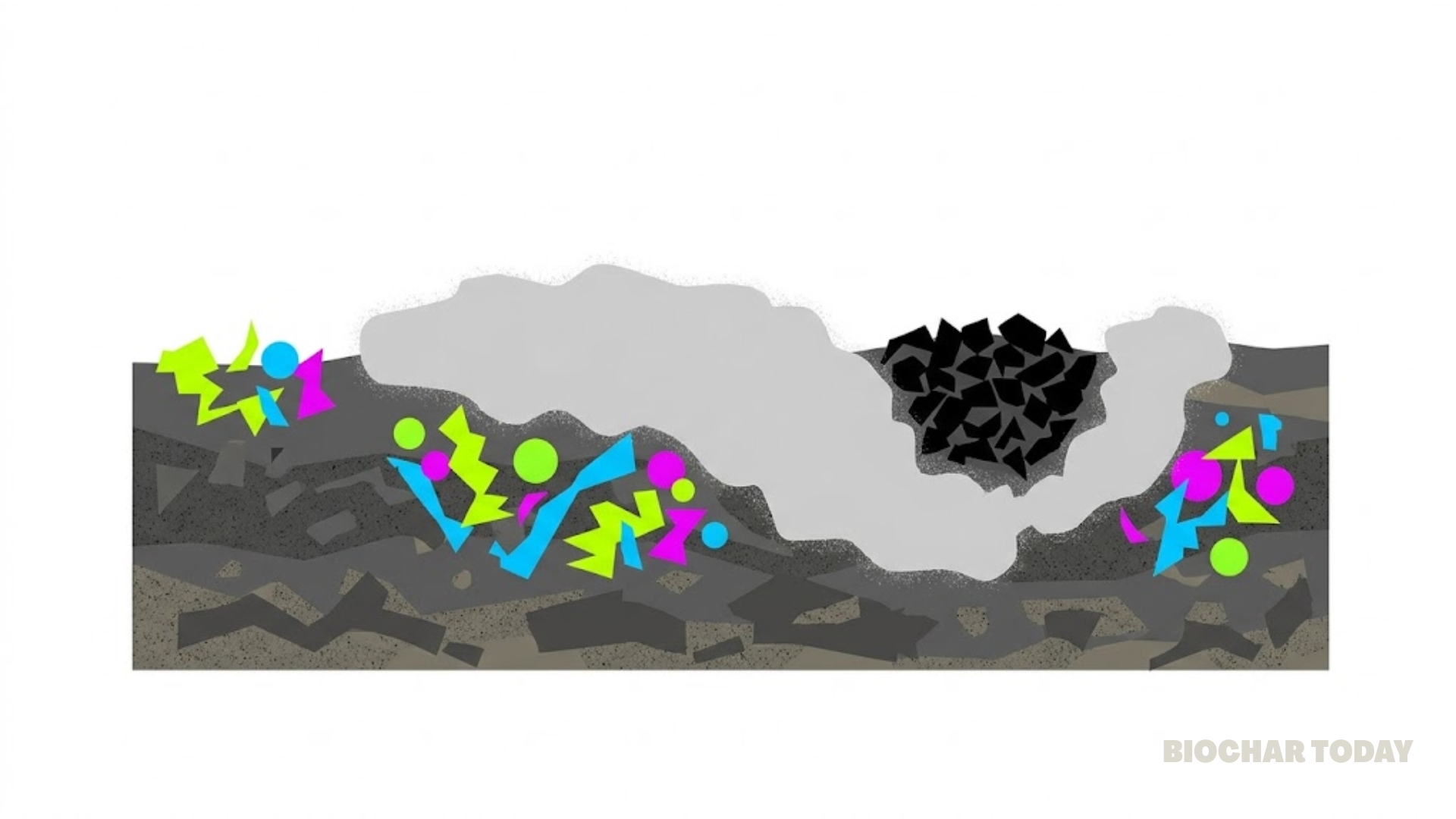
In a comprehensive synthesis published in Agricultural Ecology and Environment, authors Zhimei Yang, Khanom Simarani, Xi Zhang, Antonio Di Martino, Yi Chen, Yonglei Jiang, Binbin Hu, and Xiaodong Chen evaluated the complex biogeochemical interactions between deliberately applied biochar and unintentionally introduced microplastics in agricultural soils. The researchers established that farmland soils no longer represent chemically pristine backgrounds but instead host background microplastic concentrations ranging from hundreds to over one hundred thousand particles per kilogram. These synthetic polymers, predominantly composed of polyethylene and polypropylene fragments derived from mulch films and irrigation infrastructure, directly intersect with pyrogenic carbon amendments across the uppermost soil plough layers. The synthesis demonstrated that standard soil carbon assays create an operational measurement dilemma by indiscriminately combusting synthetic polymer carbon alongside biogenic soil organic carbon and stable pyrogenic carbon, generating false-positive signals of soil carbon sequestration.
The manuscript outlined significant quantitative discrepancies introduced during routine laboratory testing when plastic-contaminated soils are evaluated. When microplastic concentrations reach between one-tenth of a percent and one-half of a percent of soil mass in a typical twenty-centimeter plough layer, standard analytical testing inadvertently counts three to fifteen megagrams of synthetic plastic carbon per hectare as genuine organic carbon gains. This misclassification masks underlying declines in native organic matter and distorts the true climate-mitigation value of agricultural management strategies. Furthermore, physical fractionations designed to isolate particulate and mineral-associated carbon fractions suffer from cross-contamination, as mineral-coated polymer fragments are routinely carried into heavier soil fractions that researchers traditionally interpret as long-term stabilized organic carbon pools.
Beyond measurement artifacts, the coexistence of biochar and microplastics drives non-additive physical and biological transformations within the soil matrix. Biochar typically enhances aggregate stability, builds organo-mineral associations, and improves microbial carbon use efficiency by adsorbing inhibitory compounds and maintaining beneficial pore structures. Conversely, microplastics introduce structural disruption by severing pore continuity, destabilizing water-stable soil aggregates, and increasing aeration, which exposes previously protected organic carbon to accelerated microbial mineralization. Although biochar provides temporary structural buffering by adsorbing plastic-derived leachates and physical fragments within larger aggregates, this protective capacity progressively deteriorates as sorption sites become saturated and as material surfaces oxidize over time.
The authors also highlighted that combined applications alter greenhouse gas balances in non-linear ways depending on soil hydrology, nitrogen availability, and polymer properties. In saturated and flooded systems, altered microbial resource allocation and shifts in bacterial community composition generate complex trade-offs among carbon dioxide, methane, and nitrous oxide emissions. To address these challenges, the investigators presented an evidentiary reporting framework that integrates polymer-specific spectroscopic identification, specialized pyrogenic carbon quantification, and mass-based baseline bounds. Establishing these standardized measurement, reporting, and verification protocols is vital to preventing false-positive sequestration claims, ensuring that international carbon crediting systems reflect actual soil ecological improvements rather than accumulated plastic pollution.
Source: Yang, Z., Simarani, K., Zhang, X., Di Martino, A., Chen, Y., Jiang, Y., Hu, B., & Chen, X. (2026). Biochar-microplastic co-occurrence in agricultural soils: interfaces, effects on soil organic carbon, and implications for measurement and verification. Agricultural Ecology and Environment, 2, Article e017.


![Eucalyptus Wood Waste-Derived Biochar Achieves a Ninety-Eight Percent Removal Efficiency for Benzo[ghi]perylene in Vehicle-Wash Wastewater](https://biochartoday.com/wp-content/uploads/2026/10/SCIENCE-BLOGS-2026-2026-10-19T160523.703.jpg)


Leave a Reply