
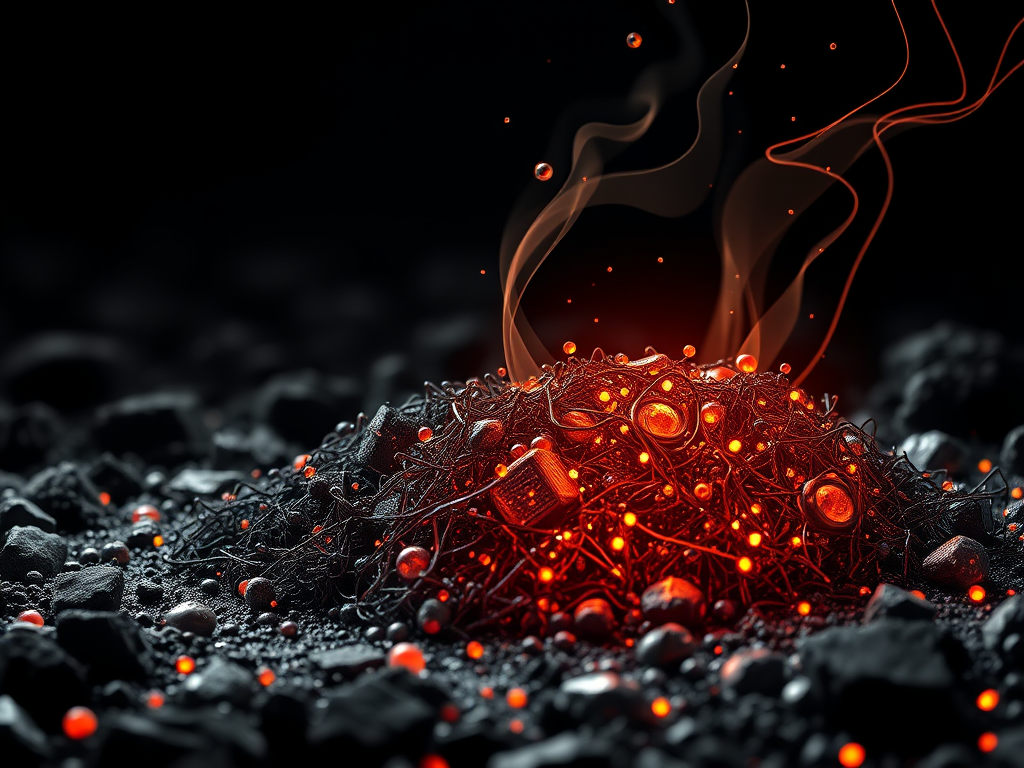
The escalating demand for sustainable energy storage has intensified the search for innovative electrode materials for supercapacitors. In a recent study published in Materials Research Express, S. Kalaivani, P. Marichamy, A. Sakunthala, and Matbiangthew Shadap explore the synthesis, characterization, and application of magnetized biocharBiochar is a carbon-rich material created from biomass decomposition in low-oxygen conditions. It has important applications in environmental remediation, soil improvement, agriculture, carbon sequestration, energy storage, and sustainable materials, promoting efficiency and reducing waste in various contexts while addressing climate change challenges. More derived from Gracilaria spinulosa red algae as a novel electrode material for supercapacitors. Their findings suggest that this magnetized biochar can serve as a viable and environmentally friendly alternative to traditional electrode materials.
Biochar produced from biomassBiomass is a complex biological organic or non-organic solid product derived from living or recently living organism and available naturally. Various types of wastes such as animal manure, waste paper, sludge and many industrial wastes are also treated as biomass because like natural biomass these More pyrolysisPyrolysis is a thermochemical process that converts waste biomass into bio-char, bio-oil, and pyro-gas. It offers significant advantages in waste valorization, turning low-value materials into economically valuable resources. Its versatility allows for tailored products based on operational conditions, presenting itself as a cost-effective and efficient More, is already recognized for its excellent porosityPorosity of biochar is a key factor in its effectiveness as a soil amendment and its ability to retain water and nutrients. Biochar’s porosity is influenced by feedstock type and pyrolysis temperature, and it plays a crucial role in microbial activity and overall soil health. Biochar More, high surface area, stability, renewability, sustainability, and cost-effectiveness, making it a promising candidate for supercapacitor electrodes. This research focuses on enhancing these properties through magnetization. The study highlights that the appropriate integration of iron oxide nanoparticles significantly increases the conductivity and surface characteristics of the material.
The synthesis process involved pyrolyzing Gracilaria spinulosa red algae at 800 °C to produce biochar. This biochar was then magnetized by treating it with an FeCl₃ solution, followed by hydrolysis, precipitation, and a second pyrolysis at 600 °C under a nitrogen atmosphere. This two-step process aimed to regulate the precipitation and integration of iron compounds while preserving the carbon structure, ensuring an even distribution of magnetic particles within the biochar matrix.
Extensive physicochemical analyses—including SEM, TEM, EDS, FTIR, Raman spectroscopy, BET, VSM, and XRD—were conducted to characterize the plain and magnetized biochar. SEM images revealed that while plain biochar had a varied structure with irregular particles and obvious pores, the magnetized biochar exhibited a more uniform and densely packed structure with smaller, aggregated particles. EDS analysis confirmed the successful incorporation of iron (0.28 wt.%) in the magnetized biochar, alongside an increase in carbon content (to 62.64 wt.%) and a decrease in oxygen content (to 36.78 wt.%). TEM images further showed that Fe₃O₄ nanoparticles with an average size of 7.1–18.4 nm were uniformly dispersed within the biochar matrix.
FTIR and Raman spectral analyses indicated that magnetization maintained the fundamental biochar architecture but altered its surface chemistry, leading to reduced hydroxyl and aliphatic groups, increased aromaticity, and the distinct presence of Fe-O stretching peaks confirming iron oxide integration. XRD patterns showcased a transition from amorphous carbon in plain biochar to crystalline phases in magnetized biochar, primarily magnetite (Fe₃O₄) and maghemite (γ-Fe₂O₃). BET analysis showed that while plain biochar had a larger specific surface area (137.42 m²/g), magnetized biochar had a slightly higher pore volume (0.078 cc/g) and a broader average pore diameter (3.693 nm), both characteristic of mesoporous materials suitable for electrochemical systems. VSM analysis confirmed the successful magnetization, revealing a saturation magnetization of 0.45 emu/g, indicative of a soft magnetic material with low coercivity, making it suitable for magnetic separation and controlled movement.
The electrochemical performance was evaluated using cyclic voltammetry (CV), galvanostatic charge-discharge (GCD), and electrochemical impedance spectroscopy (EIS). The magnetized biochar exhibited a specific capacitance of 45.90 F/g at a current density of 0.5 A/g. Its GCD curves showed predominantly electrochemical double-layer capacitance (EDLC) behavior, with almost symmetrical triangular shapes indicating good electrochemical reversibility and stability. Even after 500 charge-discharge cycles, the material retained 75% of its initial capacitance. Although some capacitance loss was observed due to mechanical detachment of the electrode material from the current collector, the impedance profiles remained stable, suggesting that the material’s inherent electronic and ionic conductivity were not significantly limited. The detected inductive component in the Nyquist plots is attributed to the magnetic properties of the material, suggesting potential enhancement of interfacial charge transfer under external magnetic fields.
This study successfully demonstrates that magnetized biochar from Gracilaria spinulosa is a promising, sustainable, and cost-effective electrode material for supercapacitors, with notable improvements in specific capacitance and cycling stability.
Source: Kalaivani, S., Marichamy, P., Sakunthala, A., & Shadap, M. (2025). Magnetized Biochar from Gracilaria Spinulosa for Enhanced Electrochemical Performance in Supercapacitors: Synthesis, Characterization and Application. Materials Research Express.




Leave a Reply