
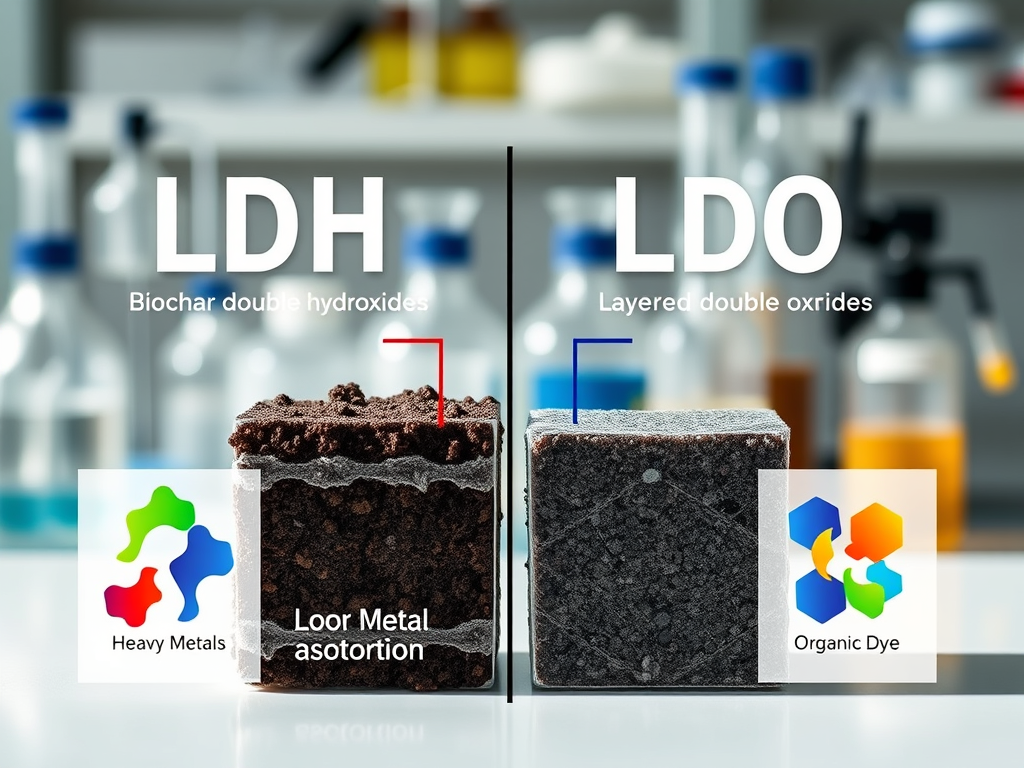
Water pollution is a growing global concern, driven by population growth and industrial expansion, with a 24% increase in wastewater pollution predicted by 2030 and a 51% increase by 2052. To combat this, innovative and sustainable solutions are urgently needed. A critical review by Yudha Gusti Wibowo et al. in Water-Energy Nexus examines the use of biochar-based composites as a promising approach for water pollution control. The review focuses on two such materials: biochar-layered double hydroxides (LDH) and biochar-layered double oxides (LDO), and compares their effectiveness in removing pollutants like heavy metals and organic dyes. The findings highlight the distinct advantages and applications for each material, providing valuable insights for future water treatment strategies.
BiocharBiochar is a carbon-rich material created from biomass decomposition in low-oxygen conditions. It has important applications in environmental remediation, soil improvement, agriculture, carbon sequestration, energy storage, and sustainable materials, promoting efficiency and reducing waste in various contexts while addressing climate change challenges. More is a good adsorbent on its own, with straw-derived biochar showing a lead (Pb) sorption capacity of 1343 mmol/kg. However, its performance can be significantly enhanced by combining it with LDHs or LDOs. LDHs consist of metal cation layers with exchangeable anions, which are effective at adsorbing heavy metals. When LDHs are heated through calcination, they transform into LDOs, which possess a “memory effect” that allows them to regenerate their structure in water, making them reusable. This synergy between biochar and these layered materials improves the composite’s surface area, adsorption capacity, and chemical stability, enabling the removal of a wider range of pollutants.
A key finding from the review is the performance difference between the two composites, especially for removing different types of pollutants. Biochar-LDH composites are particularly effective for heavy metals and anions like phosphate, nitrate, and chromate. For instance, biochar-LDH achieved high removal capacities for Pb2+ (∼591 mg/g) and CrO42− (∼330 mg/g), and up to 178 mg/g for phosphate. Their high selectivity is due to electrostatic interactions, anion exchange, and complexation within the LDH structure.
In contrast, biochar-LDO composites, with their high surface basicity and thermal stability, excel at removing organic pollutants such as dyes, antibiotics, and nanoplastics. Case studies show LDO-based composites reaching exceptional adsorption capacities for Congo red dye (∼4841 mg/g) and ciprofloxacin (744 mg/g), significantly outperforming LDH systems for these specific contaminants. One study found that LDO composites, with their “memory effect,” were able to achieve 95% phosphate removal within five minutes, showing their rapid and effective performance. This enhanced performance is attributed to the LDOs’ “memory effect,” which allows for structural reconstruction in aqueous environments, and their high surface area post-calcination.
Both materials offer sustainability and economic benefits. Biochar is a cost-effective alternative to conventional adsorbents like activated carbonActivated carbon is a form of carbon that has been processed to create a vast network of tiny pores, increasing its surface area significantly. This extensive surface area makes activated carbon exceptionally effective at trapping and holding impurities, like a molecular sponge. It is commonly More and synthetic resins because it is made from renewable biomassBiomass is a complex biological organic or non-organic solid product derived from living or recently living organism and available naturally. Various types of wastes such as animal manure, waste paper, sludge and many industrial wastes are also treated as biomass because like natural biomass these More waste, such as agricultural residues. Both biochar-LDH and biochar-LDO composites can be regenerated and reused for multiple cycles, which reduces replacement and disposal costs. For example, biochar-LDH composites have shown to maintain over 80% regeneration efficiency after multiple cycles. Additionally, the composites can recover valuable resources like phosphates from wastewater for use as agricultural fertilizers, aligning with circular economy principles.
Despite their promise, the authors identify key challenges for future research. The primary focus should be on addressing scalability, long-term stability, and regeneration in real-world conditions. Further research should explore hybridizing LDH and LDO functionalities and conducting life cycle assessments to fully understand the environmental and economic trade-offs. This work provides a foundation for designing next-generation adsorbents tailored to specific wastewater treatment needs, advancing sustainable and effective remediation technologies.
Source: Wibowo, Y. G., Anwar, D., Safitri, H., Rohman, A., Rinovian, A., Ramadan, B. S., … & Petrus, H. T. B. M. (2025). Biochar-Layered Double Hydroxide vs Biochar-Layered Double Oxide: A Critical Review on Their Applications in Water Pollution Control. Water-Energy Nexus.



Leave a Reply