
By Menwa Besheer, Kristin Eickelbeck, Kiara Kulkarni, Chris Morgan, and Katherine Tyler, published in Erosion And Deposition Comparison Of BiocharBiochar is a carbon-rich material created from biomass decomposition in low-oxygen conditions. It has important applications in environmental remediation, soil improvement, agriculture, carbon sequestration, energy storage, and sustainable materials, promoting efficiency and reducing waste in various contexts while addressing climate change challenges. More, Pumice, And Arizona Test Dust On Titanium Coupons. Wildfires are becoming more frequent and severe, burning millions of acres annually. This increase poses a growing threat to aircraft, as wildfire ashAsh is the non-combustible inorganic residue that remains after organic matter, like wood or biomass, is completely burned. It consists mainly of minerals and is different from biochar, which is produced through incomplete combustion. Ash Ash is the residue that remains after the complete More can travel vast distances and linger in the atmosphere for weeks, exposing aircraft engines to damaging conditions. While the impact of sand and volcanic ash on aircraft engines has been extensively studied, wildfire ash remains a relatively new area of research. A recent study at Virginia Tech investigated the erosive and depositional effects of wildfire ash, simulated by biochar, alongside Arizona Test Dust (ATD) for sand and pumice for volcanic ash, on titanium coupons resembling compressor blades. The findings highlight significant differences in how these particulates interact with engine components, particularly concerning deposition.
The study, building upon preliminary tests, refined its methodology to address previous uncertainties, such as eliminating large particles and preventing injector clogging. Particulates were milled and sieved to a 50-150 micron size range before being fed into a free jet at 9 grams per minute, flowing at Mach 0.65, and impacting titanium coupons. Surface roughness was measured before and after testing to quantify erosion, and visual inspections using a 3D profilometer provided insights into both erosion and deposition.
The research found that ATD (simulated sand) caused the most significant increase in surface roughness, with an average change of approximately 26.2 micro inches. Pumice (simulated volcanic ash) followed, causing a surface roughness change of about 21.5 micro inches. In contrast, biochar (simulated wildfire ash) resulted in the least erosion, with an average change of only 6.8 micro inches. These results, confirmed by visual inspection, indicate that sand is the most erosive particulate, while wildfire ash causes the least erosion on titanium compressor blades. The initial scratches on the coupons were completely eroded by ATD and pumice, but remained visible on coupons exposed to biochar, further supporting its lower erosivity.
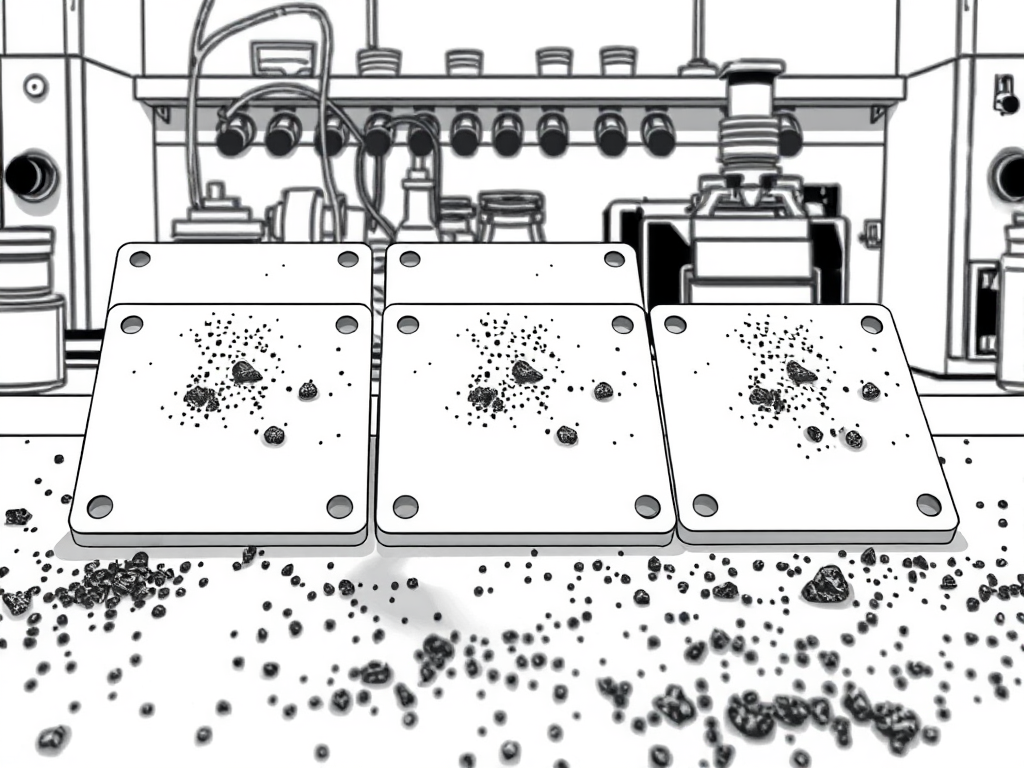
While erosion was a primary focus, the study revealed compelling insights into deposition. Biochar led to the most significant deposition on the titanium coupons. Visual inspections clearly showed black spots of biochar particles adhering to the coupon surface, with 3D scans highlighting raised areas of deposition. This was consistent with preliminary testing and suggests that wildfire ash can pose a serious problem for engines due to material accumulation, even in cooler sections like the compressor. Some deposition was also observed with ATD, but very little to no deposition occurred with pumice. The high porosityPorosity of biochar is a key factor in its effectiveness as a soil amendment and its ability to retain water and nutrients. Biochar’s porosity is influenced by feedstock type and pyrolysis temperature, and it plays a crucial role in microbial activity and overall soil health. Biochar More and large surface area of biochar likely contribute to its increased tendency to trap smaller particles and accumulate more material. In contrast, pumice’s porous and lightweight nature, coupled with its irregular shape, may have reduced its kinetic energy upon impact, leading to less abrasion and minimal deposition.
The study concluded that prolonged exposure to wildfire ash could necessitate additional aircraft inspections due to harmful deposition. While mass measurements for quantifying deposition were inconclusive due to the scale’s precision limitations, visual and surface roughness changes strongly supported the qualitative observations. Future research aims to utilize more precise techniques, such as an electron microprobe analyzer, to accurately quantify deposition. The successful modification of the testing rig to handle biochar at higher flow rates, up to 18 grams per minute, paves the way for further investigation into wildfire ash’s impact on engines. Future work may also include testing under heated conditions to simulate realistic engine environments and exploring the role of electrostatics in particle deposition.
Source: Besheer, M., Eickelbeck, K., Kulkarni, K., Morgan, C., & Tyler, K. (n.d.). Erosion And Deposition Comparison Of Biochar, Pumice, And Arizona Test Dust On Titanium Coupons. Virginia Tech.



Leave a Reply