
Key Takeaways
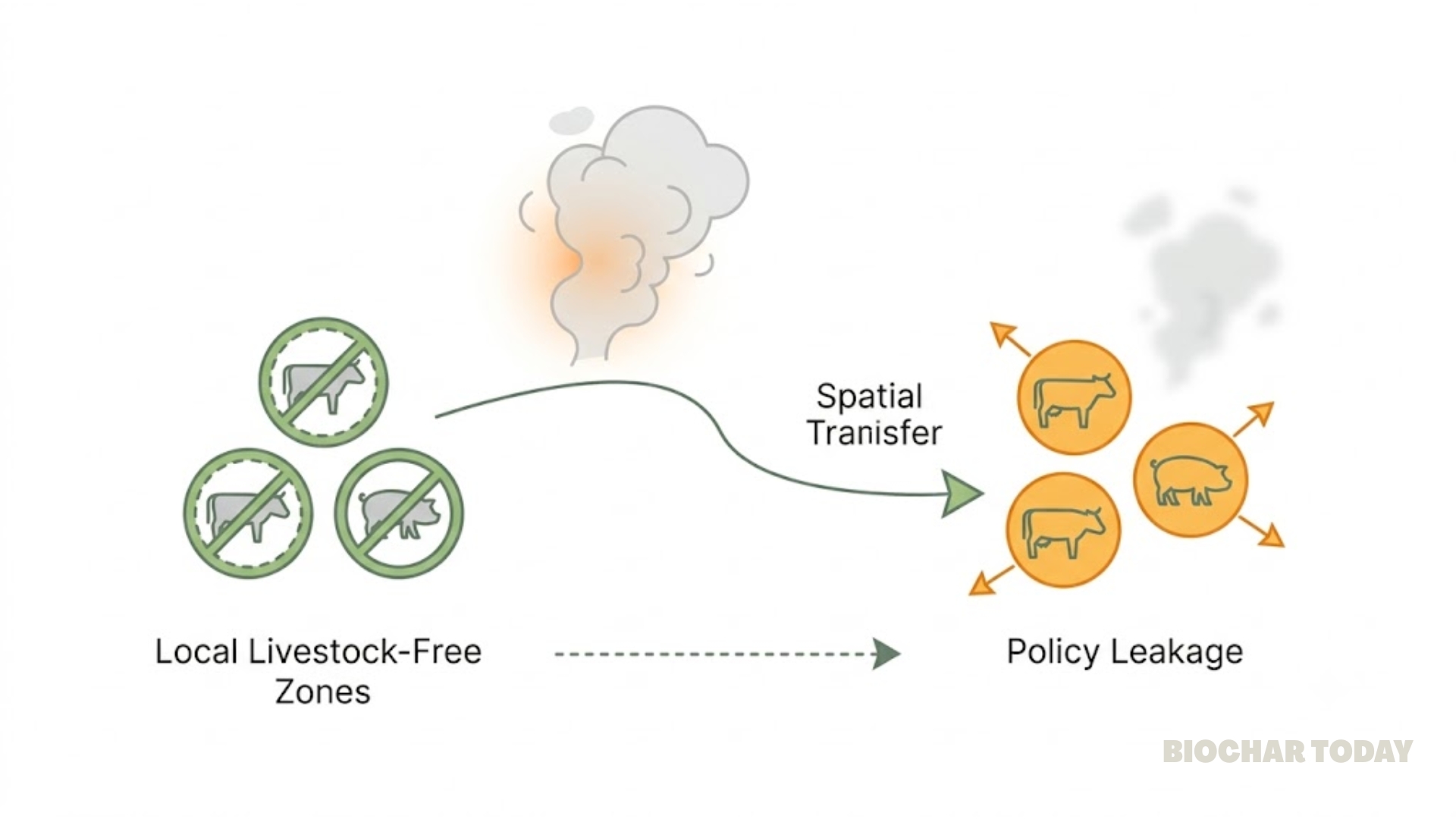
- Local environmental regulations prohibiting livestock farming lead to spatial carbon leakage that exceeds direct local reductions by over three times.
- Stringent spatial rules in core urban regions push land-intensive livestock operations into neighboring, less-regulated rural zones.
- Moving livestock production to regions lacking advanced agricultural technology creates severe efficiency dilemmas and elevates overall greenhouse gas levels.
- Geographic policy fragmentation fails to deliver net regional environmental benefits without synchronized technological support across administrative borders.
- Coordinating cross-regional environmental governance and technology transfers is essential to prevent unintended pollution displacement.
In the publication Carbon Research, lead author Zhiyi Ye and a team of researchers investigated the systemic environmental impacts of subnational environmental policies targeting agricultural greenhouse gas emissions across Guangdong Province, China. The research evaluated county-level panel data spanning a decade to track carbon dioxide equivalent output across enteric fermentation and manure management activities. While localized spatial restrictions successfully eliminate immediate pollution sources within targeted jurisdictions, the study provides robust empirical evidence that land-dependent agricultural operations do not vanish under regional bans. Instead, restrictive land-use policies displace production capacity toward neighboring regions with lower regulatory stringency, confirming the Pollution Haven Hypothesis within a land-intensive agricultural setting.
The main challenge addressed by the study centers on the severe policy leakage and unintended environmental spillovers caused by fragmented municipal regulations. Local governments frequently implement strict livestock-free zones as a rapid regulatory mechanism to meet urban environmental standards and cut non-point source pollution within their immediate borders. However, because livestock production depends heavily on land resources rather than easily reallocated financial capital, enforcing localized production bans triggers an involuntary structural reallocation of farming capacity. When core urban regions aggressively enforce these exclusions, farm operators relocate to adjacent rural peripheries where land is available and oversight is less stringent. This localized displacement creates an illusion of environmental improvement in core urban areas while simultaneously shifting and magnifying the total pollution footprint across broader geographical regions.
To resolve this issue, the researchers analyzed spatial network structures and evaluated how the synchronized deployment of capacity and technology can reform regional agricultural governance. The study highlights that preventing policy-induced carbon leakage requires moving beyond uncoordinated, single-jurisdiction exclusion zones. Effective spatial management demands integrated, cross-regional governance frameworks where regulatory enforcement in core economic centers is paired with technological support for receiving areas. Rather than allowing passive capacity migration into lower-efficiency regions, policy frameworks must incorporate synchronized transfers of modern, low-carbon breeding practices, specialized manure management systems, and high-efficiency production infrastructure to ensure recipient regions do not succumb to environmental degradation.
The outcomes documented in the study demonstrate a stark contrast between local compliance and regional environmental impact. While local policy enforcement produced a direct carbon reduction effect within designated exclusion zones, it simultaneously generated an indirect spatial spillover effect that was 3.14 times greater than the direct local savings. Furthermore, the environmental consequences varied drastically across recipient regions based on their existing technological infrastructure. In regions equipped with efficient livestock breeding technology, transferred operations maintained low carbon emission intensities despite rising total production volumes. Conversely, less-developed rural regions absorbed relocated farming capacity without accompanying efficiency gains, resulting in severe carbon intensity accumulation, heightened environmental risks, and a net increase in total regional emissions.
Source: Ye, Z., Yang, X., Cao, Y., Liang, Q., Ma, A. J., & Xu, M. (2026). Spatial transfer and policy leakage of livestock carbon emissions driven by local livestock-free zone policies. Carbon Research, 5, Article 51.





Leave a Reply