
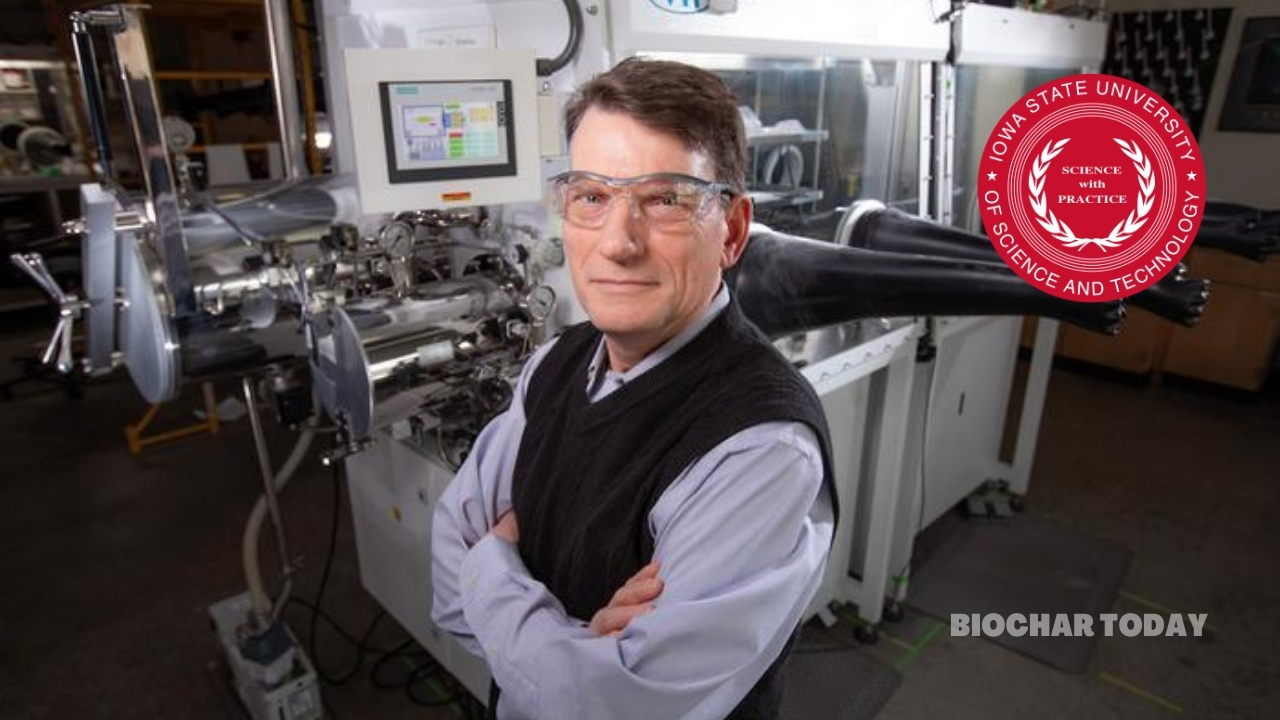
Researchers at Iowa State University have secured a $458,743 grant from the Iowa Energy Center to advance the development of “ultra-low-cost, ultra-high-performance” batteries utilizing locally sourced materials. The three-year project, led by Professors Steve Martin and Patrick Johnson, aims to create a sustainable storage solution for Iowa’s abundant wind energy. The battery design features a unique material composition: an anode made from biocharBiochar is a carbon-rich material created from biomass decomposition in low-oxygen conditions. It has important applications in environmental remediation, soil improvement, agriculture, carbon sequestration, energy storage, and sustainable materials, promoting efficiency and reducing waste in various contexts while addressing climate change challenges. More, a cathode utilizing sulfur, and a sodium-ion conducting glass separator. By focusing on materials that are significantly less expensive than lithium—such as sodium and biochar—the team is working toward a scalable industrial battery technology that could fundamentally alter the economics of long-duration energy storage.
The primary challenge addressed by this research is the high cost and supply chain instability associated with traditional lithium-ion batteries, which currently dominate the energy storage market. Lithium is expensive and often sourced through complex international networks, making it difficult to scale for the massive storage capacities required by utility-grade wind and solar farms. Furthermore, intermittent renewable energy sources like wind require batteries that are not only high-performing but also affordable enough to be deployed in large, stackable arrays. Developing a system that maintains energy density and rechargeability while using non-ideal raw materials—like waste glass and agricultural co-products—remains a significant technical hurdle for solid-state battery engineering.
The solution proposed by the Iowa State team involves repurposing regional industrial and agricultural waste into high-value battery components. Biochar, a stable co-product of biomassBiomass is a complex biological organic or non-organic solid product derived from living or recently living organism and available naturally. Various types of wastes such as animal manure, waste paper, sludge and many industrial wastes are also treated as biomass because like natural biomass these More pyrolysisPyrolysis is a thermochemical process that converts waste biomass into bio-char, bio-oil, and pyro-gas. It offers significant advantages in waste valorization, turning low-value materials into economically valuable resources. Its versatility allows for tailored products based on operational conditions, presenting itself as a cost-effective and efficient More already produced by several Iowa-based companies, serves as the carbon-rich anode. This is paired with a sulfur cathode—a common byproduct of oil refining—and a separator made from sodium-ion conducting glass derived partly from recycled waste glass. This solid-state architecture eliminates the need for flammable liquid electrolytes, enhancing safety and longevity. By utilizing Iowa’s established bio-oil and synthesis gas industries to source biochar, the researchers are creating a circular economic model that supports both the agricultural and energy sectors.
The expected outcomes of this project include the fabrication of flat, stackable pouch batteries that are two to three times larger than current electric vehicle batteries. These units are designed to be connected in large clusters to reach industrial-scale capacities for the electrical grid. Beyond the technical validation of the biochar-sulfur-sodium chemistry, the project aims to foster commercialization through partnerships with local biochar producers and potential incubation at Iowa State’s Startup Factory. If successful, this research will provide a blueprint for “all-Iowa” battery production, lowering the cost of storing renewable energy while providing a high-value market for biochar and other regional materials.




Leave a Reply