
Key Takeaways
- A new composite material made from an invasive plant and magnesium oxide removes fluoride from polluted water.
- The material sets a record fluoride adsorption capacity of over 469 milligrams per gram of material.
- It works effectively across a wide water pHpH is a measure of how acidic or alkaline a substance is. A pH of 7 is neutral, while lower pH values indicate acidity and higher values indicate alkalinity. Biochars are normally alkaline and can influence soil pH, often increasing it, which can be beneficial More range of 5.0 to 11.0 without losing performance.
- Common water additives like nitrates and sulfates do not interfere with the fluoride cleaning process.
- This strategy transforms harmful invasive weed biomassBiomass is a complex biological organic or non-organic solid product derived from living or recently living organism and available naturally. Various types of wastes such as animal manure, waste paper, sludge and many industrial wastes are also treated as biomass because like natural biomass these More into a low-carbon water purification tool.
The accumulation of fluoride ions in aquatic ecosystems has emerged as a global environmental challenge threatening public health, particularly across the Global South. While trace amounts of fluoride occur naturally in groundwater, excessive concentrations resulting from industrial activities like semiconductor manufacturing, photovoltaics, and pesticide production cause severe health conditions including dental and skeletal fluorosis. In a new paper published in BiocharBiochar is a carbon-rich material created from biomass decomposition in low-oxygen conditions. It has important applications in environmental remediation, soil improvement, agriculture, carbon sequestration, energy storage, and sustainable materials, promoting efficiency and reducing waste in various contexts while addressing climate change challenges. More X, authors Yao Tong, Donglin Wang, Lingqing Gu, Yujie Tai, Xianjie Tang, Xi Zhang, Rongdi An, Til Feike, and Jiunian Guan developed an eco-friendly composite material designed to remove fluoride from contaminated water while simultaneously repurposing problematic invasive plant biomass. The researchers utilized residues from Rhus typhina, an invasive plant species in China, to synthesize a nano-magnesium oxide modified pyro-hydrochar composite through a simple one-step pyrolysisPyrolysis is a thermochemical process that converts waste biomass into bio-char, bio-oil, and pyro-gas. It offers significant advantages in waste valorization, turning low-value materials into economically valuable resources. Its versatility allows for tailored products based on operational conditions, presenting itself as a cost-effective and efficient More process.
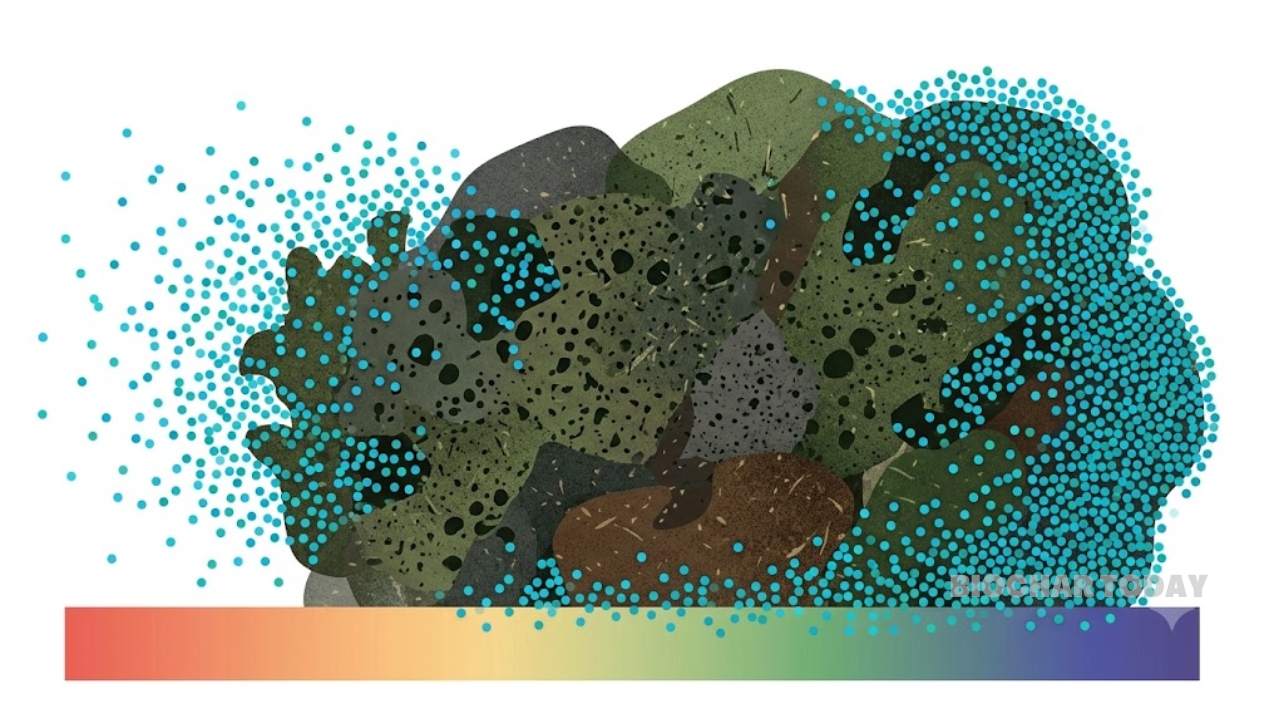
The resulting composite features a unique porous carbon matrix covered with stacked nanoscale lamellae that resemble coral reefs, providing an expanded specific surface area and abundant active binding sites. Batch adsorption experiments demonstrated that the material possesses an extraordinary maximum fluoride adsorption capacity of 469.64 milligrams per gram at room temperature. This capacity significantly outperforms previously reported defluoridation materials, including conventional biochars, metal-organic frameworks, and layered double hydroxides, which typically achieve adsorption levels below 100 milligrams per gram. Thermodynamic evaluations confirmed that the fluoride removal process occurs spontaneously and is driven primarily by strong chemical interactions rather than simple physical trapping.
A major operational advantage of the engineered composite is its exceptional adaptability to diverse water conditions. The material maintained a stable fluoride adsorption performance across a broad pH spectrum ranging from 5.0 to 11.0. Furthermore, testing revealed that coexisting background anions commonly found in natural waters, such as nitrates and sulfates, exerted virtually no interference on fluoride uptake. Only extremely high concentrations of bicarbonate ions caused noticeable competition due to similar ionic sizes and localized pH increases.
Spectroscopic characterization verified that the composite traps fluoride through a multi-step synergistic mechanism. Fluoride ions rapidly diffuse into the porous carbon network, where they are initially attracted by positive surface charges and direct magnesium complexation. Subsequently, the ions undergo ligand and anion exchange with magnesium hydroxide on the surface, precipitating as stable, insoluble magnesium fluoride or mixed magnesium hydroxyfluorides. Additional hydrogen bonding between fluoride ions and surface hydroxyl groups further secures the contaminants. The underlying carbon matrix prevents the nano-magnesium oxide particles from clumping together, while its surface oxygen groups buffer solution pH to optimize chemical reactions. The authors concluded that this dual-purpose material provides a scalable, low-carbon approach for purifying water while turning ecological waste into a valuable resource.
Source: Tong, Y., Wang, D., Gu, L., Tai, Y., Tang, X., Zhang, X., An, R., Feike, T., & Guan, J. (2026). Nano-MgO/pyro-hydrochar for enhancing adsorption of fluoride ion from aqueous solution: performance, influencing factors, and mechanisms. Biochar X, 2, e023.



Leave a Reply