
Key Takeaways
- Combining specific micro-organisms with soil amendments helps filter household wastewater directly within vertical building gardens.
- The biological treatment system cuts down heavy organic water pollution by more than fifty percent without requiring industrial chemicals.
- Adding a mixture of fungi and charred wood residues nearly triples the root growth of urban green wall plants.
- Utilizing treated wastewater for vertical greenery offers a practical method to save clean water in cities facing severe droughts.
Rapid urbanization and diminishing freshwater supplies have forced modern municipalities to seek decentralized, nature-based solutions for domestic wastewater recycling. Green walls integrated into building architectures present a dual opportunity to mitigate the urban heat island effect and purify greywater simultaneously. However, raw household wastewater contains organic compounds, surfactants, and suspended solids that induce osmotic and chemical stress in plants, frequently suppressing growth and limiting the long-term filtration efficiency of vertical vegetation systems. To resolve this problem, researchers from the Ferdowsi University of Mashhad evaluated how microscopic biological interactions within the root zone could shield vegetation from pollution stress while enhancing the mechanical purification of the filtering media.
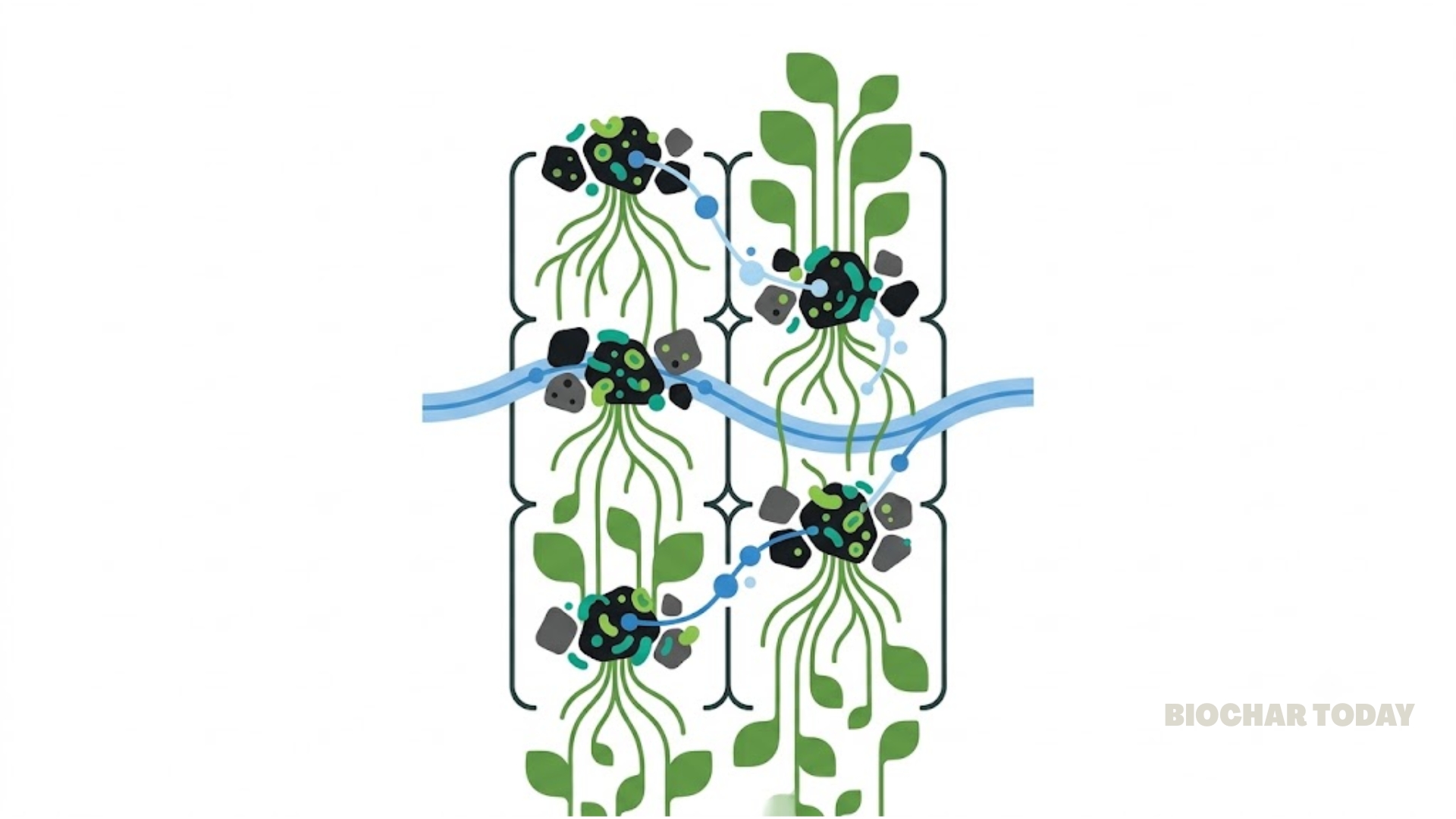
The team conducted an expansive field experiment using the succulent plant species Crassula capitella arranged across a five-tier vertical green wall infrastructure. The growth substrate was systematically inoculated with varying combinations of Oscillatoria cyanobacteria, mycorrhizal fungiThese are friendly fungi that form a partnership with plant roots. They act like an extension of the root system, helping plants access water and nutrients more effectively. Biochar can create a cozy habitat for these helpful fungi, boosting their growth and improving plant health. More, and a porous biocharBiochar is a carbon-rich material created from biomass decomposition in low-oxygen conditions. It has important applications in environmental remediation, soil improvement, agriculture, carbon sequestration, energy storage, and sustainable materials, promoting efficiency and reducing waste in various contexts while addressing climate change challenges. More synthesized through the oxygen-free pyrolysisPyrolysis is a thermochemical process that converts waste biomass into bio-char, bio-oil, and pyro-gas. It offers significant advantages in waste valorization, turning low-value materials into economically valuable resources. Its versatility allows for tailored products based on operational conditions, presenting itself as a cost-effective and efficient More of mixed woody biomassBiomass is a complex biological organic or non-organic solid product derived from living or recently living organism and available naturally. Various types of wastes such as animal manure, waste paper, sludge and many industrial wastes are also treated as biomass because like natural biomass these More residues. These elements were selected because biochar provides a protective, high-surface-area habitat for beneficial microbes, while cyanobacteria fix essential nutrients and fungi expand the structural absorption capacity of the root network. The engineered system was then subjected to continuous irrigation regimes using synthetic greywater mixed with treated industrial effluent to simulate standard municipal wastewater streams.
The empirical results established that precise biological combinations dramatically optimize water quality and plant structural adaptation. The specific combination of 0.4 grams of cyanobacteria and 10 grams of mycorrhizae without biochar achieved the highest organic decontamination rate, lowering the initial chemical oxygen demand of the wastewater from 376 milligrams per liter down to 173 milligrams per liter. This represented a massive reduction in organic pollutant density compared to the untreated baseline. Concurrently, a separate combined framework consisting of 10 grams of mycorrhizae paired with 5 grams of biochar acted as a powerful growth stimulant under urban irrigation conditions. This specific configuration accelerated subterranean plant development, expanding root fresh weight by 189 percent and multiplying root dry weight by 298 percent.
Beyond physical growth, the biological amendments significantly bolstered the internal cellular defenses and chemical uptake of the green wall vegetation. The presence of micro-organisms triggered an escalation in leaf chlorophyll content by more than 97 percent, which allowed the plants to sustain active photosynthesis even when absorbing low-quality recycled water. The symbiotic relationships also enhanced cellular redox balance, causing a rise in crucial antioxidant metabolites, defensive enzyme activity, and total nitrogen absorption within the plant tissue. These physiological upgrades resulted in a three-fold increase in the overall air pollution tolerance index of the flora. This elevated resilience proves that biologically active green walls can thrive long-term on greywater while acting as effective biological filters in heavily polluted metropolitan environments.
Source: Zarei, A., Karimian, Z., Meghdari, Z., & Heidari, A. (2026). Microbe-biochar interaction in improving plant growth and water reuse in a green wall system. Scientific Reports, 16, 1-42.



Leave a Reply