
Key Takeaways
- An innovative two-step system using sugarcane bagasse biocharBiochar is a carbon-rich material created from biomass decomposition in low-oxygen conditions. It has important applications in environmental remediation, soil improvement, agriculture, carbon sequestration, energy storage, and sustainable materials, promoting efficiency and reducing waste in various contexts while addressing climate change challenges. More followed by the duckweed Lemna minor successfully removes the UV filter Benzophenone-3 (BP-3) from wastewater.
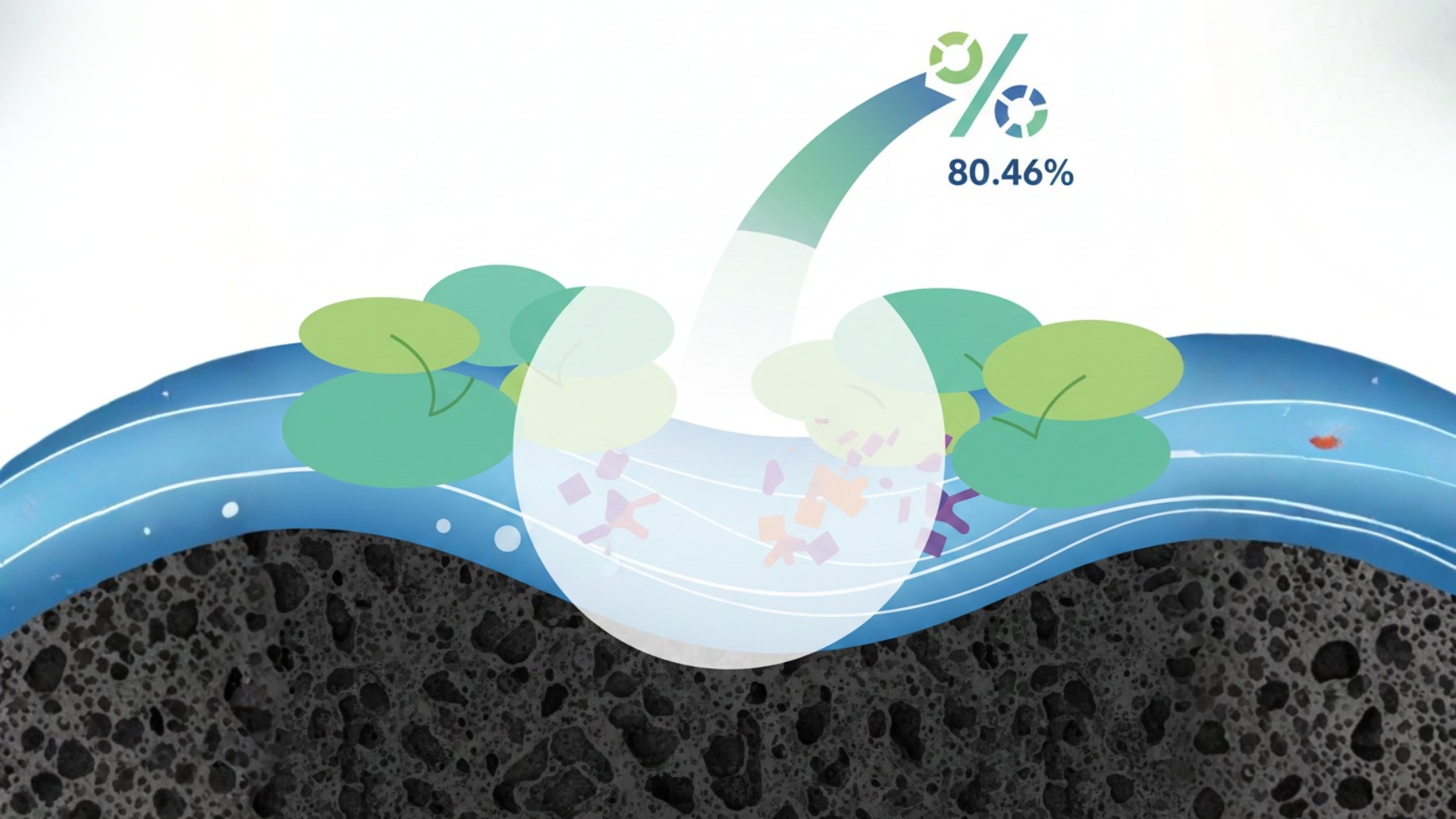
- The integrated process achieved a total BP-3 removal efficiency of 80.46% in municipal wastewater and 73.82% in spiked distilled water.
- Biochar primarily acts by adsorption, while Lemna minor degrades the compound, producing the less-potent metabolites 2,4-Dihydroxybenzophenone and, in a first-ever report in plants, 2,3,4-Trihydroxybenzophenone.
- The system significantly improved the overall quality of the municipal wastewater, notably increasing dissolved oxygen by 88.20% and decreasing ammonia by 84.01%.
- This eco-friendly, cost-effective, and synergistic approach holds great promise for sustainable remediation of emerging contaminants in constructed wetlands.
The presence of Emerging Contaminants (ECs) like Benzophenone-3 (BP-3), also known as Oxybenzone, is increasingly challenging the potential reuse of unconventional water resources, such as wastewater. BP-3 is a widely used ultraviolet (UV) filter and photostabiliser in personal care products and plastics, but its ubiquitous nature and endocrine-disrupting potential pose a significant environmental hazard, particularly for aquatic life. Current physicochemical removal methods, like chlorination or reverse osmosis, are often inefficient or financially prohibitive for ECs. Addressing this gap, a study by Shamika Shantaram Sawant, Vidya Shree Bharti, et al. in Scientific Reports investigated an integrated and eco-friendly system for BP-3 remediation.
The innovative system employs a sequential two-step treatment: first, rapid adsorption using biochar derived from waste sugarcane bagasse, followed by slower phytoremediationThis is a technique that uses plants to clean up contaminated soil or water. Biochar can enhance phytoremediation by improving soil conditions and promoting plant growth, allowing plants to absorb and break down pollutants more effectively. More using the aquatic macrophyte Lemna minor (duckweed). The hypothesis was that combining the physicochemical adsorption capacity of biochar with the biological degradation capabilities of the duckweed would overcome the limitations of each process used alone.
The results confirmed the successful synergistic remediation of BP-3, yielding a high total removal efficiency of 80.46% in municipal wastewater and 73.82% in spiked distilled water. The biochar treatment, which was optimized for a short contact time of 60 minutes, removed 32.25% of BP-3 from wastewater and 54.36% from distilled water. The Lemna minor treatment over seven days further boosted the removal by 71.16% in the pre-treated wastewater. This demonstrated the critical insight that biochar’s removal efficiency is higher in simpler distilled water, likely due to competition for adsorption sites from the complex mixture of ions and contaminants present in wastewater. Conversely, the removal by Lemna minor was greater in the nutrient-rich wastewater, supporting the healthy growth of the duckweed, which is vital for its contaminant removal potential.
Further analysis illuminated the dual removal mechanisms . The sugarcane bagasse biochar (SBB), prepared at 400∘C, possessed a porous structure (pore diameter of 32.63±1.89 Å) and a high Cation Exchange Capacity (CEC) of 38.20±0.96 cmol(+) kg−1. Micrographs confirmed that the biochar surface acted as a sieve, trapping BP-3 molecules via pore-filling and surface binding. The presence of oxygen-containing functional groups and a good fit to the Freundlich isotherm model suggested that multi-layer adsorption and ion exchange were the dominant mechanisms for the biochar stage.
For the biological stage, Lemna minor primarily removed the remaining BP-3 through plant uptake and metabolism. The plant successfully metabolized BP-3 into its constituent products, 2,4-Dihydroxybenzophenone (2,4-DHB) and 2,3,4-Trihydroxybenzophenone (2,3,4-THB). The detection of 2,3,4-THB in the plant tissues marks the first report of this specific metabolite formation in macrophytes. This metabolic breakdown renders the compound less toxic, aiding its easy elimination.
Beyond contaminant removal, the system markedly improved the quality of the municipal wastewater. Total Dissolved Oxygen (DO) content increased by 88.20% post-treatment, attributed to enhanced atmospheric diffusion from the porous biochar and the photosynthetic activity of Lemna minor. The system also achieved an 84.01% decrease in ammonia content, due to adsorption by biochar and nutrient utilization by the plant, which is crucial for water reuse.
In summary, this research establishes the integrated biochar and Lemna minor system as a highly promising, sustainable, and eco-friendly strategy for tackling emerging contaminants like BP-3, with direct potential applications in constructed wetlands.
Source: Sawant, S. S., Bharti, V. S., Shukla, S. P., Verma, A. K., Yadav, V. K., & Shinde, S. (2025). Integrated biochar and Lemna minor system for sustainable remediation of Benzophenone-3 from wastewater. Scientific Reports, 15(1), 40329.





Leave a Reply