
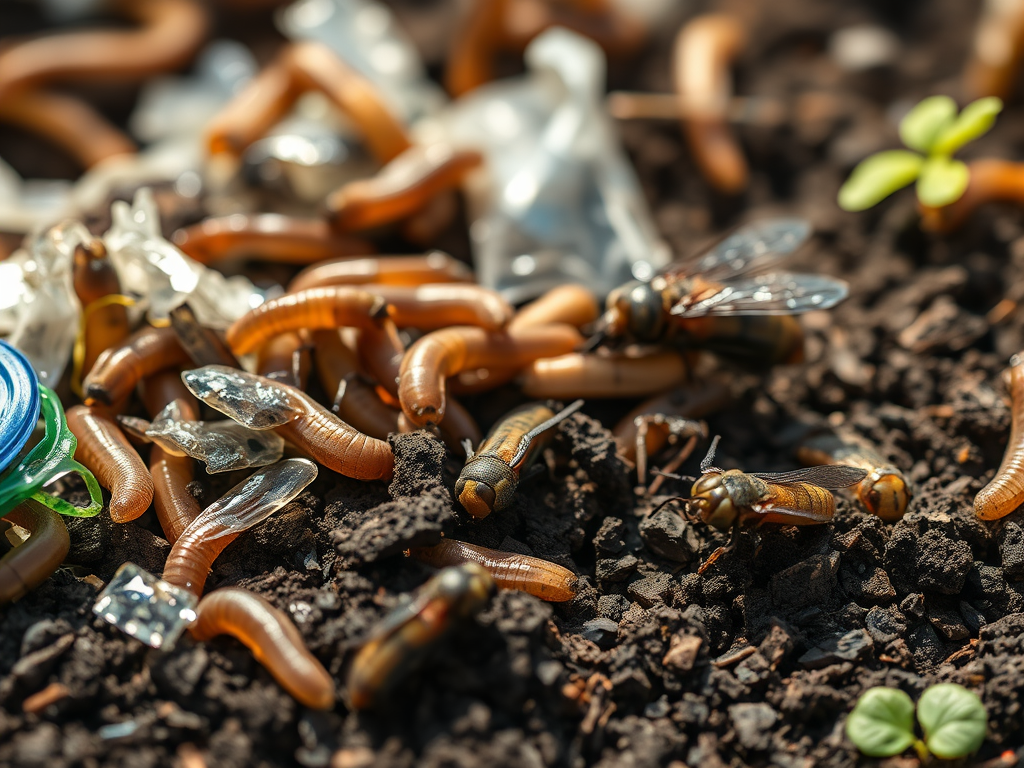
Managing plastic waste is a growing challenge, and conventional methods like landfilling, incineration, and recycling are insufficient. Sanchez-Hernandez and Megharaj , in their perspective published in Environmental Science and Ecotechnology, propose a novel two-step bioconversion system using insects to sustainably manage plastic waste and revalorize its by-products.
The first step involves using mealworms (Tenebrio molitor larvae) to partially biodegrade plastic waste. While mealworms can consume and partially degrade plastics like polystyrene and polyethylene, their digestion is incomplete, leaving microplastics in their frass (manure). This microplastic-containing frass is then pyrolyzed to produce biocharBiochar is a carbon-rich material created from biomass decomposition in low-oxygen conditions. It has important applications in environmental remediation, soil improvement, agriculture, carbon sequestration, energy storage, and sustainable materials, promoting efficiency and reducing waste in various contexts while addressing climate change challenges. More. PyrolysisPyrolysis is a thermochemical process that converts waste biomass into bio-char, bio-oil, and pyro-gas. It offers significant advantages in waste valorization, turning low-value materials into economically valuable resources. Its versatility allows for tailored products based on operational conditions, presenting itself as a cost-effective and efficient More is a thermochemical process that heats biomassBiomass is a complex biological organic or non-organic solid product derived from living or recently living organism and available naturally. Various types of wastes such as animal manure, waste paper, sludge and many industrial wastes are also treated as biomass because like natural biomass these More in the absence of oxygen, producing biochar with enhanced adsorptive properties.
The second step integrates this biochar into the entomocomposting of organic residues, such as food waste, using black soldier fly (Hermetia illucens) larvae. This process produces a nutrient-rich substrate enriched with carbon and nitrogen, termed “frasschar.” Frasschar can be used as a soil amendmentA soil amendment is any material added to the soil to enhance its physical or chemical properties, improving its suitability for plant growth. Biochar is considered a soil amendment as it can improve soil structure, water retention, nutrient availability, and microbial activity. More, contributing to improved soil fertility and resilience.
This integrated system offers a potential framework for large-scale industrial applications, contributing to the bioeconomy by addressing both plastic waste and organic residue management. It also highlights the potential of insect farming to address pressing environmental challenges and contribute to a circular economy.
Source: Sanchez-Hernandez, J. C., & Megharaj, M. (2025). Insect farming: A bioeconomy-based opportunity to revalorize plastic wastes. Environmental Science and Ecotechnology, 23, 100521. https://doi.org/10.1016/j.ese.2024.100521




Leave a Reply