
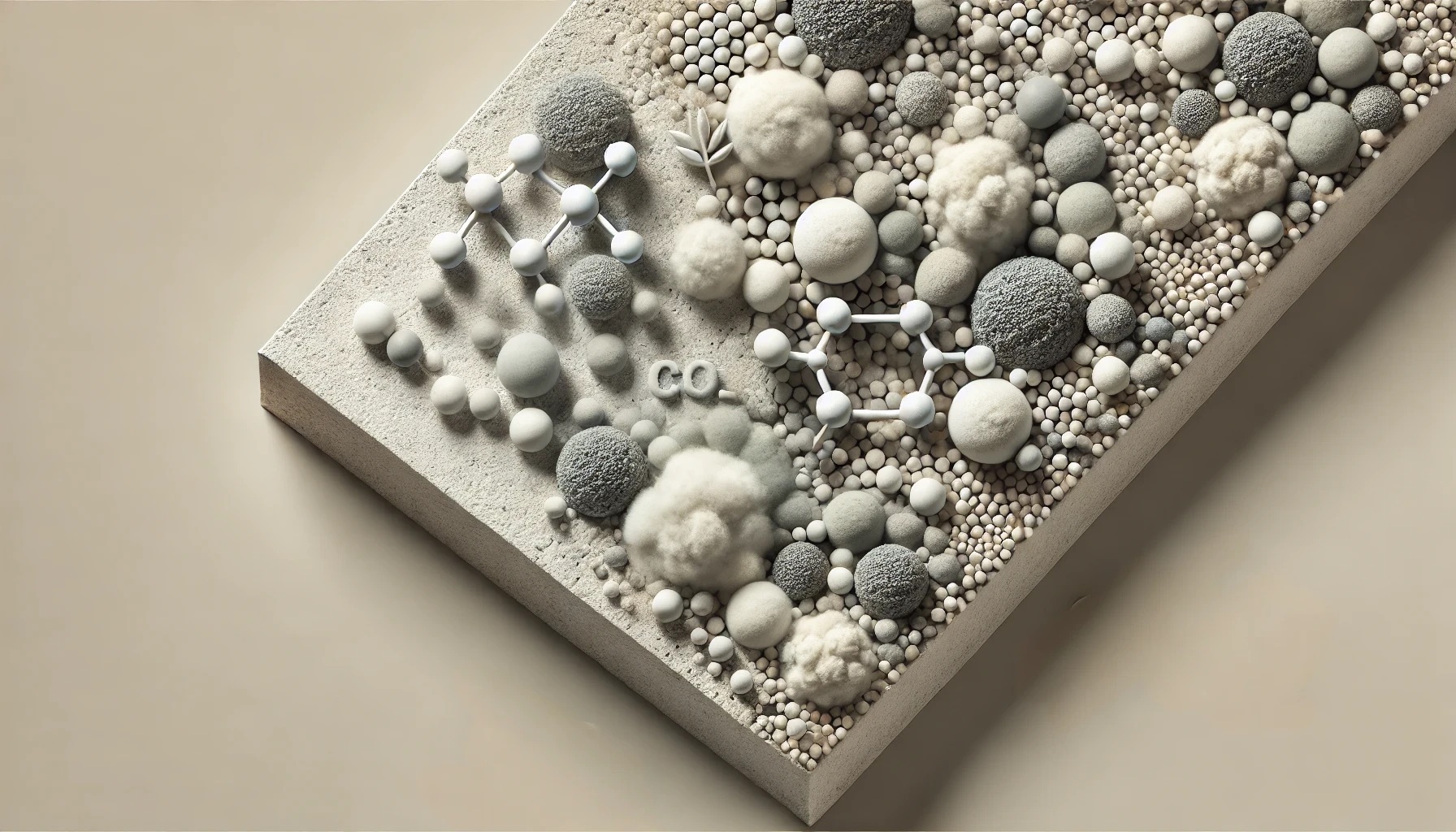
Concrete has long been recognized for its ability to absorb atmospheric CO2 through a process called carbonation, where CO2 reacts with cement hydrates to form calcium carbonate. While this offers potential for carbon sequestration, the process slows over time, limiting its overall effectiveness. A recent study explores a breakthrough solution: integrating porous biocharBiochar is a carbon-rich material created from biomass decomposition in low-oxygen conditions. It has important applications in environmental remediation, soil improvement, agriculture, carbon sequestration, energy storage, and sustainable materials, promoting efficiency and reducing waste in various contexts while addressing climate change challenges. More into concrete formulations to enhance carbonation kinetics and CO2 capture capacity.
Porous biochar, derived from the pyrolysisPyrolysis is a thermochemical process that converts waste biomass into bio-char, bio-oil, and pyro-gas. It offers significant advantages in waste valorization, turning low-value materials into economically valuable resources. Its versatility allows for tailored products based on operational conditions, presenting itself as a cost-effective and efficient More of seaweed, exhibits a unique structure with interconnected micropores, mesopores, and macropores, combined with a hydrophilic surface rich in oxygen groups. These features allow biochar to act as a reservoir for water and CO2, enabling deeper and faster carbonation in concrete. By retaining water, biochar promotes the development of capillary pores in the cement matrix, which are crucial for CO2 diffusion and the formation of calcium carbonate.
The study demonstrated that biochar-enriched concrete significantly outperforms traditional formulations in terms of CO2 uptake. Experimental results showed that biochar accelerates CO2 diffusion through the material by creating a more open and interconnected pore network. This increased porosityPorosity of biochar is a key factor in its effectiveness as a soil amendment and its ability to retain water and nutrients. Biochar’s porosity is influenced by feedstock type and pyrolysis temperature, and it plays a crucial role in microbial activity and overall soil health. Biochar More allows CO2 to penetrate deeper into the concrete and react more efficiently with the cement components. Additionally, biochar particles enhance the chemical environment for carbonation, forming dense layers of calcium carbonate at the interface between the biochar and cement matrix. These layers not only sequester CO2 but also improve the material’s structural integrity.
Numerical simulations further confirmed the role of biochar in improving CO2 diffusion. The simulations revealed that CO2 flow within biochar-enriched concrete is redirected toward the biochar particles, where it is adsorbed into the micropores. The CO2 then diffuses through the biochar’s macropores, enhancing its penetration into the cement matrix. This mechanism, combined with biochar’s high CO2 adsorption capacity, results in a substantial increase in carbonation efficiency.
Moreover, the study identified secondary carbonation mechanisms facilitated by biochar. The water-rich environment near the biochar particles allows for the dissolution and reprecipitation of calcium carbonate, further enhancing CO2 capture. This process resembles natural geological systems where carbonate weathering occurs, providing an additional pathway for CO2 sequestration within the concrete.
Incorporating biochar also addresses sustainability challenges in construction. Biochar production utilizes biomassBiomass is a complex biological organic or non-organic solid product derived from living or recently living organism and available naturally. Various types of wastes such as animal manure, waste paper, sludge and many industrial wastes are also treated as biomass because like natural biomass these More waste, offering a negative carbon footprint when the CO2 absorbed during biomass growth exceeds emissions from its processing. By substituting a portion of traditional cement materials with biochar, the construction sector can significantly reduce its carbon emissions while enhancing the performance of concrete.
This innovation positions concrete as more than just a structural material—it becomes an active tool for climate change mitigation. By integrating biochar into concrete, the industry can transform its largest material by volume into a carbon sink, aligning with global efforts to reduce greenhouse gas emissions. As this technology develops, it could revolutionize sustainable construction, making cities part of the solution to environmental challenges.
SOURCE: Mesnage, et al (2025) Porous biochar for improving the CO2uptake capacities and kinetics of concrete. Cement and Concrete Composites.https://doi.org/10.1016/j.cemconcomp.2025.105932




Leave a Reply