
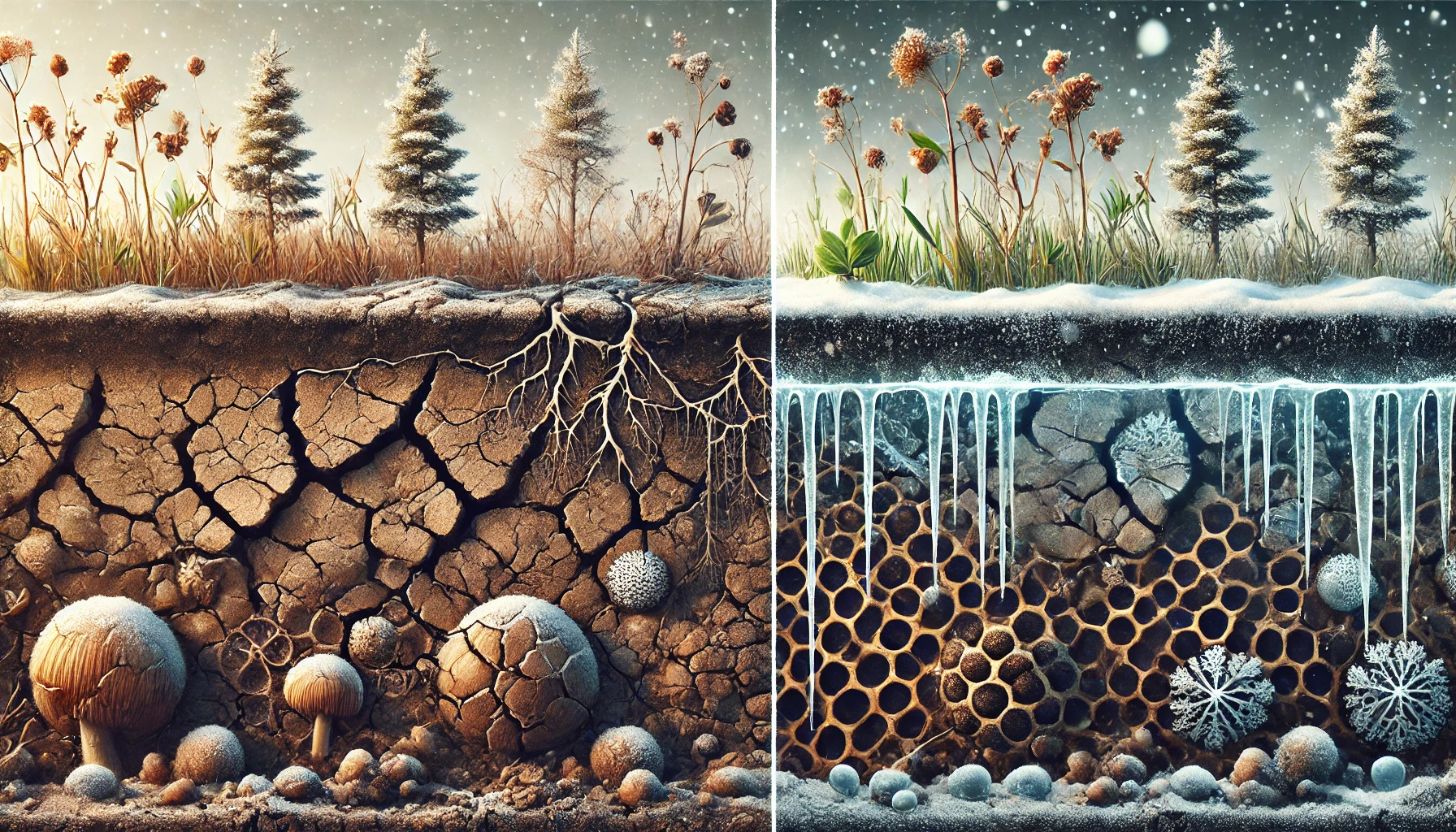
Seasonal freeze–thaw cycles significantly impact soil structure, reducing its ability to retain water and increasing its hydraulic conductivity. This effect poses challenges for agriculture, particularly in cold climates, as soil deformation and loss of water retention can hinder crop health. A recent study explored the use of peanut shell biocharBiochar is a carbon-rich material created from biomass decomposition in low-oxygen conditions. It has important applications in environmental remediation, soil improvement, agriculture, carbon sequestration, energy storage, and sustainable materials, promoting efficiency and reducing waste in various contexts while addressing climate change challenges. More as a soil amendmentA soil amendment is any material added to the soil to enhance its physical or chemical properties, improving its suitability for plant growth. Biochar is considered a soil amendment as it can improve soil structure, water retention, nutrient availability, and microbial activity. More to mitigate these effects, offering insights into improving soil properties in regions prone to freeze–thaw cycles.
The freeze–thaw process creates fissures and macropores in soil as water expands during freezing and contracts during thawing. This structural damage reduces water retention and increases hydraulic conductivity, particularly in clay soils. However, the study found that adding biochar to clay soil can significantly counteract these negative effects. Biochar’s porous structure helps to convert large soil pores into smaller micro- or meso-pores, improving water retention and reducing hydraulic conductivity across a range of conditions.
The researchers evaluated soil samples with varying biochar contents and subjected them to multiple freeze–thaw cycles. They discovered that biochar’s impact is most pronounced at higher concentrations and higher soil matric potentials. At these levels, biochar reduced soil deformation, increased water retention, and minimized the development of macropores. Interestingly, the soil’s total porosityPorosity of biochar is a key factor in its effectiveness as a soil amendment and its ability to retain water and nutrients. Biochar’s porosity is influenced by feedstock type and pyrolysis temperature, and it plays a crucial role in microbial activity and overall soil health. Biochar More increased with low biochar application rates but decreased at higher rates as freeze–thaw cycles progressed, suggesting the importance of optimizing biochar content for specific soil conditions.
Another notable finding was that biochar reduced the hydraulic conductivity of compacted soils, even under repeated freeze–thaw conditions. This improvement is attributed to biochar particles filling large soil pores and creating a more stable soil structure. Moreover, biochar-rich soils exhibited less frost heaving and more thaw settlement, characteristics that enhance soil stability and reduce water loss in cold climates.
These results emphasize the potential of biochar as a sustainable solution for improving agricultural soil resilience in cold regions. By enhancing water retention and mitigating the effects of freeze–thaw cycles, biochar can help maintain soil structure, reduce water loss, and support crop productivity. For effective application, however, farmers and land managers need to carefully consider soil composition, biochar type, and optimal application rates.
SOURCE: Chen, et al (2025) Biochar Amendment as a Mitigation Against Freezing–Thawing Effects on Soil Hydraulic Properties. Agronomy. https://doi.org/10.3390/agronomy15010137



Leave a Reply