
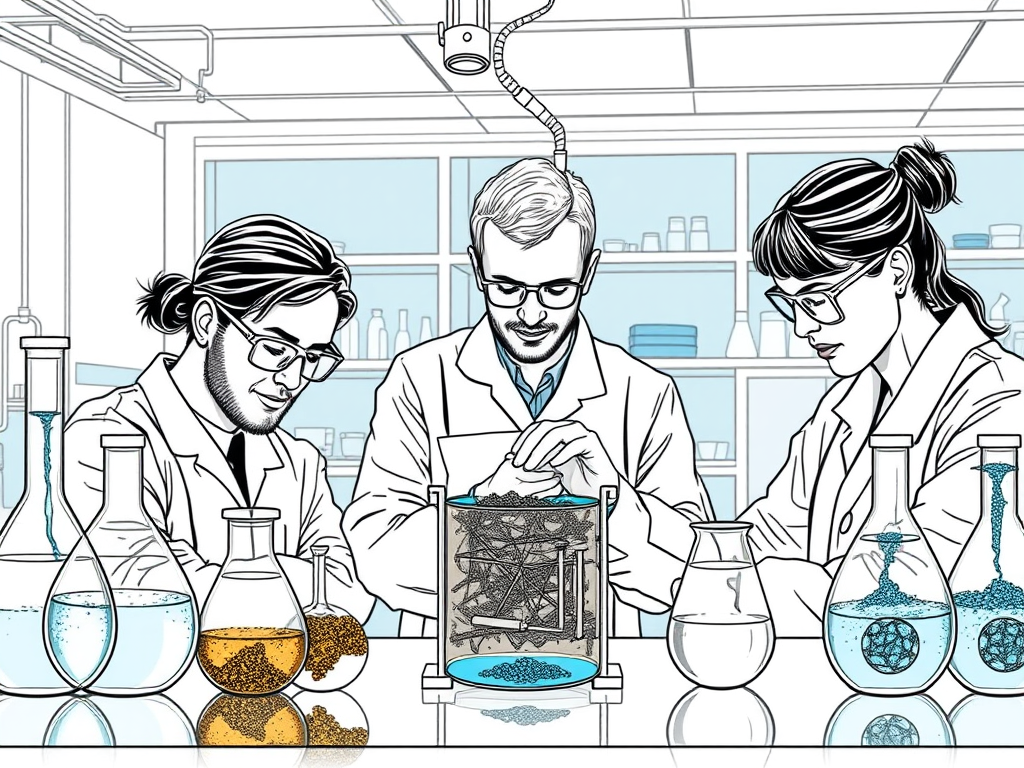
The global challenge of water scarcity intensifies, with projections indicating 3.9 billion people will face water deficits by 2030. This pressing issue underscores the critical need for effective wastewater purification, particularly given the increasing prevalence of contaminants like surfactants. These compounds, prevalent in everyday products and industrial discharge, pose significant environmental and health risks. A comprehensive review by Deepali Kulkarni, Dipika Jaspal, and Nilisha Itankar, published in Water Air Soil Pollut, investigates advanced strategies, specifically focusing on composite materials and adsorption methods, to combat surfactant pollution.
Surfactants, due to their unique chemical structure, interfere with microbial activity, leading to incomplete biodegradation in water systems. Their breakdown products can disrupt aquatic life by mimicking hormones and also impede agricultural productivity by reducing soil hydraulic conductivity. While traditional treatment methods such as biodegradation, coagulation-flocculation, and photocatalytic degradation exist, they frequently present limitations. For instance, biodegradation often falls short of achieving complete removal at higher concentrations, and chemical coagulants, despite their effectiveness, are often costly and can generate hazardous sludge. Photocatalytic techniques, while promising for mineralizing a wide range of pollutants, can be energy-intensive and require substantial operational space.
The review highlights adsorption as a particularly advantageous method for surfactant removal. Its ease of design, simplicity of use, adaptability across various treatment formats, and broad pHpH is a measure of how acidic or alkaline a substance is. A pH of 7 is neutral, while lower pH values indicate acidity and higher values indicate alkalinity. Biochars are normally alkaline and can influence soil pH, often increasing it, which can be beneficial More operability make it a favorable option. Moreover, adsorption is noted for its efficiency, cost-effectiveness, minimal energy requirements, and absence of harmful byproducts. Adsorbents can be derived from diverse materials, including biomassBiomass is a complex biological organic or non-organic solid product derived from living or recently living organism and available naturally. Various types of wastes such as animal manure, waste paper, sludge and many industrial wastes are also treated as biomass because like natural biomass these More products, nanomaterials, and various clays. Among these, biochar-based adsorbents emerge as a notably cost-effective and highly efficient solution for removing physicochemical pollutants, including surfactants. They are, on average, 60% less expensive than granular activated carbonActivated carbon is a form of carbon that has been processed to create a vast network of tiny pores, increasing its surface area significantly. This extensive surface area makes activated carbon exceptionally effective at trapping and holding impurities, like a molecular sponge. It is commonly More (GAC). For example, sludge-derived biocharBiochar is a carbon-rich material created from biomass decomposition in low-oxygen conditions. It has important applications in environmental remediation, soil improvement, agriculture, carbon sequestration, energy storage, and sustainable materials, promoting efficiency and reducing waste in various contexts while addressing climate change challenges. More (SBC) activated with peroxymonosulfate (PMS) demonstrated a 66.7% effectiveness in degrading triclosan.
The future of surfactant removal, according to the authors, hinges on the development of more efficient, economical, and environmentally friendly approaches, with a strong emphasis on composite and hybrid technologies. Composites, which combine two or more distinct materials, offer enhanced properties such as superior adsorption capacity, improved recyclability, and increased selectivity compared to individual materials. Illustratively, an eggshell-zeolite composite achieved an 88% Chemical Oxygen Demand (COD) removal rate in handwashing wastewater. Rice husk-derived biochar (RHB) demonstrated a 96.6% surfactant removal efficiency in shipboard bilgewater under optimal conditions. Furthermore, a composite of bentonite and Duranta erecta fruit powder mixed and embedded in alginate beads showed high adsorption capacities for CTAB, ranging between 2352 and 2862 mg/g.
Continued research into novel functional materials and the development of hybrid technologies, particularly those involving modified biochar and other biomass-based adsorbents, holds significant promise. These advancements aim to reduce production costs and enhance the overall effectiveness of wastewater treatment processes, steering towards a more sustainable circular economy. While challenges remain, notably in ensuring real-time applicability and preventing secondary contamination from carbon-based technologies, the ongoing innovations in composite design and adsorbent modification point to a cleaner and more sustainable future for global water resources.
Source: Kulkarni, D., Jaspal, D., & Itankar, N. (2025). Methods and Composites for Surfactant Removal From Wastewater: A Review. Water Air Soil Pollut, 236



Leave a Reply