
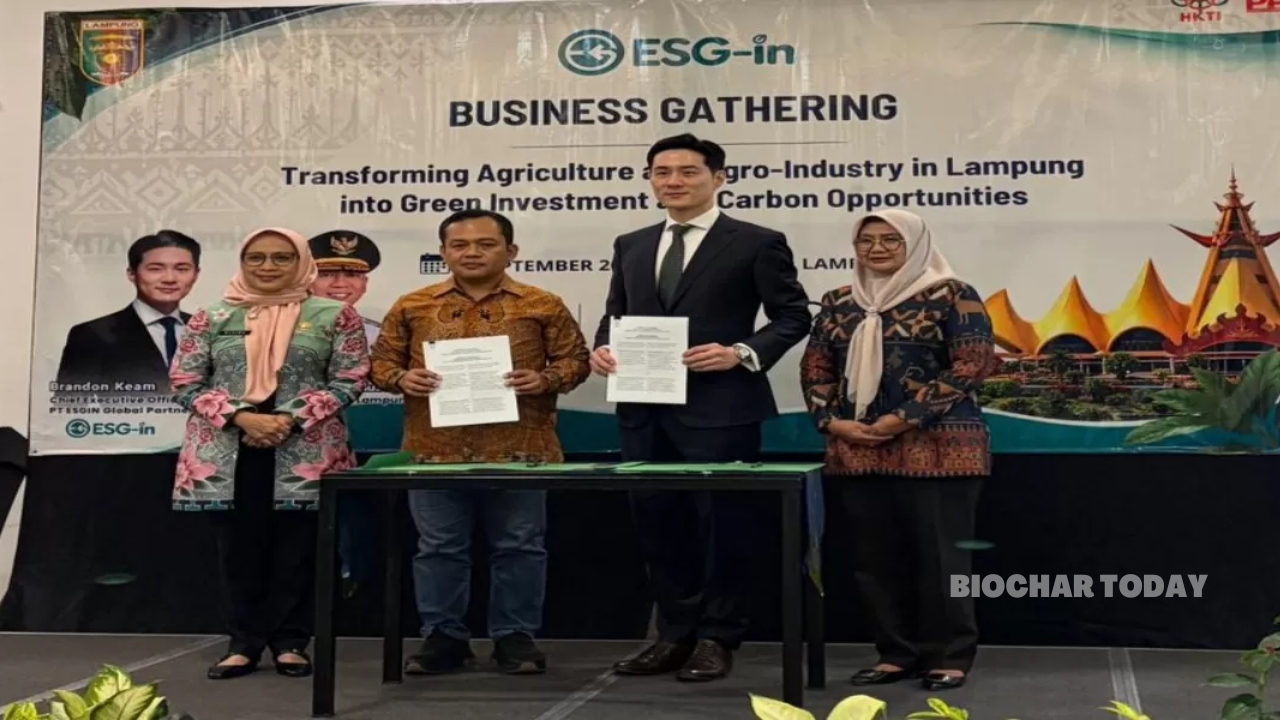
PT ESGIN Global Partners (ESGIN) has advanced a multi-sector decarbonization initiative in Indonesia through targeted agreements with the Indonesian Tapioca Flour Entrepreneurs Association (PPTTI) and cattle farming operator PT Juang Jaya Abdi Alam. Confirmed during the ESGIN Business Gathering 2026 in Lampung, the collaboration establishes an industrial climate project pipeline. The framework combines methane mitigation across 23 tapioca processing plants with a dedicated commercial biocharBiochar is a carbon-rich material created from biomass decomposition in low-oxygen conditions. It has important applications in environmental remediation, soil improvement, agriculture, carbon sequestration, energy storage, and sustainable materials, promoting efficiency and reducing waste in various contexts while addressing climate change challenges. More development initiative utilizing local agricultural and livestock residues.
The agricultural and agro-industrial sectors in Lampung generate significant volumes of organic waste, creating severe environmental management challenges. Industrial tapioca processing produces high-strength organic wastewater that releases substantial amounts of methane during anaerobic degradation. Concurrently, regional livestock operations and crop farming generate vast quantities of cattle manure and rice straw. Managing these unutilized agricultural residues presents persistent logistical difficulties and environmental risks when left untreated.
To address these waste streams, ESGIN signed a Memorandum of Agreement with PT Juang Jaya Abdi Alam, leverage its population of approximately 20,000 cattle to process livestock manure combined with rice straw biomassBiomass is a complex biological organic or non-organic solid product derived from living or recently living organism and available naturally. Various types of wastes such as animal manure, waste paper, sludge and many industrial wastes are also treated as biomass because like natural biomass these More into high-grade biochar. The process incorporates digital Monitoring, Reporting, and Verification (Digital MRV) and rigorous carbon accounting frameworks to assess carbon-removal durability. Simultaneously, ESGIN is deploying methane capture, destruction, and utilization technologies across the 23 PPTTI-affiliated tapioca facilities to directly eliminate industrial wastewater emissions.
The partnership with PT Juang Jaya Abdi Alam targets a potential biochar production capacity of up to 30,000 tons annually, providing the local agricultural sector with a biochar soil amendmentA soil amendment is any material added to the soil to enhance its physical or chemical properties, improving its suitability for plant growth. Biochar is considered a soil amendment as it can improve soil structure, water retention, nutrient availability, and microbial activity. More to enhance soil quality and support sustainable farming. Furthermore, the combined tapioca wastewater treatment and biochar initiatives establish an initial project pipeline projected to yield approximately 500,000 tons of CO₂ equivalent in total emission reductions. The initiatives also lay the technical foundation for future carbon credit registration, green financing, and carbon market participation in Southeast Asia.




Leave a Reply