
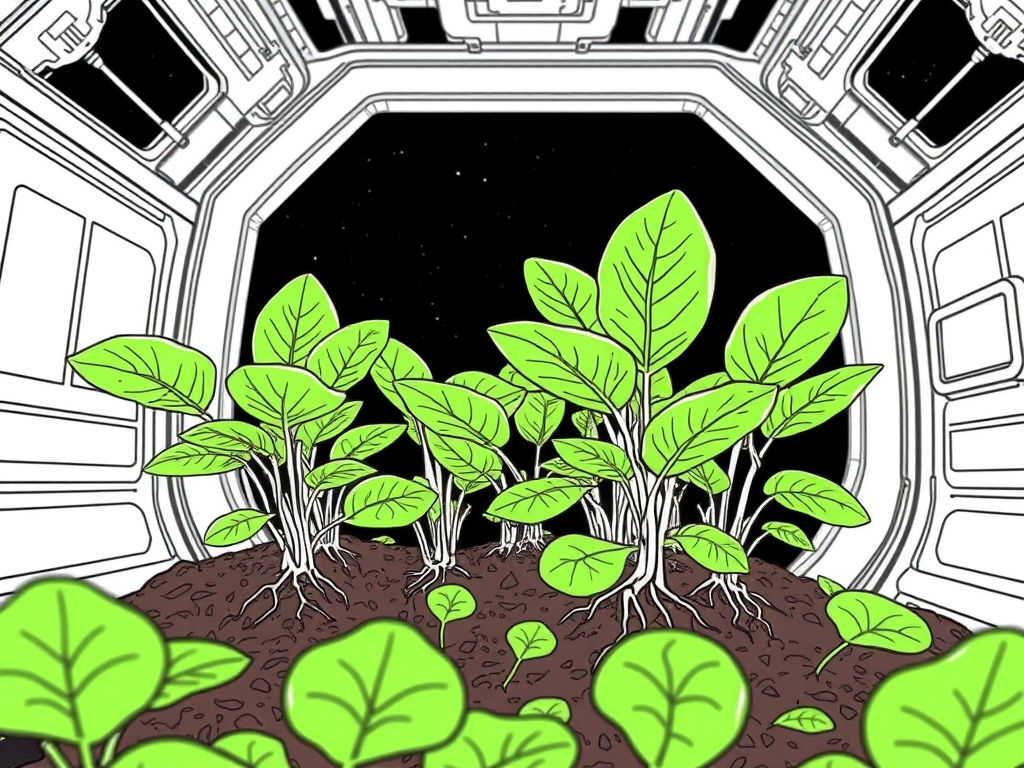
Study by Charles Wang Wai Ng and Yu Chen Wang, published in npj Microgravity, investigates a crucial aspect of future space exploration: enhancing plant growth in microgravity conditions. Their research explores the effectiveness of soil conditioning using biocharBiochar is a carbon-rich material created from biomass decomposition in low-oxygen conditions. It has important applications in environmental remediation, soil improvement, agriculture, carbon sequestration, energy storage, and sustainable materials, promoting efficiency and reducing waste in various contexts while addressing climate change challenges. More and hydrochar to support the cultivation of Malabar Spinach, a commonly grown vegetable, under simulated microgravity.
Growing plants in outer space is essential for bioregenerative life support systems, providing oxygen through photosynthesis and a renewable food source for extended human missions. However, space presents formidable challenges for plant cultivation, including nutrient deficiencies, limited water, and altered gravity. The study aimed to understand how biochar and hydrochar, derived from biomassBiomass is a complex biological organic or non-organic solid product derived from living or recently living organism and available naturally. Various types of wastes such as animal manure, waste paper, sludge and many industrial wastes are also treated as biomass because like natural biomass these More, could help plants adapt to these harsh extraterrestrial conditions.
Biochar is known to improve soil fertility, enhance water retention, and promote beneficial microbial activity on Earth. Hydrochar, produced through hydrothermal carbonization of biomass in the presence of water, offers similar benefits and typically has a lower pHpH is a measure of how acidic or alkaline a substance is. A pH of 7 is neutral, while lower pH values indicate acidity and higher values indicate alkalinity. Biochars are normally alkaline and can influence soil pH, often increasing it, which can be beneficial More, which can be advantageous in certain soil types. While their terrestrial benefits are established, their impact on plant development in low-gravity environments remained largely unknown.
The researchers simulated microgravity using a Random Positioning Machine (RPM) and grew Malabar Spinach for 18 days. They found that microgravity significantly inhibited plant growth, reducing the fresh biomass accumulation of Malabar Spinach by up to 71%. This reduction was primarily due to hindered leaf and root growth, impacting light interception and nutrient uptake.
However, the application of soil conditioners showed promising results. Biochar proved more effective than hydrochar in promoting plant production under microgravity. For instance, biochar treatment enhanced the fresh biomass accumulation of Malabar Spinach by 344% compared to control soil in microgravity. Both biochar and hydrochar also significantly increased leaf area enlargement, with biochar showing up to a 109% improvement by day 16, regardless of gravity conditions. The study attributed biochar’s superior performance to its abundant mineral nutrients, such as potassium (K), phosphorus (P), and calcium (Ca), which contribute to improved leaf and root growth.
Interestingly, microgravity, in the presence of biochar, significantly enhanced the biosynthesis of chlorophyll a and carotenoids in Malabar Spinach leaves by up to 36%. This suggests an amplified stimulation of plant pigment biosynthesis when microgravity and biochar treatment occur together. Furthermore, both biochar and hydrochar treatments under microgravity conditions significantly increased nutrient contents, specifically K and P, in the leaves. K content increased by up to 174% with biochar treatment, and microgravity further boosted K uptake by 22% and 25% in the presence of biochar and hydrochar, respectively. Plant P content also saw a 38-52% increase with soil conditioners, and microgravity further improved P levels by 31% with hydrochar treatment.
Another critical finding related to the accumulation of potentially toxic metals. Microgravity significantly increased plant cadmium (Cd) accumulation by up to 114%, regardless of soil conditions. However, hydrochar remarkably reduced plant Cd accumulation by 36% under microgravity, while biochar reduced it by 9%. This reduction is due to the immobilization of heavy metals in the soil by the conditioners, decreasing their bioavailability to the plant.
This research underscores the potential of biochar and hydrochar as vital soil conditioners for future extraterrestrial agriculture. By mitigating the inhibitory effects of microgravity on plant growth and simultaneously enhancing nutrient uptake and reducing toxic metal accumulation, these materials offer promising solutions for sustainable food production in space environments.
Source: Ng, C. W. W., & Wang, Y. C. (2025). Soil conditioning for enhancing plant growth using biochar and hydrochar under microgravity. npj Microgravity, 11(1), 31



Leave a Reply