
Key Takeaways
- Modified plant waste can be turned into biochar- a powerful tool for cleaning carbon dioxide from the air.
- Adding specific elements like nitrogen and phosphorus helps the material grab onto carbon more tightly.
- These advanced materials are much more effective at capturing pollution than regular charcoalCharcoal is a black, brittle, and porous material produced by heating wood or other organic substances in a low-oxygen environment. It is primarily used as a fuel source for cooking and heating. More.
- The materials are reusable, meaning they can be cleaned and used many times without losing their strength.
- This technology provides a cheaper and more eco-friendly way to fight global warming using natural leftovers.
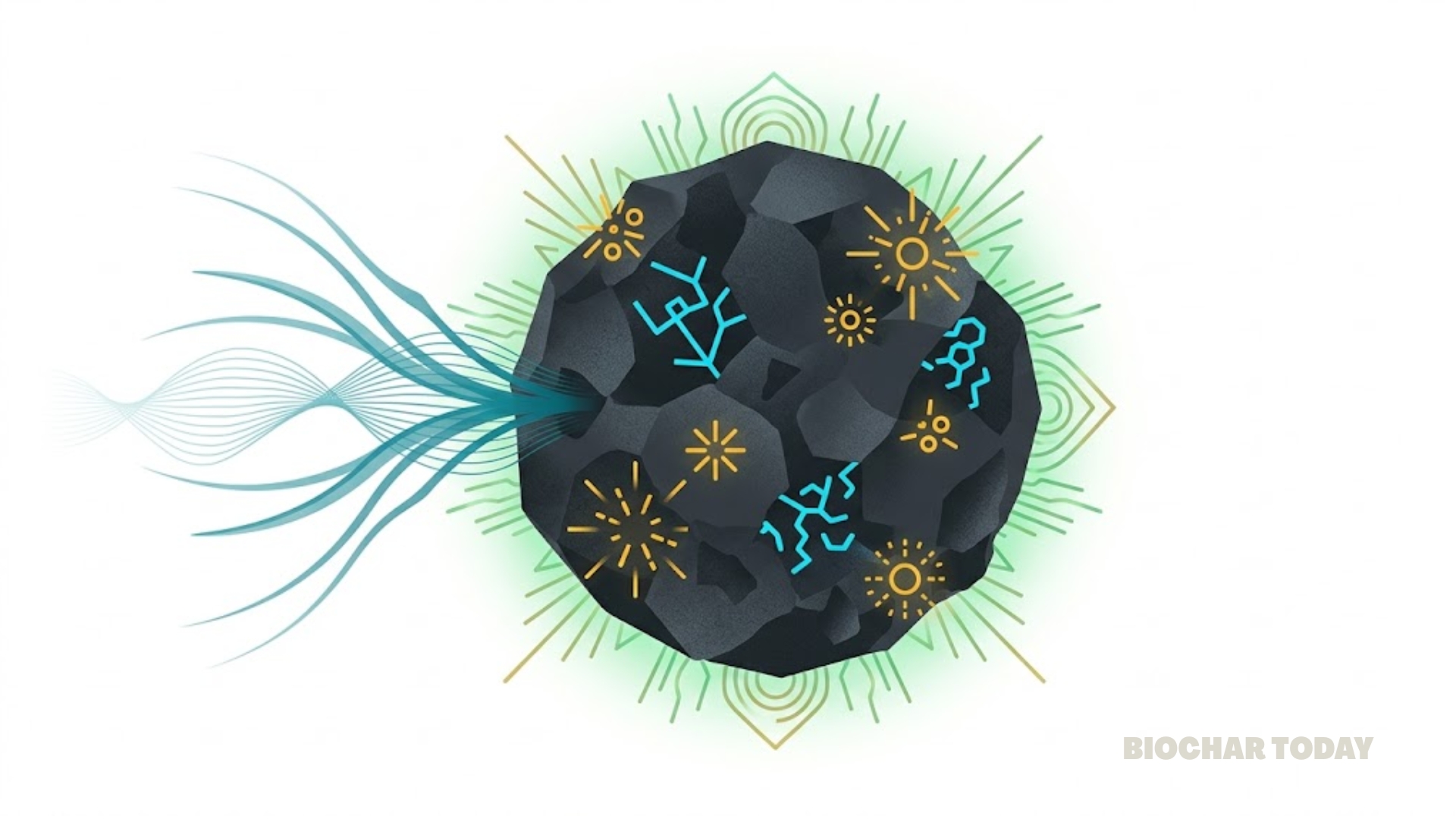
In a comprehensive review published in the journal Carbon Research, authors Xiangping Li, Xuanxuan Li, and their research team evaluate the transformation of biocharBiochar is a carbon-rich material created from biomass decomposition in low-oxygen conditions. It has important applications in environmental remediation, soil improvement, agriculture, carbon sequestration, energy storage, and sustainable materials, promoting efficiency and reducing waste in various contexts while addressing climate change challenges. More from a simple agricultural byproduct into a sophisticated tool for carbon capture. The global increase in atmospheric carbon dioxide has created an urgent need for carbon capture, utilization, and storage technologies that are both affordable and scalable. While traditional biochar is known for being environmentally friendly and cost-effective, its natural state often lacks the complex pore structure and surface chemistry required for high-level gas capture. To overcome these limitations, the researchers focus on engineered biochar, which is modified through a process called heteroatom doping to fundamentally change how the material interacts with greenhouse gases.
The primary strategy discussed involves introducing elements such as nitrogen, sulfur, phosphorus, and boron into the carbon framework of the biochar. Among these, nitrogen doping has emerged as a leading approach because nitrogen atoms can effectively regulate the material’s electronic structure. This modification enhances the dual effects of physical and chemical attraction, allowing the biochar to act like a molecular sponge that specifically targets carbon dioxide. The study highlights that nitrogen-doped materials often achieve double the adsorption energy of their unmodified counterparts. Furthermore, when nitrogen is combined with phosphorus, the resulting co-doped material shows even greater performance, achieving carbon uptake capacities of up to 5.68 millimoles per gram at higher pressures.
The researchers also distinguish between two main ways to add these beneficial elements: pre-modification and post-modification. Pre-modification, which involves adding the special elements during the initial charring of the biomassBiomass is a complex biological organic or non-organic solid product derived from living or recently living organism and available naturally. Various types of wastes such as animal manure, waste paper, sludge and many industrial wastes are also treated as biomass because like natural biomass these More, generally results in better efficiency and a more stable structure. For example, using materials like longan shells or water chestnut shells as a base and treating them with nitrogen-rich sources can produce a material with exceptional surface area. Some of these engineered carbons exhibit surface areas as high as 2784 square meters per gram. This massive internal surface area, combined with the chemical attraction of the added atoms, ensures that the carbon dioxide is trapped efficiently even when it is present in low concentrations, such as in industrial exhaust or ambient air.
Beyond just grabbing the carbon dioxide, a critical finding of the research is the reusability of these engineered materials. For any carbon capture technology to be industrially viable, the material must be able to release the captured gas so it can be stored or used, and then be ready to capture more. The study found that most of these advanced biochars could be reused for many cycles without significant loss in performance. Some materials, such as those modified with magnesium or nitrogen-rich compounds, maintained nearly all of their capacity after 10 to 25 separate uses. This durability is essential for reducing the overall cost of carbon capture systems and making them competitive with more expensive synthetic alternatives like metal-organic frameworks.
The review concludes that while there are still hurdles to overcome, such as the energy cost of regenerating the materials and the need for standardized production protocols, engineered biochar represents a major step forward. By using machine learning to design better materials and focusing on sustainable feedstocks like sewage sludge, animal manure, and wood waste, the industry can create a circular economy that turns waste into a climate solution. The synergy between high mechanical stability, low production costs, and tunable chemical properties makes these doped biochars a highly promising candidate for large-scale deployment in the global effort to mitigate the impacts of climate change and reach net-zero emission goals.
Source: Li, X., Li, X., Zhang, C., Yu, Y., Liu, Q., Hordagoda, M., Ding, W., Xu, S., Ariyadasa, T. U., Nimarshana, P. H. V., Qin, X., & Liang, P. (2026). Recent advances in the development of engineered biochar for CO2 adsorption: Research on heteroatom-doped biochar. Carbon Research, 5(26).




Leave a Reply