
Key Takeaways
- Modified biocharBiochar is a carbon-rich material created from biomass decomposition in low-oxygen conditions. It has important applications in environmental remediation, soil improvement, agriculture, carbon sequestration, energy storage, and sustainable materials, promoting efficiency and reducing waste in various contexts while addressing climate change challenges. More significantly improves contaminant removal efficiency and nutrient retention compared to traditional unmodified biochar materials.
- Agricultural and forestry wastes serve as the primary raw feedstocks for producing engineered biochars in tropical regions.
- Metal and mineral modifications successfully target severe tropical soil challenges such as extreme acidity and high phosphorus fixation.
- Advanced surface engineering achieves contaminant removal rates exceeding ninety percent within rapid reaction timeframes.
- Long-term stability and field-scale validation remain critical areas requiring further research in dynamic tropical pedoenvironments.
Tropical agricultural soils face persistent hurdles including low natural fertility, severe acidity, high aluminum toxicity, and intense nutrient leachingLeaching is the process where nutrients are dissolved and carried away from the soil by water. This can lead to nutrient depletion and environmental pollution. Biochar can help reduce leaching by improving nutrient retention in the soil. More that challenge global food security and environmental sustainability. Traditional reliance on heavy mineral fertilization often generates adverse environmental impacts while failing to overcome chemical constraints like strong phosphorus fixation. Although pristine biochar offers notable benefits for carbon sequestration and soil conditioning, it frequently lacks the specific surface reactivity needed to immobilize toxic elements or supply immediate nutrients under harsh weathering conditions. To bridge this gap, researchers and engineers have increasingly turned to material modifications and chemical doping to tailor biochar properties for distinct agricultural and environmental goals.
The review synthesizes data from seventy-nine original peer-reviewed studies to map how geographic origin, biomassBiomass is a complex biological organic or non-organic solid product derived from living or recently living organism and available naturally. Various types of wastes such as animal manure, waste paper, sludge and many industrial wastes are also treated as biomass because like natural biomass these More selection, and modification strategies interconnect across tropical regions. China, Brazil, India, and Indonesia emerge as the leading contributors to this growing scientific literature, reflecting the urgent need for scalable soil management strategies in vulnerable agroecosystems. Agricultural and forestry residues predominate as the most accessible raw feedstocks, while pyrolysisPyrolysis is a thermochemical process that converts waste biomass into bio-char, bio-oil, and pyro-gas. It offers significant advantages in waste valorization, turning low-value materials into economically valuable resources. Its versatility allows for tailored products based on operational conditions, presenting itself as a cost-effective and efficient More temperatures maintained between 300 and 500 degrees Celsius are most commonly employed to preserve beneficial oxygen-containing functional groups. Metal and mineral impregnation strategies dominate the literature, serving as effective mechanisms for contaminant immobilization, whereas soil fertility enhancements frequently utilize unmodified or minimally altered carbon materials.
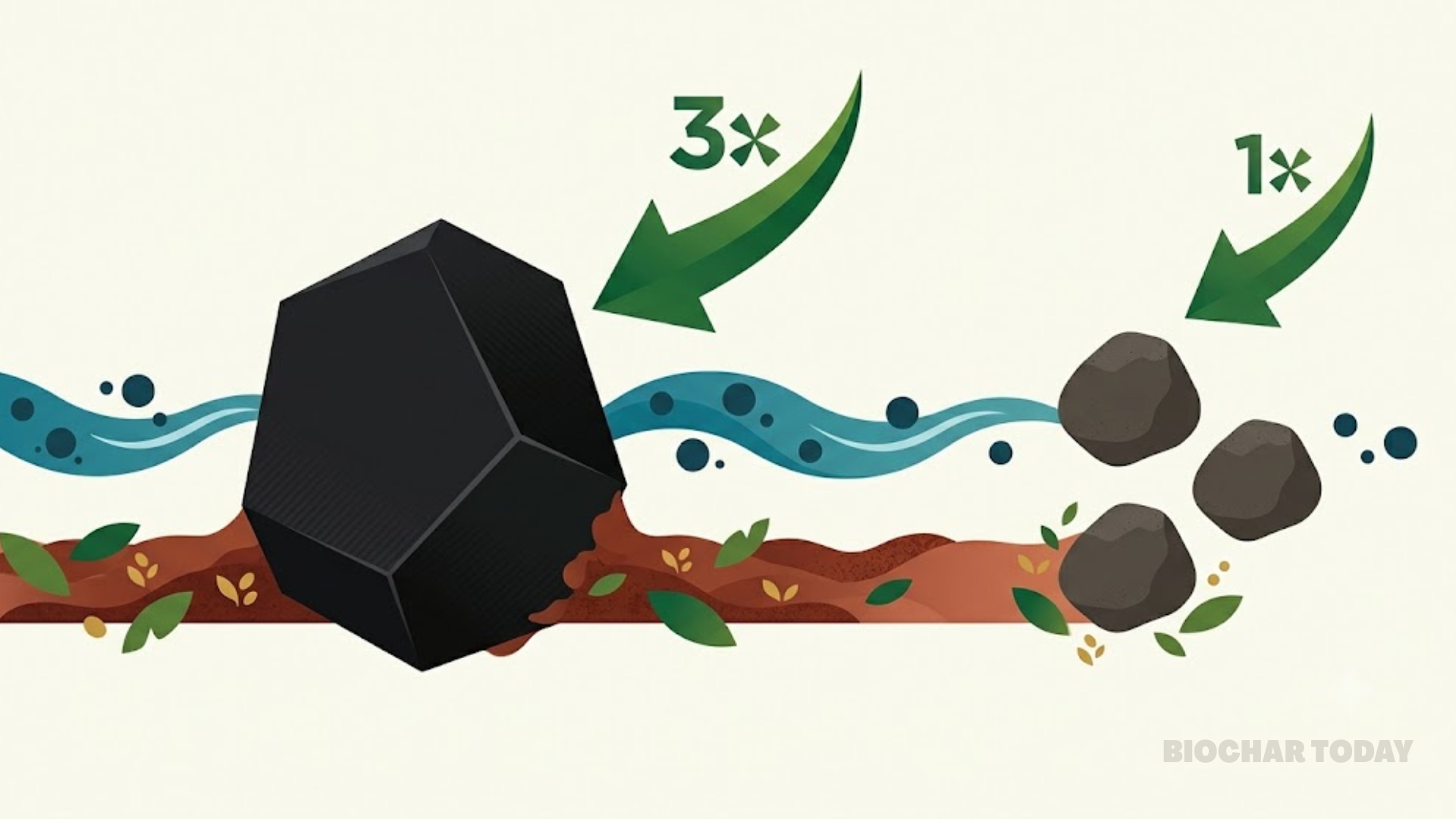
Across the evaluated studies, engineered biochars frequently outperformed pristine materials by approximately two to threefold in specific sorption capacity and reaction kinetics. Metal-loaded and heteroatom-doped biochars achieved contaminant removal efficiencies exceeding ninety percent in water treatment applications, while magnesium and biological enrichments successfully elevated phosphorus availabilityPhosphorus is another essential nutrient for plant growth, but it can sometimes be locked up in the soil and unavailable to plants. Biochar can help release phosphorus from the soil and make it more accessible to plants, reducing the need for chemical fertilizers. More and crop yields in acidic tropical soils. Despite these promising laboratory advancements, the authors emphasize that critical knowledge gaps persist regarding the long-term stability of modified biochars, potential modifier leaching, and performance validation under dynamic field conditions.
Source: Soares, M. B., Oliveira, I. K. R. de, & Alleoni, L. R. F. (2026). Modified biochar in tropical environments: trends, applications and future perspectives. Scientia Agricola, 83, e20260138.


Leave a Reply