
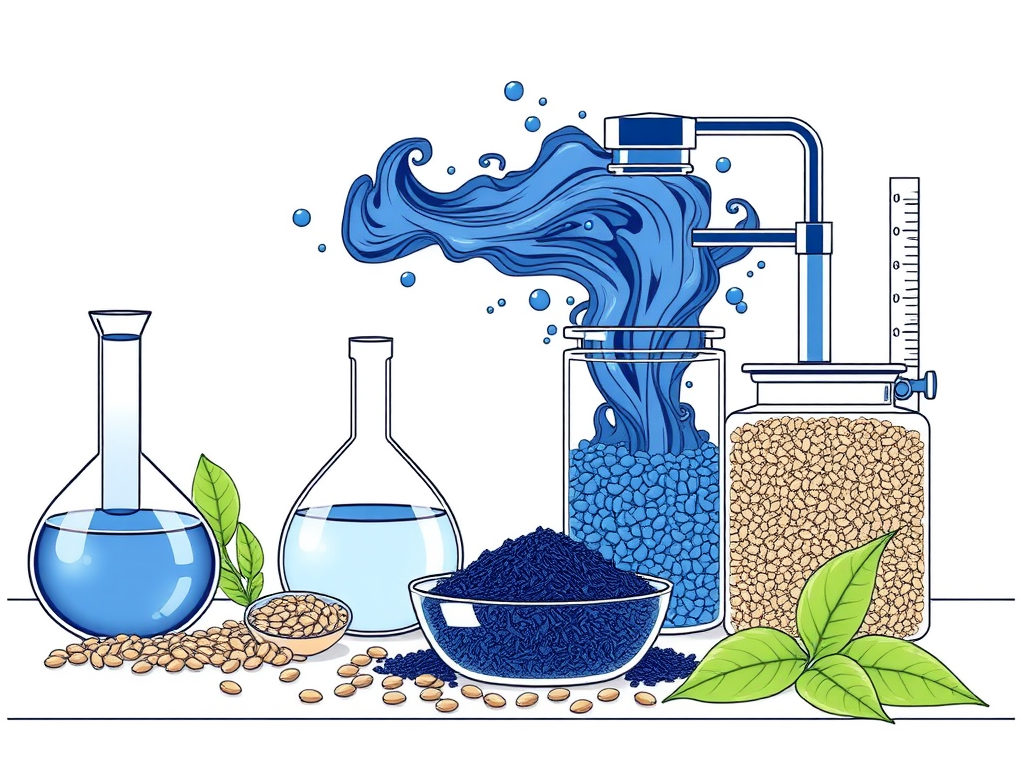
In a recent study published in Applied Water Science, researchers Mai ElKammah, Elsayed Elkhatib, and Maneea Moubarak investigated a highly effective and sustainable solution for wastewater treatment: green nanostructured modified biocharBiochar is a carbon-rich material created from biomass decomposition in low-oxygen conditions. It has important applications in environmental remediation, soil improvement, agriculture, carbon sequestration, energy storage, and sustainable materials, promoting efficiency and reducing waste in various contexts while addressing climate change challenges. More. Their work focuses on the efficient elimination of indigo carmine (IC) dye, a common and hazardous pollutant from textile industries, using nano-activated biochar derived from Moringa oleifera seeds (nMOSAB).
Synthetic dyes are a major contributor to environmental contamination, with industries like textiles, paper, and plastics releasing effluents laden with non-biodegradable, toxic byproducts. Indigo carmine, an anionic dye, is widely used in textile dyeing, particularly for denim, and its presence in wastewater necessitates effective treatment methods to mitigate its harmful effects. While various techniques such as advanced oxidation processes and membrane separation exist, adsorption methods using waste materials offer a practical and promising approach due to their sustainability and reusability. Biochar has emerged as an excellent candidate for sequestering contaminants in wastewater. Its microporous structure and large specific surface area enhance its efficacy. The researchers synthesized nMOSAB by grinding Moringa oleifera seeds and subjecting them to thermal pyrolysisPyrolysis is a thermochemical process that converts waste biomass into bio-char, bio-oil, and pyro-gas. It offers significant advantages in waste valorization, turning low-value materials into economically valuable resources. Its versatility allows for tailored products based on operational conditions, presenting itself as a cost-effective and efficient More at temperatures exceeding 600°C, resulting in nano-sized biochar particles.
The performance of nMOSAB in removing IC dye was remarkable. The nano-biochar exhibited a maximum adsorption capacity of 344.8 mg/g, a staggering 9.5 times greater than that of bulk biochar particles. This high capacity is attributed to various chemical interactions, including pi-pi interactions, hydrogen bonding, and electrostatic interactions during the adsorption process. Thermodynamic analyses further confirmed that the adsorption process is both spontaneous and exothermic, meaning it occurs naturally and releases heat. The researchers optimized the adsorption conditions, finding that a pHpH is a measure of how acidic or alkaline a substance is. A pH of 7 is neutral, while lower pH values indicate acidity and higher values indicate alkalinity. Biochars are normally alkaline and can influence soil pH, often increasing it, which can be beneficial More of 4, a contact time of 90 minutes, and an adsorbent dosage of 100 mg of nMOSAB yielded the best results. Under these optimal conditions, nMOSAB achieved an impressive 97.5% removal rate of IC from wastewater. The kinetics of the adsorption process were best described by the pseudo-second-order model and power function model, indicating that the adsorption rate is primarily controlled by chemical adsorption.
Beyond laboratory conditions, the effectiveness of nMOSAB was tested using actual textile wastewater. Through traditional batch tests and a packed-bed system, the removal efficiency for IC was determined to be 91.6% and 89.6%, respectively. While slightly lower than the 96.8% and 95.2% removal rates observed in distilled water solutions, this modest reduction is likely due to the complex, heterogeneous nature of real textile effluents and the presence of other contaminants. The reusability of nMOSAB was also evaluated, demonstrating its economic feasibility. After four adsorption-desorption cycles, nMOSAB maintained a significant removal efficiency of 80.3%. Even in the fifth cycle, the removal efficiency was still 75%. This highlights the great adsorption capability and stability of nMOSAB over multiple uses.
This research clearly demonstrates the potential of nano-biochar derived from Moringa oleifera seeds as an efficient, eco-friendly, and economical adsorbent for the removal of IC dyes from wastewater. While further studies are needed to explore its efficacy in removing a wider range of pollutants and its long-term stability, this study provides a novel and promising solution for addressing industrial dye contamination.
Source: ElKammah, M., Elkhatib, E., & Moubarak, M. (2025). Effective elimination of indigo carmine in wastewater using green nanostructured modified biochar: optimization, sorption equilibrium, kinetics, thermodynamics and mechanisms. Applied Water Science, 15(194).



Leave a Reply