
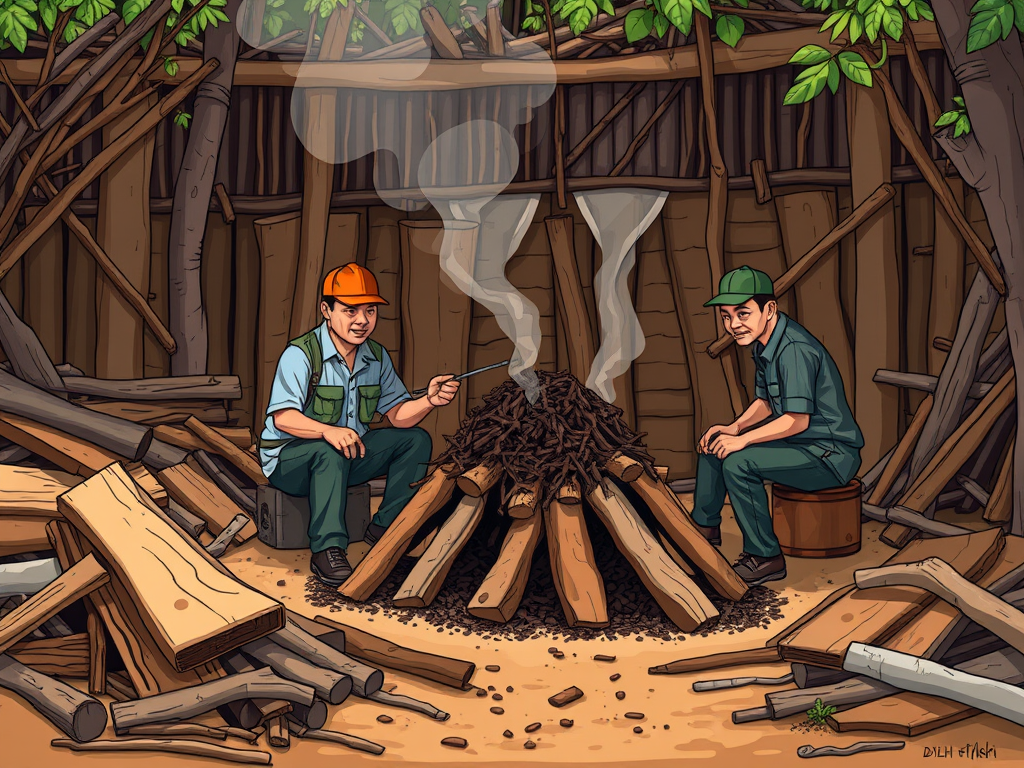
The Dharmasraya Environmental Agency (DLH) has executed an applied research trial (kajiterap) focused on producing biocharBiochar is a carbon-rich material created from biomass decomposition in low-oxygen conditions. It has important applications in environmental remediation, soil improvement, agriculture, carbon sequestration, energy storage, and sustainable materials, promoting efficiency and reducing waste in various contexts while addressing climate change challenges. More from local organic waste streams. The trial took place at the Sitiung V Rabusa Final Disposal Site (TPA), utilizing a straightforward pyrolysisPyrolysis is a thermochemical process that converts waste biomass into bio-char, bio-oil, and pyro-gas. It offers significant advantages in waste valorization, turning low-value materials into economically valuable resources. Its versatility allows for tailored products based on operational conditions, presenting itself as a cost-effective and efficient More method to process surplus materials into a high-value agricultural input.
The initiative saw DLH staff conduct the trial last week. Head of DLH Dharmasraya, Budi Waluyo, confirmed that the method employed was the simple Kon Tiki technique, which was originally developed by the Agricultural Research and Development Agency (Litbang Pertanian). This choice of methodology is critical, as the simplicity and efficiency of the Kon Tiki system allows the agency to leverage readily available materials—specifically, the significant volume of wood construction remnants and tree branches commonly found accumulated at the TPA—without requiring complex, high-capital infrastructure.
The resulting biochar product is slated for post-processing refinement, where it will be pulverized before distribution for use by local farmers. The DLH views this utilization of organic waste as a strategic two-pronged approach. Firstly, it provides a functional means to significantly reduce the overall accumulation of waste at the TPA, alleviating environmental pressures. Secondly, it offers tangible economic value.
Mr. Waluyo noted that the biochar project holds the clear potential to contribute to the region’s Local Own-Source Revenue (PAD). This projection is grounded in the success of the TPA’s existing waste management strategy, which has successfully processed other organic waste into compost, generating consistent revenue streams for the government over the last two years. This track record serves as a model for the new biochar venture.
The agency indicated that a formal, comprehensive report detailing the outcomes of the trial will be completed and published subsequent to simple field testing of the biochar on local agricultural land. This rigorous, measured approach ensures the innovation provides maximum added value for the agricultural sector in Dharmasraya. The successful implementation of the trial positions biochar production as a core element in the region’s waste diversion and circular economy policy moving forward, marking a focused effort to integrate environmental stewardship with local economic development.
SOURCE: DLH Dharmasraya Lakukan Uji Coba Produksi Biochar dari Sampah Organik


![Eucalyptus Wood Waste-Derived Biochar Achieves a Ninety-Eight Percent Removal Efficiency for Benzo[ghi]perylene in Vehicle-Wash Wastewater](https://biochartoday.com/wp-content/uploads/2026/10/SCIENCE-BLOGS-2026-2026-10-19T160523.703.jpg)

Leave a Reply