
Key Takeaways
- Removing nitrogen atoms creates active pentagon-vacancy defects in agricultural biocharBiochar is a carbon-rich material created from biomass decomposition in low-oxygen conditions. It has important applications in environmental remediation, soil improvement, agriculture, carbon sequestration, energy storage, and sustainable materials, promoting efficiency and reducing waste in various contexts while addressing climate change challenges. More frameworks.
- Defect-engineered biochar converts traditional electron-donating carbon into a high-capacity electron-accepting sink.
- Electrophilic biochar selectively generates acetylperoxyl radicals with over 99 percent reaction purity.
- The catalyst sustains high-flux radical output and pollutant removal over 260 hours.
- Wind-powered biochar production combined with permanent carbon storage enables a net-negative carbon footprint.
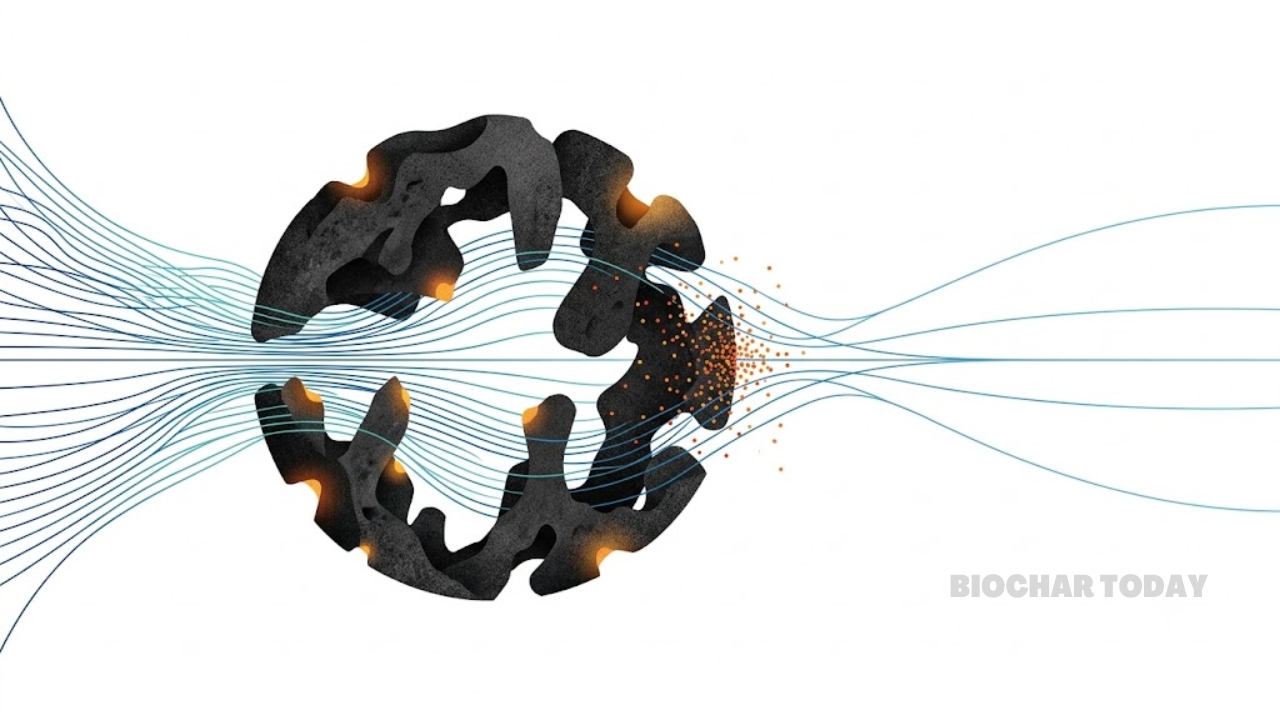
Water decontamination through advanced oxidation processes frequently suffers from low catalytic efficiency in real-world environments because standard hydroxyl radicals react nonselectively and undergo rapid quenching by background water constituents. In a new paper published in Nature Communications, authors Ying Hu, Wei Ren, Min Wang, Zhenqi Xu, and Yongfa Zhu demonstrate a universal nitrogen-removal strategy to engineer defect-rich biochar catalysts that overcome these long-standing operational limitations. By thermally eliminating nitrogen atoms from nitrogen-containing agro-forestry biomassBiomass is a complex biological organic or non-organic solid product derived from living or recently living organism and available naturally. Various types of wastes such as animal manure, waste paper, sludge and many industrial wastes are also treated as biomass because like natural biomass these More precursors—such as corn straw, sorghum straw, reed straw, sugarcane bagasse, and rose petals—at high annealing temperatures, the researchers synthesized biochar frameworks populated with localized 5-14-5 vacancy-pentagon topological defects.
The sequential removal of lattice-bound nitrogen reconfigures the electronic landscape of the biochar, downshifting its Fermi level and upshifting its p-band center. This structural transformation shifts the carbon lattice from a standard electron donor into a potent electrophilic electron sink. In electrochemical evaluations using corn-stalk-derived biochar pyrolyzed at 1100 degrees Celsius, the optimized catalyst achieved an electron accepting capacity of 3.77 millimoles of electrons per gram, an 8- to 40-fold increase over conventional biomass chars. This strong surface electron-deficiency establishes a thermodynamically favorable activation pathway for peracetic acid, lowering the Gibbs free energy for acetylperoxyl radical formation to -0.09 electron volts while suppressing competing nucleophilic hydroxyl radical generation. Consequently, the catalytic system achieves near-total selectivity (>99 percent) for producing acetylperoxyl radicals.
The selective production of acetylperoxyl radicals drives rapid chemical degradation of targeted organic pollutants across various operating conditions. The defect-engineered biochar catalyst achieved a normalized kinetic constant of 409.82 per minute per molar for bisphenol A removal, significantly outperforming conventional metal-oxide and carbonaceous Fenton-like catalysts. Because acetylperoxyl radicals possess an extended half-life relative to hydroxyl radicals and can freely migrate into the solution phase, the catalytic process avoids surface site poisoning caused by intermediate accumulation. In continuous-flow testing, cotton fiber films coated with the optimized biochar sustained over 90 percent bisphenol A removal for 260 hours in a membrane filtration setup. Multi-trophic ecotoxicity assays with soybean, wheat, Lemna minor, and zebrafish embryos confirmed that the selective cleavage of the pollutant’s core structure fully neutralized ecological risks. Furthermore, life-cycle assessment verified that integrating the biochar’s long-term carbon storage with renewable wind energy during thermal annealing yields a net-negative carbon footprint for precision water purification.
Source: Hu, Y., Ren, W., Wang, M., Xu, Z., & Zhu, Y. (2026). Selective radical pathways on defect-engineered electrophilic biochar for sustainable water purification. Nature Communications, Article in press.



Leave a Reply