
Major Takeaways
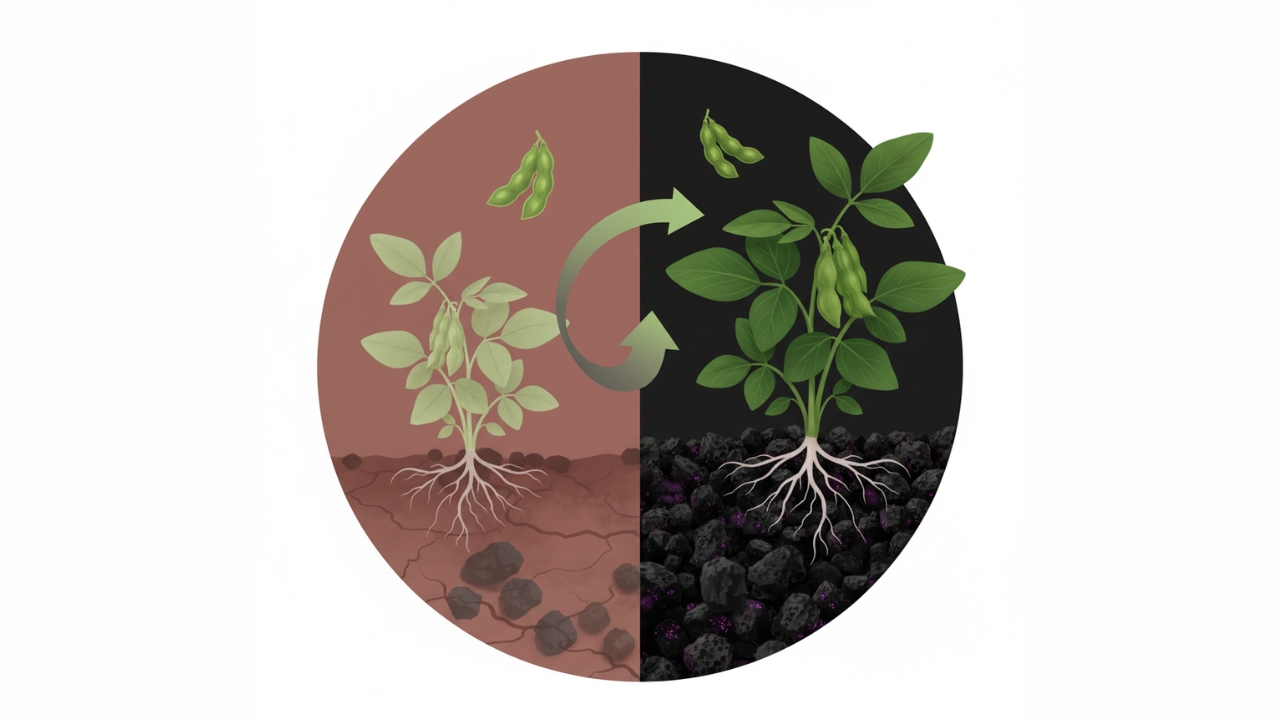
- Big Yield Boost: Applying a high dose of biocharBiochar is a carbon-rich material created from biomass decomposition in low-oxygen conditions. It has important applications in environmental remediation, soil improvement, agriculture, carbon sequestration, energy storage, and sustainable materials, promoting efficiency and reducing waste in various contexts while addressing climate change challenges. More (6 tons per hectare) over ten years increased soybean yield by nearly half—45.83%.
- Supercharged Soil Health: The treatment more than doubled the amount of Soil Organic Carbon (up 112.45%), making the soil much richer and healthier.
- Better Breathing for Roots: Biochar loosens up the soil, increasing porosityPorosity of biochar is a key factor in its effectiveness as a soil amendment and its ability to retain water and nutrients. Biochar’s porosity is influenced by feedstock type and pyrolysis temperature, and it plays a crucial role in microbial activity and overall soil health. Biochar More by 12.71% and reducing compaction, allowing roots to grow stronger and deeper.
- Natural Disease Defense: Biochar helps good soil microbes thrive while suppressing bad, disease-causing ones, acting like a natural defense system for the plant.
- Stronger Plant Immunity: Biochar triggers the plant to produce more natural, protective chemicals (metabolites) that help it fight off stress and potential infections.
In a landmark field study spanning ten years, Di Wu, Yuxue Zhang, and their team of researchers investigated and publisehd their finding in Biochar, on how the long-term use of biochar affects the resilience and productivity of soybeans grown in a continuous cropping system. Continuous soybean cultivation often degrades soil structure, causes nutrient imbalances, and fosters the growth of harmful soil-borne pathogens, leading to chronic yield decline, demonstrate that biochar is a highly effective, long-term solution that significantly improves soil health, rebalances the root environment, and substantially boosts crop yields.
The experiment compared two biochar application rates—BC1 (3 t ha−1) and BC2 (6 t ha−1)—against conventional fertilization (CF). The high-dose BC2 treatment showed the most profound and beneficial effects on the soil. The long-term application of BC2 resulted in monumental improvements to soil properties compared to CF: Soil Organic Carbon (SOC) increased by 112.45%, a critical measure of soil fertility and health. The soil’s physical structure also saw substantial benefits, with porosity increasing by 12.71% and bulk density dropping by 9.92%. Furthermore, biochar, which is alkaline, helped counteract soil acidification often associated with continuous cropping, raising the soil pHpH is a measure of how acidic or alkaline a substance is. A pH of 7 is neutral, while lower pH values indicate acidity and higher values indicate alkalinity. Biochars are normally alkaline and can influence soil pH, often increasing it, which can be beneficial More by 11.60% in the BC2 treatment.
These physical and chemical improvements were accompanied by a massive surge in the biological activity essential for plant nutrition. BC2 elevated soil urease activity (SUE), soil sucrase activity (SSC), soil acid phosphatase activity (SACP), and soil catalase activity (SCAT). Notably, SSC increased by 185.52% and SACP increased by 91.87% in the BC2 treatment. These enzymes are crucial for nutrient cycling and organic matter decomposition.
The physical and nutrient-rich environment created by the biochar was a boon for beneficial soil life. The high-dose BC2 treatment exhibited the highest bacterial and fungal diversity. Critically, biochar application restructured the microbial community by stimulating beneficial taxa like Firmicutes, Enterococcus, and Pseudomonas (involved in nutrient cycling and decomposition). Simultaneously, it suppressed potential pathogens like Ceratobasidium and Cyathus, which are commonly associated with root rot diseases in continuous cropping systems. This shift strongly implies a more disease-suppressive environment.
The study also delved into rhizosphere metabolites—the chemical signals exchanged between the plant, soil, and microbes. Biochar effectively acted as a mediator, regulating these signals for the benefit of the plant. It down-regulated metabolites linked to soil degradation and potential antimicrobial stress, specifically capric acid, β1-tomatine, daidzin, and phosphocreatine. Conversely, BC2 up-regulated key defense-related metabolites such as hypoxanthine (important for nitrogen and energy) and caffeic acid phenethyl ester (CAPE) (an antioxidant and antimicrobial agent). This metabolic reprogramming, particularly the enrichment of compounds in the isoflavonoid biosynthesis pathway , suggests that biochar is actively enhancing the soybean plant’s natural defense mechanisms.
The cumulative benefits of improved soil structure, enhanced enzyme activity, balanced microbial communities, and a fortified defense system translated directly into higher crop yields. The BC2 treatment led to a 51.25% increase in aboveground biomassBiomass is a complex biological organic or non-organic solid product derived from living or recently living organism and available naturally. Various types of wastes such as animal manure, waste paper, sludge and many industrial wastes are also treated as biomass because like natural biomass these More and a 26.89% increase in root biomass. Most notably, the decade-long, high-dose biochar application resulted in a significant soybean yield increase of 45.83% compared to the conventional fertilization plot.
The mechanism behind this boost was confirmed using a Partial Least Squares Path Model ( PLS−PM), which showed a strong fit to the data (GOF:0.765). The model demonstrated that biochar promotes soybean growth through a dual pathway: it directly enhances soil properties, and it indirectly improves soil properties by negatively regulating detrimental rhizosphere metabolites. This comprehensive, long-term evidence provides a strong case for integrating high-dose biochar into continuous soybean cropping systems to ensure sustainable productivity and resource efficiency.
Source: Wu, D., Zhang, Y., Gu, W., Liu, Z., Wang, W., Sun, Y., Xiu, L., Zhang, W., & Chen, W. (2025). Rhizosphere metabolite-mediated soil enhancement: long-term biochar application optimizes continuous soybean production systems. Biochar, 7(95), 1–17.





Leave a Reply