
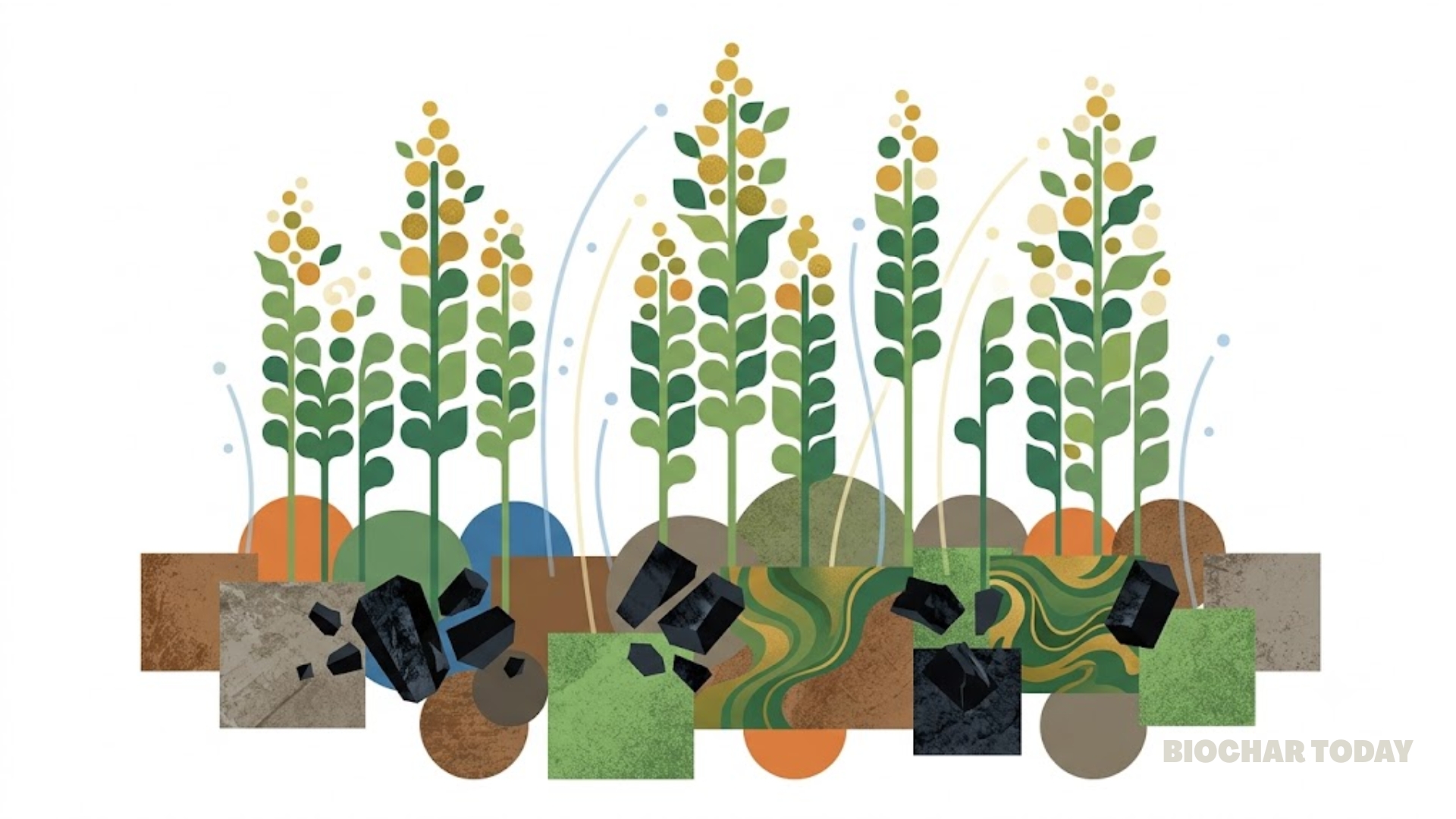
Key Takeaways
- Combining biocharBiochar is a carbon-rich material created from biomass decomposition in low-oxygen conditions. It has important applications in environmental remediation, soil improvement, agriculture, carbon sequestration, energy storage, and sustainable materials, promoting efficiency and reducing waste in various contexts while addressing climate change challenges. More and bio-organic fertilizer boosts quinoa plant growth far more than using either treatment on its own.
- Applying biochar to coastal saline-alkali soil significantly lowers electrical conductivity without altering soil pHpH is a measure of how acidic or alkaline a substance is. A pH of 7 is neutral, while lower pH values indicate acidity and higher values indicate alkalinity. Biochars are normally alkaline and can influence soil pH, often increasing it, which can be beneficial More.
- Organic soil additions enrich essential soil nutrients including nitrogen, phosphorus, potassium, and organic matter.
- Biochar helps build a more stable, complex, and resilient community of beneficial soil bacteria around plant roots.
- A biochar application rate of fifteen metric tons per hectare delivers the strongest improvements in crop biomassBiomass is a complex biological organic or non-organic solid product derived from living or recently living organism and available naturally. Various types of wastes such as animal manure, waste paper, sludge and many industrial wastes are also treated as biomass because like natural biomass these More.
In a recent study published in Microorganisms, researchers Meng Li, Yinyu Gu, Chuanjie Chen, Zongshuai Wang, Xiaohong Guo, Xiaoyan Liang, Kuihua Yi, Junlin Li, Dongyang Li, and Haiyang Zhang investigated sustainable land remediation strategies. The team focused on coastal saline-alkali land located in the Yellow River Delta of China. Soil salinization presents a persistent challenge to global agricultural food security by inflicting severe osmotic stress on roots, disrupting essential nutrient uptake, and damaging beneficial microbial ecosystems. To address these environmental constraints, the researchers tested field applications of wood-derived biochar and a Bacillus subtilis-inoculated bio-organic fertilizer, evaluating their independent and combined effects on quinoa growth, soil chemistry, and root-associated bacterial communities.
The field trial revealed that organic amendments dramatically enhance plant development and aerial biomass in degraded coastal soils. While applying bio-organic fertilizer alone yielded moderate improvements, sole biochar application generated substantial growth increases. The most pronounced benefits occurred under co-application treatments, which produced the highest plant heights and maximum aerial fresh weight. Among the various testing conditions, an application rate of fifteen metric tons of biochar per hectare proved to be the optimal dosage for maximizing above-ground plant growth.
PDF+ 3
Beyond driving crop growth, the amendments induced favorable transformations in the physical and chemical properties of the rhizosphere soil. Soil electrical conductivity, a key measure of salinity stress, dropped significantly in all plots receiving biochar. Notably, this reduction in salinity occurred without causing significant shifts in soil pH levels. Furthermore, the amendments enriched the rhizosphere with vital plant nutrients. Levels of soil organic matter, available nitrogen, available phosphorus, available potassium, and total nitrogen all experienced significant increases compared to untreated control plots. The porous architecture of biochar worked synergistically with the nutrient-dense fertilizer to retain moisture and slow-release essential minerals over time.
PDF+ 4
High-throughput genetic sequencing showed that biochar exerted a dominant influence over the assembly and structural complexity of rhizosphere bacterial networks. Treatments containing biochar supported a higher proportion of ecological generalist bacteria, which possess broad environmental adaptability and maintain functional stability under fluctuating conditions. Key plant growth-promoting bacterial genera, including Pseudomonas, Arthrobacter, Streptomyces, and Skermanella, showed increased relative abundances in biochar-amended soils. Correlation network analyses confirmed that co-applying biochar and bio-organic fertilizer fostered highly complex and interconnected microbial associations, encouraging positive ecological interactions among soil microbes.
PDF+ 3
Ultimately, the study confirms that integrating biochar with bio-organic fertilizer offers an effective ecological strategy for reclaiming coastal saline-alkali farmlands. By simultaneously alleviating salt stress, boosting soil nutrient availability, and stabilizing root microbial ecosystems, this combined approach transforms marginal soil into productive agricultural land. These findings provide a practical, sustainable framework for optimizing halophyte crop yields and restoring degraded coastal soils worldwide.
Source: Li, M., Gu, Y., Chen, C., Wang, Z., Guo, X., Liang, X., Yi, K., Li, J., Li, D., & Zhang, H. (2026). Biochar and bioorganic fertilizer amendment improved soil qualities and altered bacterial communities in quinoa rhizosphere soils of the Yellow River Delta. Microorganisms, 14(9), 1878.



Leave a Reply