
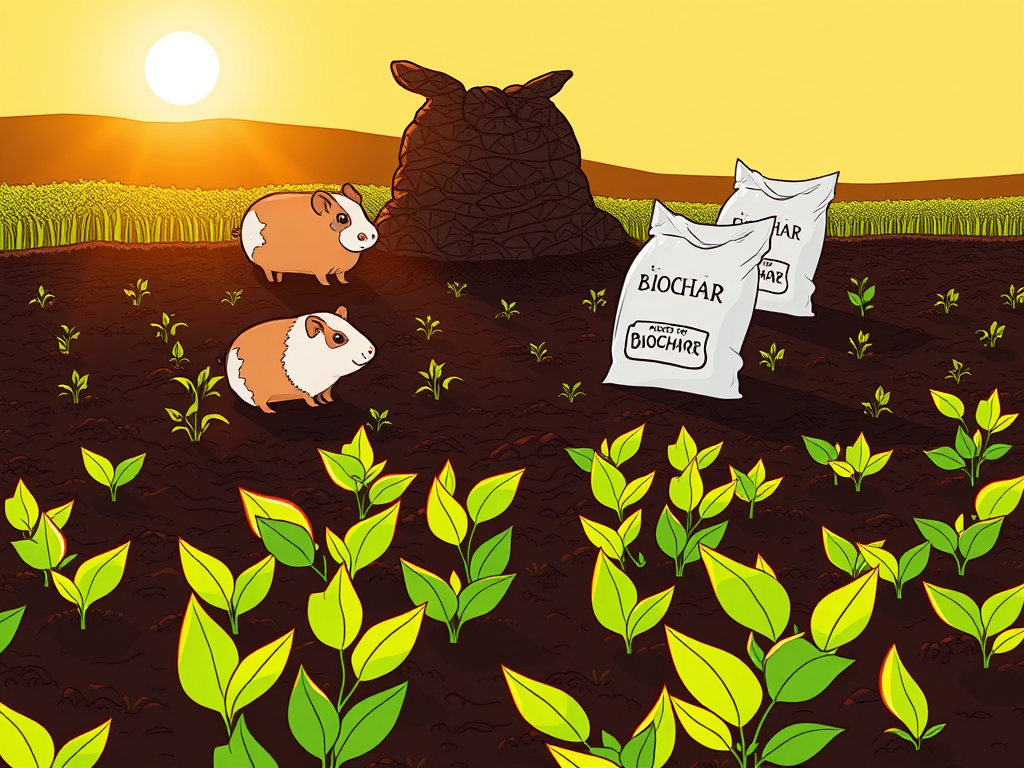
In a groundbreaking study, “BiocharBiochar is a carbon-rich material created from biomass decomposition in low-oxygen conditions. It has important applications in environmental remediation, soil improvement, agriculture, carbon sequestration, energy storage, and sustainable materials, promoting efficiency and reducing waste in various contexts while addressing climate change challenges. More from guinea pig manure as soil amendmentA soil amendment is any material added to the soil to enhance its physical or chemical properties, improving its suitability for plant growth. Biochar is considered a soil amendment as it can improve soil structure, water retention, nutrient availability, and microbial activity. More: agronomic potential and cost analysis for sustainable agricultural circularity,” Richard Solórzano and his team from Instituto Nacional de Innovación Agraria (INIA) and Universidad César Vallejo have explored a novel approach to sustainable agriculture. Published as a preprint on Research Square, this research delves into the valorization of guinea pig manure, transforming it from a traditional input into a high-value biochar, with significant implications for soil health and agricultural economics in Peru and beyond.
Soil degradation and contamination pose a major threat to agricultural productivity worldwide, including in Peru’s high Andean regions, where intensive farming practices and increased fertilizer use have led to alarming rates of soil erosion and acidity. Traditional methods like liming can adjust soil pHpH is a measure of how acidic or alkaline a substance is. A pH of 7 is neutral, while lower pH values indicate acidity and higher values indicate alkalinity. Biochars are normally alkaline and can influence soil pH, often increasing it, which can be beneficial More, but biochar offers a more sustainable solution by not only increasing pH but also improving fertility through a slow, sustained release of nutrients and by enhancing microbial habitats.
This study focused on biochar produced from guinea pig manure, a readily available organic waste product from a rapidly growing agricultural sector in Peru. The researchers characterized both fresh guinea pig manure and the biochar produced through open pyrolysisPyrolysis is a thermochemical process that converts waste biomass into bio-char, bio-oil, and pyro-gas. It offers significant advantages in waste valorization, turning low-value materials into economically valuable resources. Its versatility allows for tailored products based on operational conditions, presenting itself as a cost-effective and efficient More at temperatures estimated between 400°C and 700°C. The resulting biochar exhibited impressive physicochemical properties. It had an alkaline pH of 9.07, indicating its strong potential for neutralizing acidic soils. This aligns with other studies showing biochar pH values increasing with pyrolysis temperature, often exceeding 9 for manure-derived biochar.
Furthermore, the guinea pig manure biochar was rich in essential nutrients, including nitrogen, phosphorus (4.0%), potassium, magnesium, copper, calcium, and zinc, along with a high ashAsh is the non-combustible inorganic residue that remains after organic matter, like wood or biomass, is completely burned. It consists mainly of minerals and is different from biochar, which is produced through incomplete combustion. Ash Ash is the residue that remains after the complete More content of 34.6% and a fixed carbon content of 37.9%. These characteristics are crucial for improving soil fertility and carbon sequestration. The biochar also demonstrated a high cation exchange capacity (48.8 meq/100g) and elevated organic matter (62%), which are key indicators of its ability to retain nutrients and improve soil structure.
A critical aspect of the study involved evaluating the biochar’s toxicity and its capacity to neutralize soil acidity. In corn seed germination tests, the biochar showed an estimated median lethal dose (LD50) of 40%. However, for practical agricultural use without lethal effects, the study recommends limiting applications to a maximum of 30%. This high tolerance suggests effective stabilization of potentially toxic compounds during pyrolysis and a strong buffering capacity.
In terms of acidity neutralization, the biochar significantly increased the pH of acidic soils. For instance, a 7% dose raised the pH from 6.37 to 7.15, confirming its liming effect. This effect is attributed to the release of carbonates and basic oxides, the formation of organo-mineral complexes, and the stimulation of microbial activity. This neutralizing capacity is particularly valuable for the high Andean soils in Peru that often suffer from acidity.
Beyond its agronomic benefits, the study also presented a compelling economic analysis. Producing one ton of biochar from guinea pig manure costs approximately 231.23 soles. However, its market value is estimated at 3,515.31 soles per ton, representing a substantial added value. This economic viability makes guinea pig manure-derived biochar a promising alternative to plant-based biochars, offering a sustainable and profitable pathway for farmers and contributing to a circular economy model in agriculture. The authors emphasize the need for continued support through economic incentives, training programs, and applied research to fully integrate this innovation into agricultural practices, particularly in remote and marginalized communities.
Source: Solórzano, R., Damián, L., Herrera, S., Pichis-García, R., Cabello-Torres, R., Padilla-Castro, C., Arias, A., & Chávez, A. (2025). Biochar from guinea pig manure as soil amendment: agronomic potential and cost analysis for sustainable agricultural circularity. Research Square.



Leave a Reply