
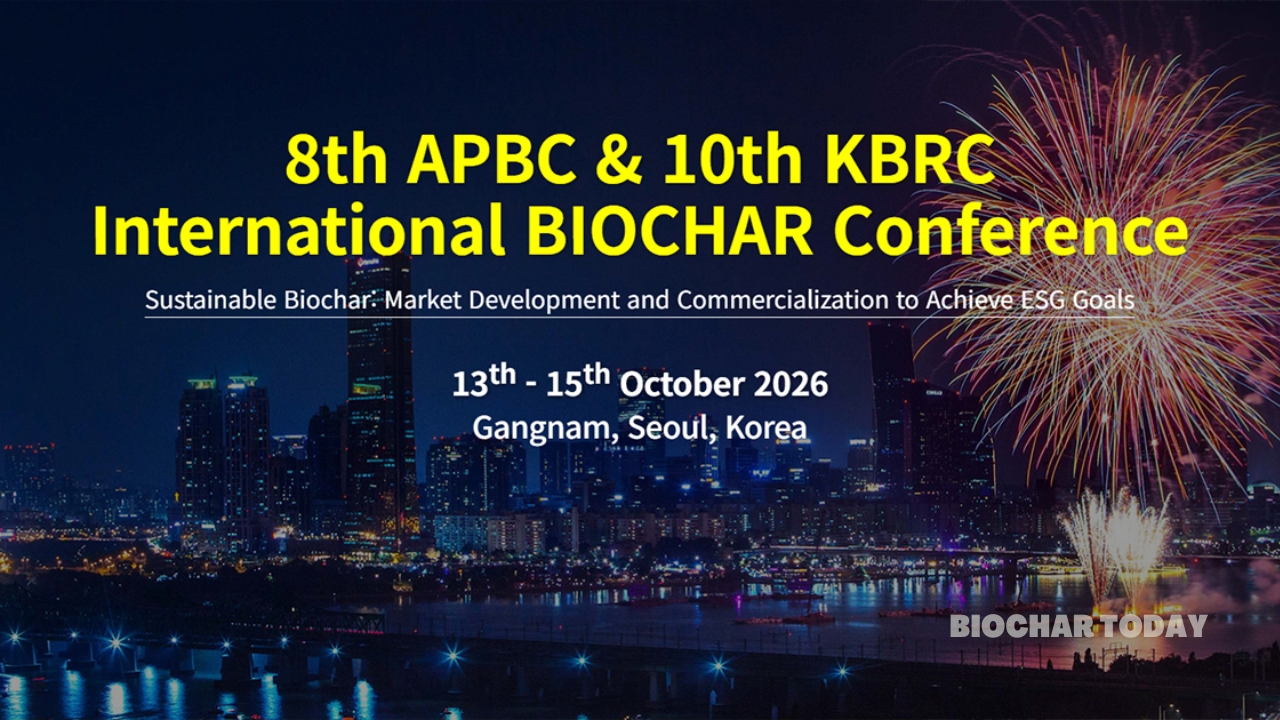
The Korea University Korea BiocharBiochar is a carbon-rich material created from biomass decomposition in low-oxygen conditions. It has important applications in environmental remediation, soil improvement, agriculture, carbon sequestration, energy storage, and sustainable materials, promoting efficiency and reducing waste in various contexts while addressing climate change challenges. More Research Center (KBRC) and the International ESG Association (IESGA) have officially announced the upcoming eighth Asia-Pacific Biochar Conference (APBC 2026). Scheduled to take place in Seoul, South Korea, at the Korea Science and Technology Center from October 13 to 15, 2026, this international gathering serves as a premier venue for cross-disciplinary advancement. Organized around the central theme of establishing sustainable market development and commercialization to achieve environmental, social, and governance (ESG) goals, the conference unites academic researchers and industry professionals. The primary focus centers on bridging scientific innovation with corporate sustainability structures across the Asia-Pacific region.
A major challenge addressed by the coordinating institutions is the historical fragmentation between laboratory-scale biochar research and large-scale industrial commercialization. While individual technological benchmarks and ecological benefits are well-documented, the sector frequently struggles with establishing standardized commercialization roadmaps that align with strict global corporate ESG criteria. Furthermore, upgrading processing machinery to generate uniform, high-value carbon products remains an operational hurdle. Without a structured platform to bridge these technical gaps, industrial entities face difficulties integrating carbon-negative applications into their broader compliance frameworks. This gap slows down the overall trajectory of market penetration.
To mitigate these systemic inefficiencies, KBRC and IESGA have structured a comprehensive three-tiered operational program targeting critical developmental bottlenecks. The strategic framework segments the core issues into environmental application, engineering innovation, and corporate strategy. Specifically, the conference highlights advanced carbonization equipment and specialized modification techniques alongside real-world case studies of carbon sequestration and environmental remediation. By embedding commercialization roadmaps directly into corporate ESG investment strategies, the organizers provide a definitive mechanism for industrial adoption, moving past theoretical applications toward scalable manufacturing practices.
The collaborative initiatives established by KBRC and IESGA deliver clear, actionable outcomes for the global industry by synchronizing engineering benchmarks with corporate governance objectives. Providing standardized pathways for carbon credit tracking and material modification allows industrial stakeholders to quantify emissions reductions accurately. Consequently, these efforts accelerate the transition from localized, artisanal manufacturing to high-volume production facilities capable of meeting rigorous corporate standards. Ultimately, the conference establishes a scalable blueprint for cross-border carbon management, accelerating regional market penetration and fostering long-term compliance within the international green economy.





Leave a Reply