
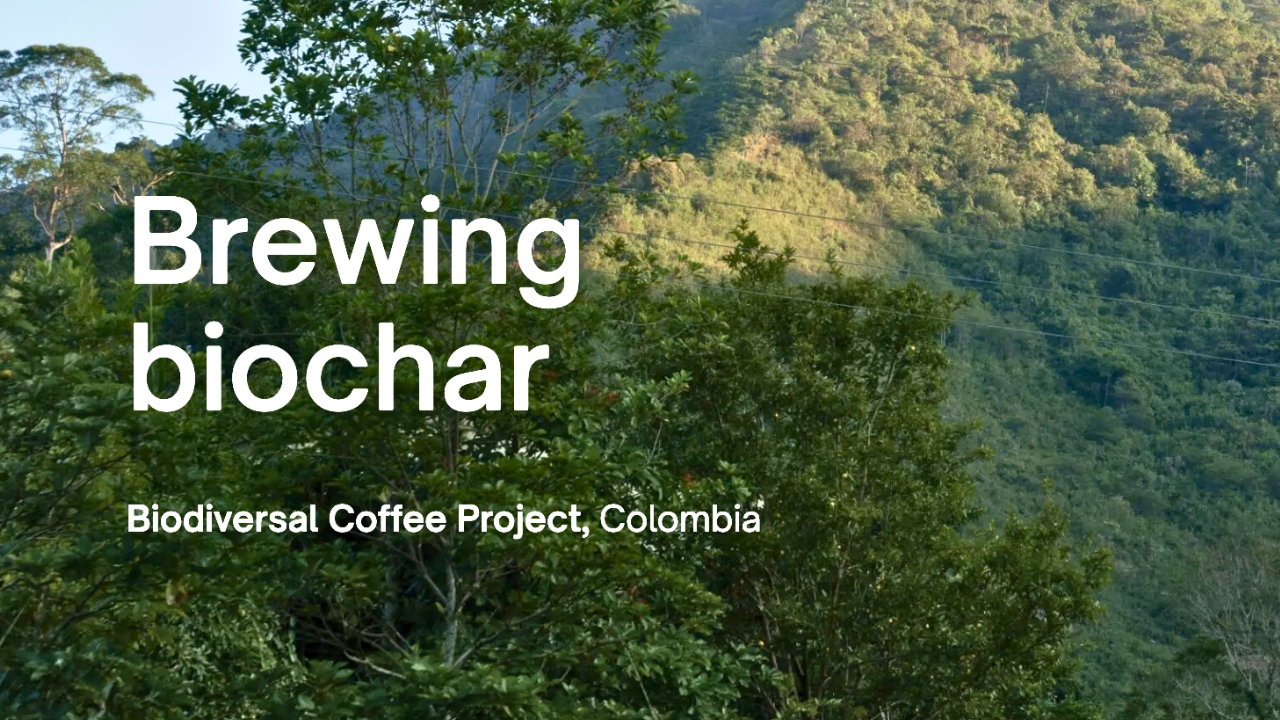
The “Transformando la Zoca en Biochar” program in Colombia is demonstrating a scalable, community-led model for converting agricultural residues into a valuable resource. Led by Biodiversal S.A.S BIC, with Planboo providing MRV (monitoring, reporting, and verification) technology, Cirkular acting as a financial partner, and the Federación Nacional de Cafeteros assisting with community engagement, the project empowers smallholder coffee farmers to turn coffee pruning waste into biocharBiochar is a carbon-rich material created from biomass decomposition in low-oxygen conditions. It has important applications in environmental remediation, soil improvement, agriculture, carbon sequestration, energy storage, and sustainable materials, promoting efficiency and reducing waste in various contexts while addressing climate change challenges. More, generating climate, soil, and livelihood co-benefits.
The core challenge stems from the massive quantities of agricultural waste generated by Colombia’s vital coffee industry, which supports over 500,000 smallholder farmers. Pruned coffee trees, or zoca, produce approximately 25 tons of waste per hectare. This residue is typically left to decompose, creating significant problems, including attracting pests, fostering the spread of plant diseases, and releasing CO2 and other greenhouse gases as it breaks down.
The solution implemented by the partnership involves training farmers to collect this zoca and process it into stable biochar. This is achieved using Kon-Tiki pyrolysisPyrolysis is a thermochemical process that converts waste biomass into bio-char, bio-oil, and pyro-gas. It offers significant advantages in waste valorization, turning low-value materials into economically valuable resources. Its versatility allows for tailored products based on operational conditions, presenting itself as a cost-effective and efficient More units and the Global Artisan C-Sink 2.1 methodology. A critical component is Planboo’s MRV technology, which tracks and verifies the entire process. This robust verification allows for the generation of high-quality carbon removal credits from the captured CO2.
Outcomes from the project are multifaceted. The carbon credits generated create a revenue stream that finances the program’s continuation and provides farmers with a direct cash stipend. Farmers also retain the biochar they produce. By applying it to their fields, they can improve soil fertility, with projections citing a 48 percent increase in both phosphorus and microbial biomassBiomass is a complex biological organic or non-organic solid product derived from living or recently living organism and available naturally. Various types of wastes such as animal manure, waste paper, sludge and many industrial wastes are also treated as biomass because like natural biomass these More. This, in turn, is expected to boost productivity by 16 percent and yields by 13 percent. The project also improves local air quality by eliminating the baseline practice of open-burning waste.
This program provides a framework for integrating smallholder farmers into the carbon credit economy. The model effectively uses carbon revenue to fund the technology transfer and capacity-building, creating a direct financial incentive for farmers. It aligns climate mitigation securely with tangible improvements in soil health, farm productivity, and rural livelihoods, demonstrating a circular economy solution for agricultural residues.



Leave a Reply