
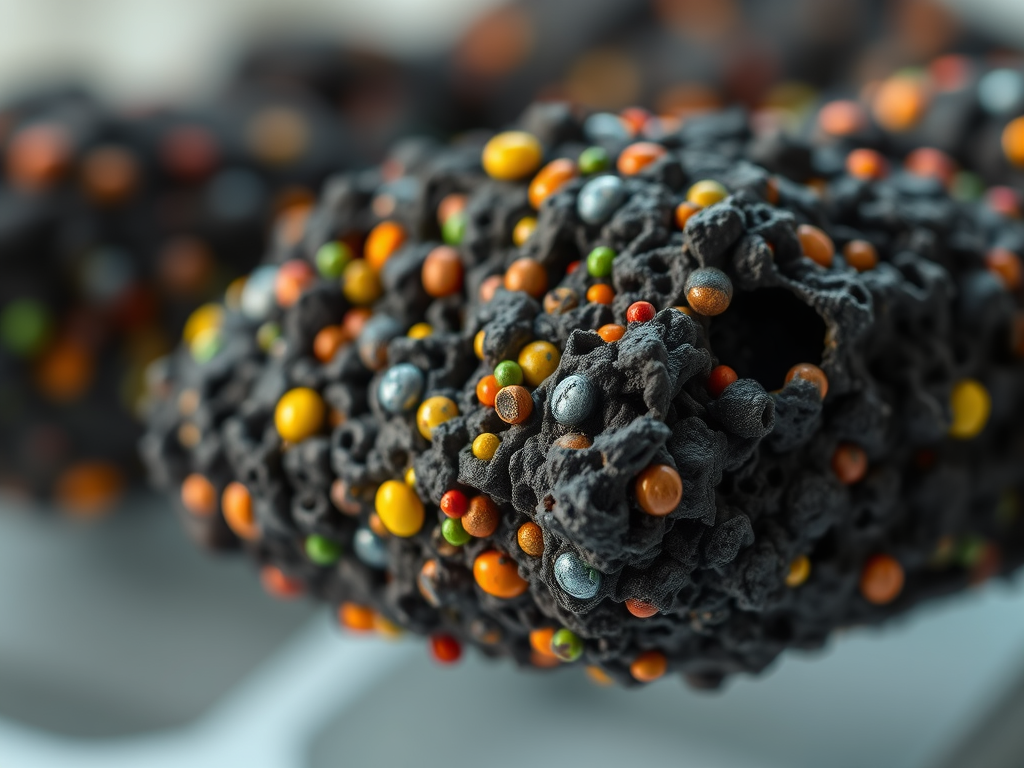
In a recent study published in Environmental Science and Pollution Research, researchers Donald Raoul and colleagues have unveiled a novel, low-cost adsorbent material called N-dopped Cu/Al@BiocharBiochar is a carbon-rich material created from biomass decomposition in low-oxygen conditions. It has important applications in environmental remediation, soil improvement, agriculture, carbon sequestration, energy storage, and sustainable materials, promoting efficiency and reducing waste in various contexts while addressing climate change challenges. More. This innovative biochar, created by integrating nitrogen (N), copper (Cu), and aluminum (Al) atoms into its structure, demonstrates exceptional efficiency in removing common antibiotic contaminants, tetracycline (TC) and norfloxacin (NC), from wastewater. The findings highlight a promising and sustainable approach to tackling the pervasive issue of antibiotic pollution in aquatic environments.
Tetracycline, a broad-spectrum antibiotic, is commonly used in human, veterinary, and agricultural settings, while norfloxacin is widely used for treating urinary tract infections and infectious diseases in animals. These drugs pose environmental risks, as they can be toxic to aquatic species like zebrafish, and tetracycline can cause liver and kidney dysfunction in humans. Biochars, derived from natural biomassBiomass is a complex biological organic or non-organic solid product derived from living or recently living organism and available naturally. Various types of wastes such as animal manure, waste paper, sludge and many industrial wastes are also treated as biomass because like natural biomass these More, are attractive adsorbents due to their low cost and large surface areas, but often have limitations such as small particle size, low density, poor pore structure, and limited surface functions.
To overcome these limitations, the researchers modified biochar through a one-step doping process. This involved mixing biochar with copper sulfate, aluminum hydroxide, and urea (as a nitrogen source), followed by calcination at 550°C. Characterization revealed that while the modification altered the original biochar’s mesoporous structure, it introduced numerous functional groups on the material’s surface, significantly enhancing its adsorption properties.
Interestingly, a high proportion of silicon was detected in the doped biochar, possibly from the porcelain vessel used during the treatment. Nitrogen adsorption-desorption analysis showed that the modification reduced the mesoporous character of the biochar, promoting the formation of micropores, with micropore area increasing from 14.402 m2/g for undoped biochar to 24.922 m2/g for the doped material. This suggests a partial collapse of the mesoporous structure and pore obstruction by incorporated metals.
The adsorption experiments demonstrated impressive results. The N-dopped Cu/Al@Biochar achieved maximum adsorption capacities of 65 mg/g for tetracycline at pHpH is a measure of how acidic or alkaline a substance is. A pH of 7 is neutral, while lower pH values indicate acidity and higher values indicate alkalinity. Biochars are normally alkaline and can influence soil pH, often increasing it, which can be beneficial More 8 and 96 mg/g for norfloxacin at pH 6. This translated to high removal percentages of up to 90% for tetracycline and 82% for norfloxacin. The optimal pH values for adsorption were influenced by the chemical speciation of the antibiotics and the surface charge of the biochar. While electrostatic attractions played a role, complexation reactions between the antibiotic molecules and the metal ions in the adsorbent were likely predominant.
Kinetic studies revealed that the Elovich model best described tetracycline adsorption kinetics, while the pseudo-nth-order model was most appropriate for norfloxacin, suggesting chemical adsorption through interactions like π-π, n-π, and hydrogen bonding. Isotherm studies indicated a multilayer adsorption process on heterogeneous surfaces, with both chemical and physical interactions contributing to the retention of antibiotic molecules. The Dubinin-Radushkevich and Freundlich models, in particular, highlighted the heterogeneous nature of the adsorbent surface.
The superior reusability, compared to other adsorbents, positions N-dopped Cu/Al@Biochar as a highly promising and cost-effective solution for treating antibiotic-contaminated wastewater. The material’s structural stability was further confirmed by SEM and XRD analyses after adsorption, which showed that while a coating of adsorbed antibiotic molecules was present, the crystalline structure of the biochar remained largely intact.
Source: Tchuifon Tchuifon, D. R., Fotsop, C. G., Kenda, G. T., Feudjio, F. D. S., Mafo, S. G. M., Dongmo, D. S. M., Anagho, S. G., & Hosseini-Bandegharaei, A. (2025). Efficient removal of tetracycline and norfloxacin contaminants in wastewater onto N-dopped Cu/Al@Biochar as low-cost sorbent: kinetic and adsorption mechanism investigation. Environmental Science and Pollution Research.


![Eucalyptus Wood Waste-Derived Biochar Achieves a Ninety-Eight Percent Removal Efficiency for Benzo[ghi]perylene in Vehicle-Wash Wastewater](https://biochartoday.com/wp-content/uploads/2026/10/SCIENCE-BLOGS-2026-2026-10-19T160523.703.jpg)


Leave a Reply