
Key Takeaways
- BiocharBiochar is a carbon-rich material created from biomass decomposition in low-oxygen conditions. It has important applications in environmental remediation, soil improvement, agriculture, carbon sequestration, energy storage, and sustainable materials, promoting efficiency and reducing waste in various contexts while addressing climate change challenges. More made from wood, agricultural waste, and food scraps is a renewable and low-cost alternative to the mined graphite currently used in batteries.
- By changing the temperature used to bake the waste materials, scientists can create “hard carbons” that are perfectly suited to hold power in different types of batteries.
- Biochar batteries based on sodium or potassium are more sustainable than lithium batteries because sodium and potassium are found everywhere on Earth.
- Advanced biochar anodes can survive being charged and discharged up to 10,000 times, making them durable enough for long-term use in power grids.
- Using biochar in energy storage helps the environment twice: it repurposes waste products and creates a “green” way to store energy from wind and solar power.
The journal ChemElectroChem recently featured a comprehensive review by Valerio C. A. Ficca, Afef Dhaffouli, and Rocco Cancelliere regarding the potential of biochar as a cornerstone material for the next generation of electrochemical energy storage. As the global community shifts toward sustainable technologies, the demand for high-performance batteries has skyrocketed, yet the industry remains heavily reliant on mined graphite and critical raw materials like lithium and cobalt. The research team argues that biochar, a carbon-rich material produced through the thermal treatment of biomassBiomass is a complex biological organic or non-organic solid product derived from living or recently living organism and available naturally. Various types of wastes such as animal manure, waste paper, sludge and many industrial wastes are also treated as biomass because like natural biomass these More, offers a versatile and renewable platform to resolve these resource insecurities. Because biochar can be derived from abundant sources such as agricultural residues, forestry by-products, and food-processing waste, it aligns perfectly with circular economy principles and offers a path to climate neutrality.
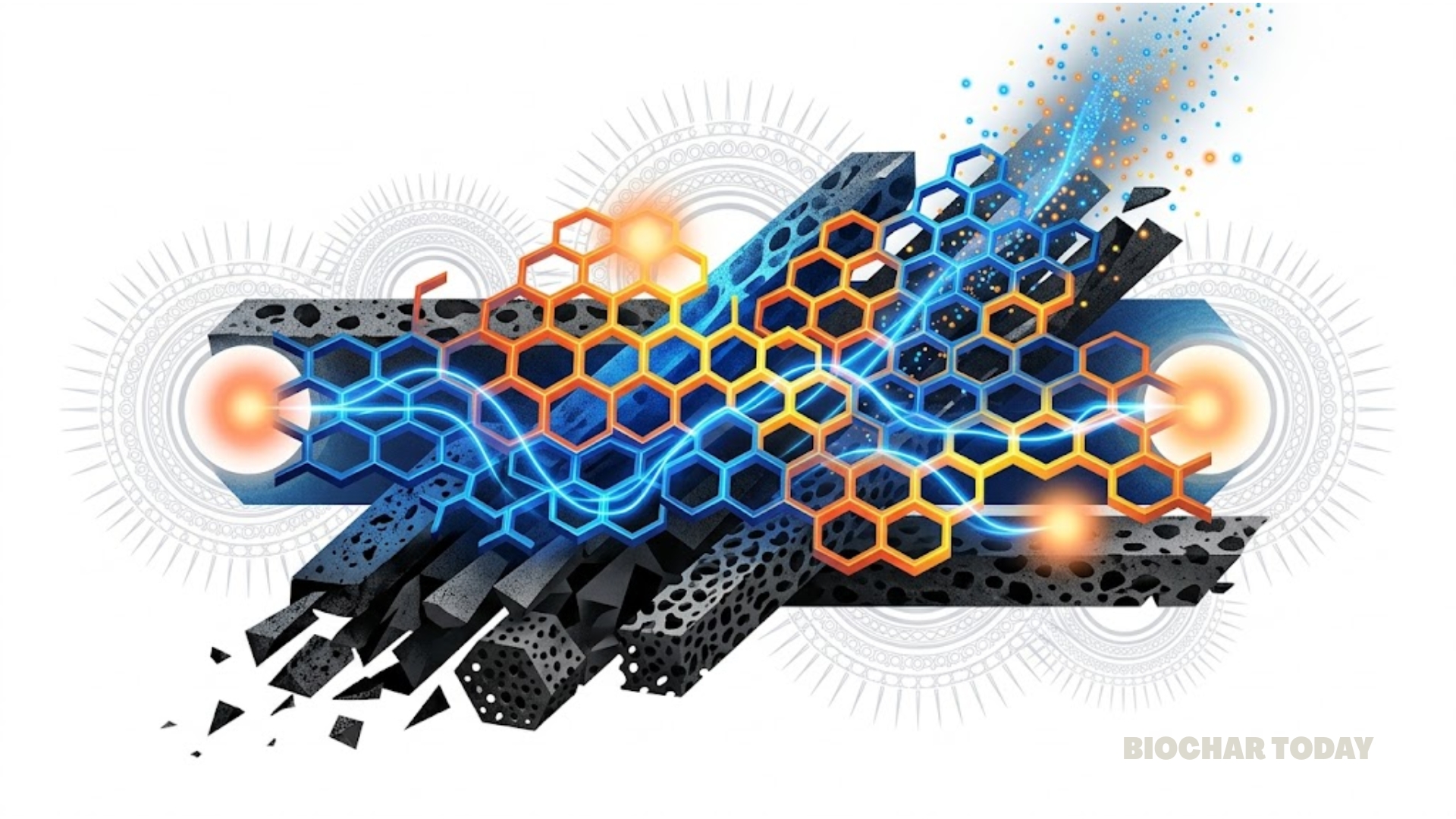
The findings highlight that the electrochemical performance of biochar is highly dependent on its internal structure, which can be precisely tuned during production. Low-temperature processing results in amorphous carbons with high surface reactivity, while higher temperatures, typically above 1,000 degrees Celsius, produce what is known as hard carbon. These hard carbons are particularly significant because they are nongraphitizable, meaning they maintain a rigid, disordered framework even under extreme heat. This disordered “house-of-cards” structure is actually an advantage for batteries using larger ions like sodium and potassium. While traditional graphite cannot easily host these larger atoms, the enlarged spacing between layers in biochar-based hard carbons allows sodium and potassium ions to shuttle back and forth efficiently, enabling high-capacity energy storage that is impossible with standard materials.
The manuscript details impressive quantitative results from various biomass precursors. For instance, anodes derived from lotus stems and decorated with quantum dots achieved reversible capacities as high as 460 milliampere-hours per gram. In terms of long-term durability, the researchers noted that nitrogen-doped hard carbon derived from lignin could withstand 10,000 charge-discharge cycles while maintaining stability. This level of endurance is critical for stationary energy storage systems that support wind and solar farms. Additionally, the study found that biochar-derived materials can serve as functional additives in lithium-ion batteries, where they improve the transport of lithium ions and enhance the overall rate at which a battery can be charged and discharged without losing power.
One of the most compelling aspects of the research is the systematic correlation established across different battery chemistries. The authors found that as the size of the ions increases from lithium to sodium and then to potassium, the ideal biochar structure shifts from a more ordered, graphite-mimetic architecture toward a more porous, defect-rich framework. This means that biochar is not just a cheap replacement for graphite but a superior material for the sodium and potassium-ion batteries that are expected to dominate the future of large-scale grid storage. By engineering the biochar to have specific types of pores and adding heteroatoms like nitrogen or phosphorus, scientists can customize the material to maximize power output and efficiency based on the specific type of battery being built.
Despite these laboratory-scale successes, the review identifies several challenges that must be overcome for widespread industrial adoption. The primary hurdles are the inherent variety in natural waste materials and the need for standardized manufacturing protocols. Because different plants have different chemical makeups, the biochar produced from them can vary in quality. To solve this, the authors suggest the use of standardized pretreatment methods, such as acid washing or hydrothermal carbonization, to remove impurities and ensure consistent performance across different batches. They also emphasize that while aggressive chemical treatments can boost battery capacity, they can also increase the environmental footprint of production, necessitating a careful balance between performance gains and sustainability goals.
Ultimately, the manuscript positions biochar-derived carbons as a disruptive technology that can transform how we store energy. By moving away from fossil-derived graphite and toward waste-based hard carbons, the battery industry can become more resilient, cost-effective, and environmentally friendly. The transition from laboratory demonstrations to commercial reality will depend on the continued optimization of these structure-property relationships and the development of scalable, low-impact manufacturing routes. As these technologies mature, biochar-based anodes are poised to become a vital component of a resilient and carbon-neutral energy landscape, providing the storage capacity needed to power a world driven by renewable electricity.
Source: Ficca, V. C. A., Dhaffouli, A., & Cancelliere, R. (2026). Biochar-based materials for electrochemical energy storage. ChemElectroChem, 13, 202500477.


![Eucalyptus Wood Waste-Derived Biochar Achieves a Ninety-Eight Percent Removal Efficiency for Benzo[ghi]perylene in Vehicle-Wash Wastewater](https://biochartoday.com/wp-content/uploads/2026/10/SCIENCE-BLOGS-2026-2026-10-19T160523.703.jpg)


Leave a Reply